The Gift of Procrastination : What Cognitive Dissonance Reveals About Identity and Behavior
The Gift of Procrastination: What Cognitive Dissonance Reveals About Identity and Behavior
Procrastination is commonly framed as laziness, poor time management, or a lack of discipline. That interpretation is incomplete.
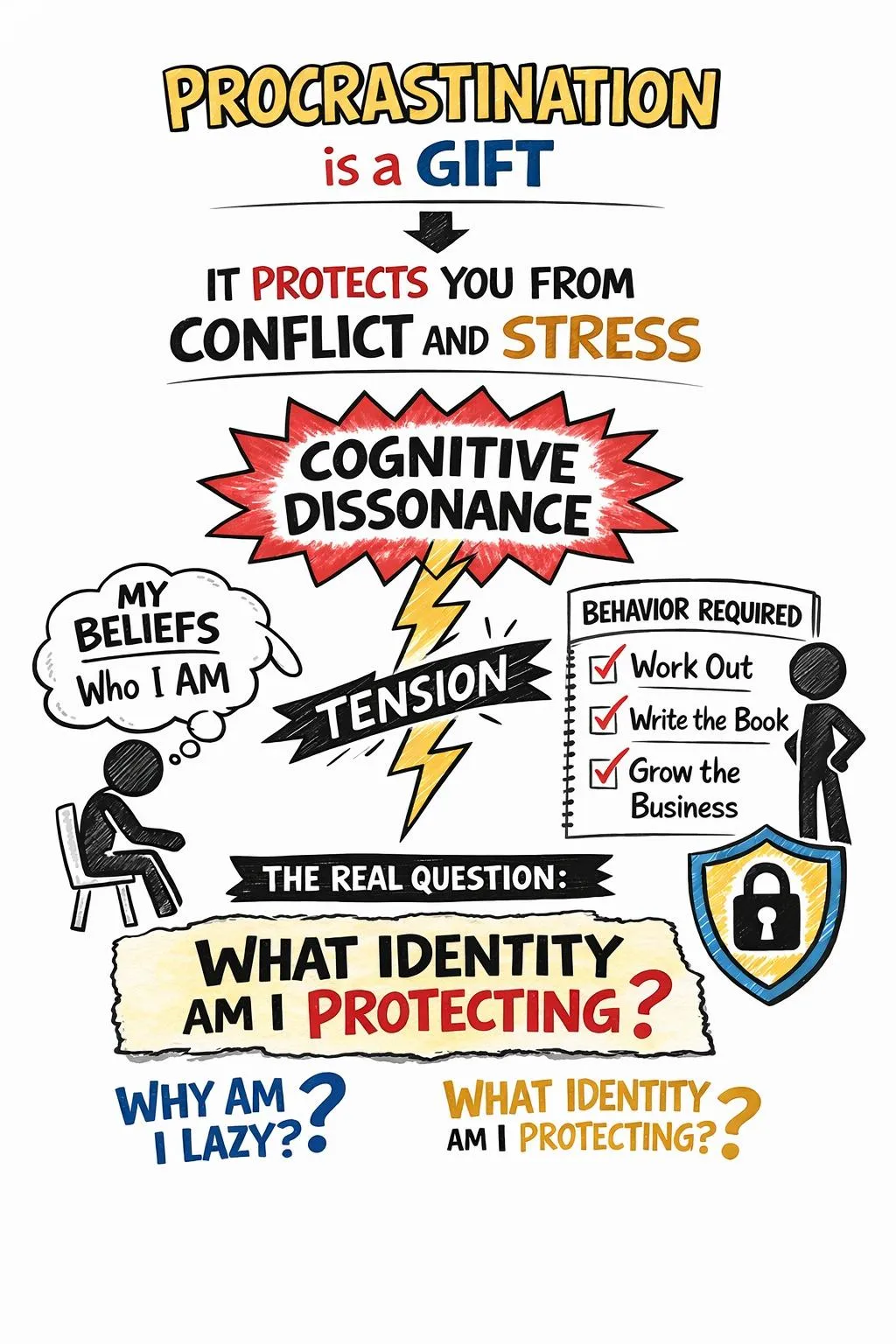
Procrastination is more accurately understood as a psychological regulator — a mechanism that reduces internal tension created by cognitive dissonance.
In 1957, social psychologist Leon Festinger introduced the theory of cognitive dissonance, describing the mental discomfort that occurs when beliefs and behaviors are inconsistent. When individuals perceive themselves as disciplined yet repeatedly delay meaningful work, or when they value health but avoid exercise, psychological tension emerges.
The nervous system seeks coherence.
When behavior conflicts with deeply held beliefs about identity, the resulting dissonance is uncomfortable. To reduce that discomfort, the mind either changes the belief or abandons the behavior. In many cases, behavior is what collapses — and procrastination appears.
Why Behavior Change Fails Without Identity Change
Most personal development strategies emphasize behavioral tactics:
Better scheduling
Accountability systems
Habit stacking
Productivity tools
While these interventions can be helpful, they often fail long term because they do not address identity architecture.
Beliefs and values operate largely outside conscious awareness. When a new behavior challenges an existing identity — “I’m not athletic,” “I’m not disciplined,” “I’m not capable of leading” — sustained action becomes psychologically costly.
Procrastination, in this context, is protective. It prevents sustained engagement in behaviors that destabilize self-concept.
Identity Congruence and Sustainable Performance
Research in cognitive psychology consistently demonstrates that individuals strive for internal consistency. When identity shifts, behavior follows more naturally.
Consider the difference between:
“I’m trying to work out”
vs.“I am an athlete.”
The first requires willpower.
The second reflects congruence.
The same applies to leadership, entrepreneurship, health, and personal growth. When behavior aligns with identity, resistance decreases and consistency increases.
Reframing Procrastination
Instead of asking:
“How do I become more disciplined?”
A more productive question is:
“What belief about myself makes this action feel incongruent?”
Procrastination is not a flaw. It is feedback.
It signals that identity evolution has not yet matched aspiration.
Practical Application
If you are repeatedly delaying action toward a meaningful goal:
Identify the behavior you are avoiding.
Ask what identity that behavior requires.
Examine whether your current self-concept supports or contradicts that identity.
Update internal language and repetition patterns accordingly.
Sustainable change occurs when identity, values, and behavior align.
Procrastination is often the first indicator that they do not.
Learn something? Share the post with others, and follow me,Allen Kanerva, for more.
Want to learn more on healing trauma?
Subscribe to my YouTube community today:https://www.youtube.com/@allen.kanerva
About the author: Allen Kanerva is a former military helicopter pilot and humanitarian worker. He has spent over a decade understanding the impact of trauma and interventions that produce results.
References
Festinger, L. (1957). A Theory of Cognitive Dissonance. Stanford University Press.
Burke, P. J., & Stets, J. E. (2009). Identity theory. Oxford University Press.
