The Dynamic of Change: A Neuroscience-Based System for Real Transformation
The Dynamic of Change: A Neuroscience-Based System for Real Transformation
Last week we explored cognitive dissonance - the tension between who I am and who I want to be. This week we move forward, because change is not an idea. Change is a system. When you understand the system, transformation becomes predictable.
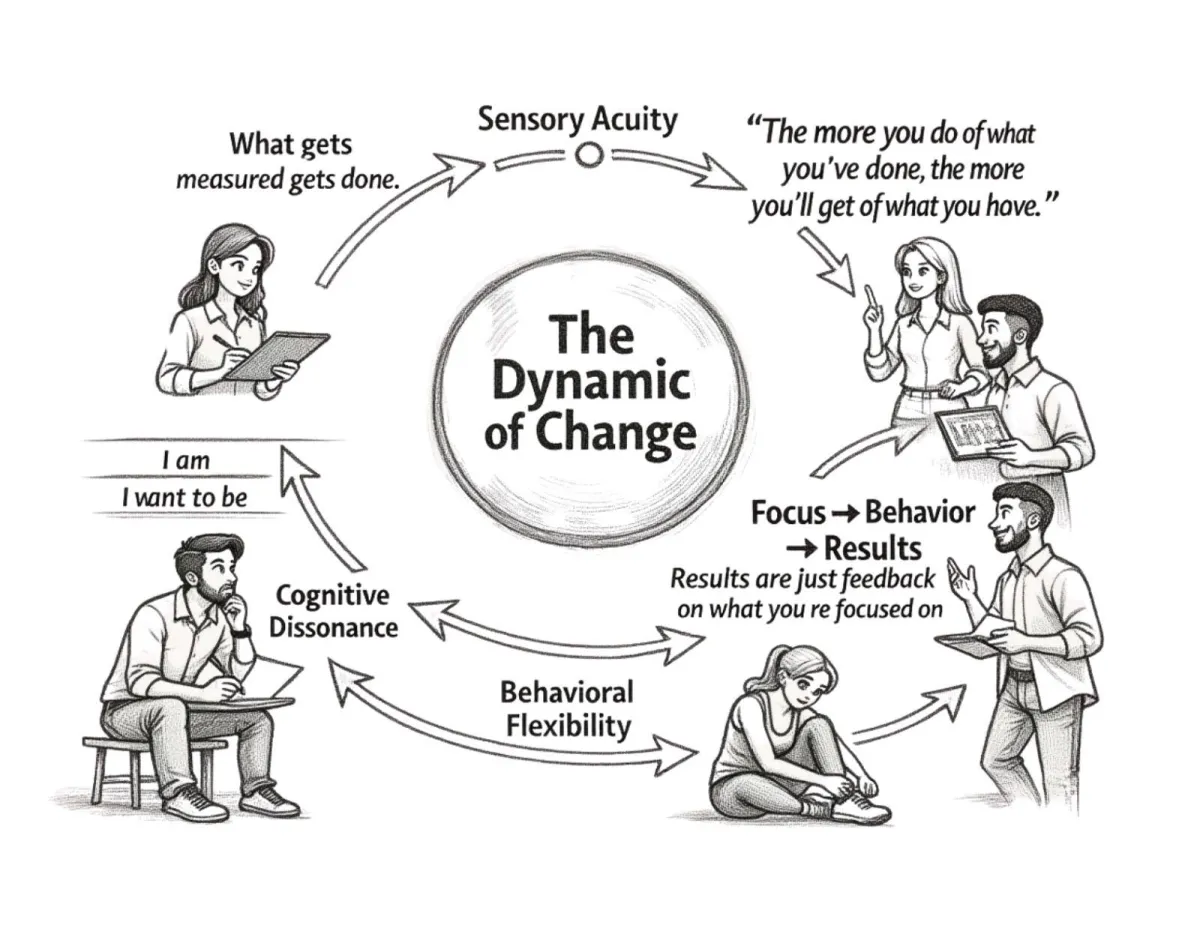
Imagine a circle. In the center are the words: The Dynamic of Change. This is not motivational language; it is structural language. It describes how identity, behavior, performance, and nervous system regulation actually evolve over time. When people struggle to change, it is rarely because they lack desire. It is usually because they lack structure.
We begin in the lower left of the circle, around seven to eight o’clock, with cognitive dissonance. This concept was formally described by Leon Festinger in 1957 and refers to the psychological discomfort that arises when our behavior and our identity are misaligned. In practical terms: I am sedentary, but I want to be fit. I am reactive, but I want to be regulated. I am avoiding, but I want to be decisive. That tension is not weakness. It is data. It signals misalignment, and misalignment generates energy. However, energy alone does not produce change. Structure does.
Moving clockwise to the top left - between ten and eleven o’clock - we encounter a principle associated with W. Edwards Deming and the philosophy of Kaizen: what gets measured gets done. Deming’s work in post-war Japan demonstrated something profoundly simple: if you cannot measure it, you cannot improve it. Change requires metrics, not inspiration and not insight alone. If you want to improve your health, what are you measuring - sleep duration, protein intake, training frequency, resting heart rate? If you want to improve emotional regulation, what are you measuring - triggers per week, recovery time after activation, sleep latency, conflict patterns? Without measurement, intention decays. Measurement stabilizes attention.
At twelve o’clock sits sensory acuity, a foundational principle in NLP. Sensory acuity is the capacity to notice precisely and without distortion what is actually happening. Most people do not fail because they lack motivation; they fail because they lack accurate feedback. If your nervous system is still hyper-aroused, your sleep data will show it. If your training is inconsistent, performance numbers will reveal it. If your communication style is abrasive, relational outcomes will expose it. Sensory acuity allows reality to interrupt fantasy. It prevents self-deception and keeps the change process anchored in observable data.
Continuing to the upper right, around one-thirty to two o’clock, we encounter a statement often attributed to Albert Einstein - and sometimes to Henry Ford - that the more you do of what you’ve done, the more you’ll get of what you have. Whether either said it is less important than whether it is accurate. Neuroscience confirms it. Repetition strengthens neural circuitry. Hebbian learning - neurons that fire together wire together - ensures that repeated patterns become automatic patterns. If you continue identical behaviors, you reinforce identical outcomes. When measurement and sensory acuity reveal stagnation, logic demands change.
In the lower right quadrant, between four and five o’clock, the model becomes operational: Focus → Behavior → Results. This framing, influenced in part by Tad James, clarifies that focus drives behavior, behavior creates results, and results are feedback about what you are focused on. Attention is not neutral; it organizes neurology. Your nervous system amplifies what you repeatedly orient toward. Threat focus produces defensive behavior. Possibility focus produces exploratory behavior. Precision focus produces skilled behavior. If your results are inconsistent, your focus is inconsistent. If your results are poor, your focus is misallocated. This is attentional neuroscience, not motivational rhetoric.
At six o’clock we arrive at behavioral flexibility. In NLP we often say that the person with the most behavioral flexibility controls the system. When results are not aligned with intention, the solution is not more effort or more intensity. It is flexibility. Different language, different timing, different strategy, different environment. Rigidity produces predictable outcomes. Flexibility interrupts repetition and opens new neurological pathways.
The circle then returns us to cognitive dissonance - the gap between I am and I want to be. The full cycle looks like this: you experience dissonance, you define measurable indicators, you develop sensory acuity to interpret feedback, you recognize that repetition reinforces results, you adjust your focus, you change behavior, and you measure again. The cycle continues. This is Kaizen applied to emotion, behavior, and identity - continuous improvement through small corrections repeated consistently, rather than dramatic reinvention.
In the domain of trauma and nervous system healing, this structure becomes clinically essential. Many people attempt change cognitively. They declare new intentions, visualize outcomes, and repeat affirmations. But if the nervous system remains in sympathetic activation, behavior defaults to protection. Trauma is not a mindset failure; it is a nervous system injury. Nervous system injuries resolve through correct neurological engagement. Measurement in this context may include sleep metrics, heart rate variability, emotional reactivity frequency, and trigger intensity. Sensory acuity means noticing activation early. Behavioral flexibility may involve shifting from confrontation to pacing, from rumination to movement, or from isolation to structured connection. Focus must shift from “fixing myself” to “regulating my system.”
The Dynamic of Change is not linear; it is circular. Each pass through the loop narrows the gap between who you are and who you intend to become. Dissonance decreases. Identity updates. Not through force, but through feedback. Remove measurement and the cycle collapses. Remove sensory acuity and you lose direction. Remove flexibility and you stagnate. Remove focus and behavior fragments. Suppress cognitive dissonance and growth stops.
Change is not magic. It is mechanics. When you understand the mechanics, progress becomes predictable. If you are currently experiencing tension between who you are and who you want to be, do not interpret that as failure. Interpret it as the beginning of the cycle. Define what matters. Measure it. Observe honestly. Adjust deliberately. Repeat. That is the dynamic of change.
Learn something? Share the post with others, and follow me, Allen Kanerva, for more.
Want to learn more on healing trauma?
Subscribe to my YouTube community today:https://www.youtube.com/@allen.kanerva
About the author: Allen Kanerva is a former military helicopter pilot and humanitarian worker. He has spent over a decade understanding the impact of trauma and interventions that produce results.
References
Festinger, L. (1957). A theory of cognitive dissonance. Stanford University Press.
Festinger’s foundational work introduced cognitive dissonance theory, explaining the psychological tension that arises from inconsistencies between beliefs, identity, and behavior. This theory underpins the “I am / I want to be” component of The Dynamic of Change.Imai, M. (1986). Kaizen: The key to Japan’s competitive success. McGraw-Hill.
Imai formalized Kaizen as a philosophy of continuous, incremental improvement — directly aligning with the cyclical and feedback-based structure described in The Dynamic of Change.Hebb, D. O. (1949). The organization of behavior: A neuropsychological theory. Wiley.
Hebb’s principle — “neurons that fire together wire together” — provides the neuroscientific basis for repetition reinforcing behavioral and emotional patterns.James, T., & Woodsmall, W. (1988). Time line therapy and the basis of personality. Meta Publications.
This work influenced the NLP-based framing of focus, behavioral flexibility, and systemic change used in the Focus → Behavior → Results model.
