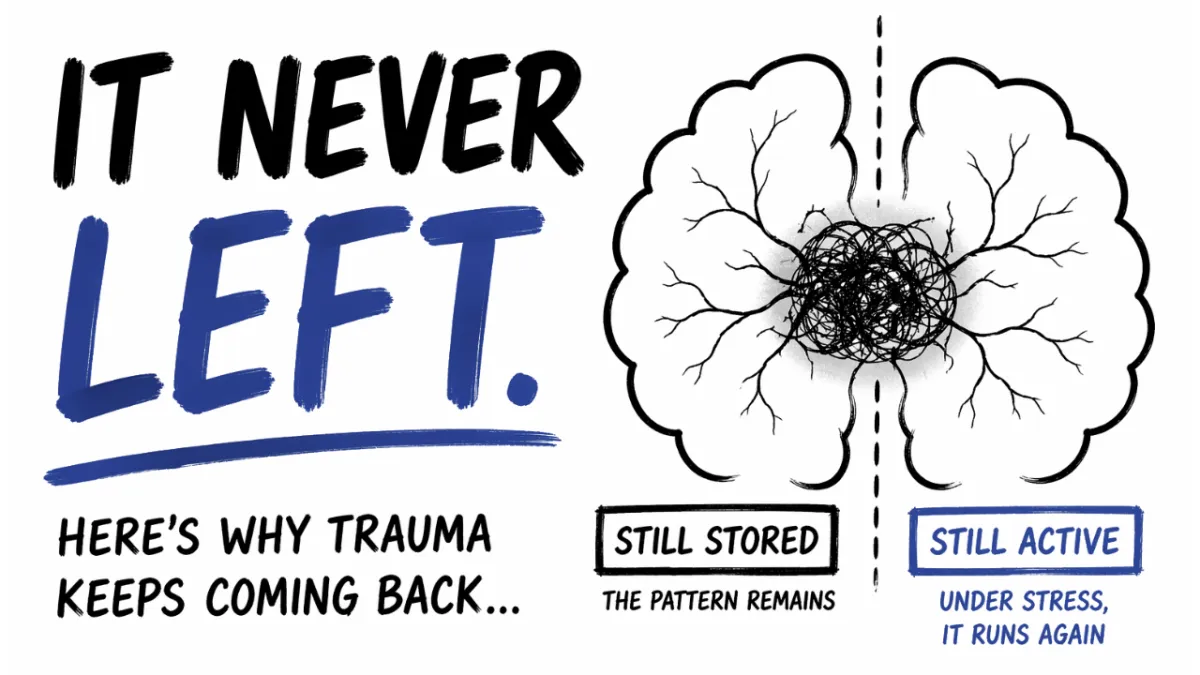
The Reconsolidation Window - Why most change does not last, and what actually updates a memory.
Pillar 3 of the INSPYRD framework · Affective Memory Resolution series
Every client I have ever worked with has heard the explanation of their problem.
They have insight. They have frameworks. Some of them could teach the theory back to you.
And still the pattern runs.
This is the clinical paradox of the field. Understanding is not resolution. If it were, self-help would have cured us.
The more precise question is this. What has to happen, biologically, for a pattern to change at the level of the nervous system and stay changed?
This is Pillar 3 of the INSPYRD framework. The mechanism that sits under every Affective Memory Resolution session we run.
The physical basis of memory
In 1949, Donald Hebb proposed a principle that still holds.
Neurons that fire together, wire together.
When two neurons activate in the same window, the synaptic connection between them strengthens. That is learning. That is how a memory becomes a memory.
Every response a client has that they do not want is a pattern that was learned. The pattern fired, the synapses wired, and the pattern became easier to run the next time.
This is not abstraction. It is biology. And it matters because if something was learned, something can be relearned. But only under the right conditions.
Why most interventions lose traction
Most approaches to change assume new learning overwrites old learning. It does not.
When you introduce new information on top of an existing pattern, the old pattern does not disappear. It goes quiet. It is suppressed, not removed. Neuroscience calls this extinction learning.
This is why so many clients experience the return of the pattern their intervention was supposed to resolve. They feel better for weeks, sometimes months. Then stress arrives, sleep is disrupted, life gets loud, and the old response comes back online. The intervention did not fail. It was never operating on the original pattern. It was operating on top of it.
If you have wondered why most therapy and coaching produces uneven long-term results, this is the structural reason.
The reconsolidation window
In 2000, a research group led by Karim Nader at McGill published findings that changed the field.
When a memory is activated, it becomes biologically unstable. The proteins that hold the synaptic pattern in place begin to break down. For a limited time, minutes to a few hours, the memory is modifiable.
The technical term is labile.
Inside that window, whatever happens to the memory becomes the memory. If nothing new enters, the original pattern re-consolidates as it was. If new information enters, the pattern updates. When the window closes, the new version is the stored version.
This is memory reconsolidation. It is the only currently identified mechanism by which an existing emotional memory can be updated at the level of the nervous system, rather than covered or tolerated.
Three conditions for the update
To use the window, three conditions have to hold.
The memory must be activated. Not discussed. Not described. Activated, so the pattern is running in the nervous system. Sensory acuity tells the practitioner whether the client has reached activation.
The client must be regulated. A system in sympathetic overdrive cannot integrate new information. Change does not happen in chaos, and the practitioner has to be able to return the client to parasympathetic function before the intervention begins.
New information must enter inside the window. New meaning. New resources. A different internal response. Not a narrative about how things are now better. A direct update to the pattern itself.
When all three conditions hold, the original pattern is rewritten. Not forgotten. Not suppressed. Rewritten. That is why the change holds.
Where AMR and VST fit
Affective Memory Resolution is the process of resolving emotionally encoded neural patterns that continue to influence physiology, perception, and behavior.
Reconsolidation is the biological window that makes that resolution possible. Visual-Spatial Tasking creates the working-memory competition that allows the update to happen without re-traumatization. Together they form a protocol that operates at the only layer where lasting change is available.
Every pillar in the INSPYRD framework is built on top of this mechanism. When a practitioner knows what layer they are working on, outcomes become repeatable. When they do not, outcomes depend on rapport, luck, and the client’s capacity to tolerate suppression.
Why does the body hold what it holds
A question I get constantly. If the memory is in the nervous system, why does trauma show up in the body?
Because the body is expressing what the nervous system is holding. The tension, the gut response, the hypervigilance, the chronic fatigue, the reactivity. These are downstream. They are symptoms of a pattern that is still running upstream.
When the memory is resolved at the source, the body stops running the pattern. The shoulders soften. The breathing changes. The hypervigilance drops. Sleep normalizes. Not because the practitioner intervened on the body. Because the memory driving the body was updated.
This is why AMR does not need to reconcile with body-oriented approaches. It subsumes them. When the memory is resolved, the body symptoms resolve with it. That is the work.
Why do most interventions lose traction over time
Durability is not a function of willpower, repetition, or tolerance. It is a function of what happened during the reconsolidation window.
If the old pattern was activated, new information entered, and the window closed with the update in place, that is the new baseline.
This is why AMR holds when extinction-based interventions do not. We are not installing a coping strategy on top of an unchanged pattern. We are editing the pattern itself.
How do you know when a memory is actually resolved
You measure. Before and after. Zero to ten. Fear, terror, helplessness. One number for each.
You reactivate the memory with the client fully associated. You watch for the physiological signs you used to track activation. If the memory is still there, but the charge is not, the update held.
Then you take them into the future. A situation that would have triggered them before. They run it. They notice the pattern is not there. They are calm, regulated, and present. Then you extend it. How are other people responding to you now? Because when the internal state changes, the external world changes with it.
That is the test. That is the signal. Not a question of belief. A question of measurement.
What this means for practitioners
If you work with clients, the practical implications are clear.
Know what layer you are working on. If you are only talking with the client, you are working on explicit memory and insight. If you are activating and updating the pattern inside the window, you are working on the biology. Only one of those produces durable change.
Watch for activation. Watch for regulation. Keep sensory acuity sharp. If the client drifts out of the window, nothing you do will reach the pattern.
And choose your model accordingly. Most training in the field teaches conversation. A smaller portion teaches mechanism. The distinction is not academic. It shows up in the outcomes your clients report six months and two years after they leave you.
Where this sits in the series
This is Pillar 3 of the INSPYRD framework. Pillar 1 covers Affective Memory Resolution in depth. Pillar 2 covers Visual-Spatial Tasking, the intervention that makes the reconsolidation update possible. The pillars that follow build on this foundation, starting with trauma as a nervous system injury, then sleep and emotional memory, submodalities, language, identity, and the PACE protocol.
Where to take this next
If you work with clients where outcomes have to be repeatable, the INSPYRD certification is where we teach the full mechanism and the protocols that apply it. If you want a lighter introduction, the app walks you through it experientially. If you want to work with a coach, that option is available as well.
But before any of that, one question.
Which of these matters most for the work you are doing right now?
• Why does the body hold what it holds?
• Why do most interventions lose traction over time?
• How do you know when a memory is actually resolved?
Comment below. The next article in this series is built on what you tell me.
About the Author
Allen Kanerva is the founder of INSPYRD and the developer of Affective Memory Resolution (AMR) and Visual-Spatial Tasking (VST) — a neuroscience-grounded protocol for resolving trauma at the level of the nervous system rather than managing it at the level of behaviour. He trains practitioners internationally in NLP, trauma intervention, and mechanism-first change work, integrating Hebbian learning, memory reconsolidation research, and working-memory interference into a repeatable clinical framework.
His work is used by clinicians, coaches, and practitioners whose outcomes have to hold under pressure.
Train with INSPYRD → [https://certification.inspyrd.com/] · Experience AMR through the app → [https://inspyrd.com/app-subscribe] · Work with a coach → [https://go.inspyrd.com/widget/bookings/trauma-consult]
References
1. Hebb, D. O. (1949). The Organization of Behavior: A Neuropsychological Theory. Wiley.
2. Nader, K., Schafe, G. E., & LeDoux, J. E. (2000). Fear memories require protein synthesis in the amygdala for reconsolidation after retrieval. Nature, 406(6797), 722–726.
3. Schiller, D., Monfils, M. H., Raio, C. M., Johnson, D. C., LeDoux, J. E., & Phelps, E. A. (2010). Preventing the return of fear in humans using reconsolidation update mechanisms. Nature, 463(7277), 49–53.
4. Lane, R. D., Ryan, L., Nadel, L., & Greenberg, L. (2015). Memory reconsolidation, emotional arousal, and the process of change in psychotherapy: New insights from brain science. Behavioral and Brain Sciences, 38, e1.
5. van den Hout, M. A., & Engelhard, I. M. (2012). How does EMDR work? Journal of Experimental Psychopathology, 3(5), 724–738.
6. Ecker, B., Ticic, R., & Hulley, L. (2012). Unlocking the Emotional Brain: Eliminating Symptoms at Their Roots Using Memory Reconsolidation. Routledge.
