Sleep, REM, and the Repair of Affective Memory
In the previous article in this series, I argued that trauma is an encoding failure under threat. A memory stored without the contextual binding the system normally provides. An injury at the level of the nervous system.
That account left a question. If an emotional memory is encoded without proper contextualisation, what is supposed to integrate it across time? What system, in normal operation, takes today’s emotional content and metabolises it so that tomorrow it sits as past rather than present?
There is a system for that. It runs every night. And when it fails to do its job, recovery stalls.
The built-in overnight integrator
Trauma is not a story. It is an affective memory.
And every night, the nervous system tries to file it.
The mechanism is the architecture of REM sleep. During REM, the brain replays emotional content from the previous day in a structured sequence. Stickgold (2005) established that memory consolidation is sleep-dependent and that REM in particular plays a privileged role for emotionally salient material. Walker (2009) extended the account into what he called the “sleep-to-remember, sleep-to-forget” model: sleep both consolidates the informational content of an emotional event and dampens its affective charge over successive nights.
That dual function is not metaphor. It is a specific neurobiological mechanism. And it has a feature that makes it therapeutic.
What makes REM therapeutic: noradrenaline drops
During REM sleep, central noradrenergic activity is suppressed. Toward zero.
Noradrenaline is the neurotransmitter that drives sympathetic arousal. It is what fires the body during a threat response and what keeps the autonomic system loaded after one. In REM, that signal is functionally offline.
Which means the emotional content can be replayed without the somatic activation that originally accompanied it.
The memory runs. The autonomic charge does not.
van der Helm and colleagues (2011) demonstrated this directly. Participants were exposed to emotionally provocative images, then re-exposed after a night of polysomnographic recorded sleep. After healthy REM, amygdala reactivity to the previously emotional images was reduced — and the reduction tracked with the suppression of central noradrenergic activity during REM. The information was integrated. The charge was removed.
Matthew Walker has described this as the brain’s overnight therapy session. That phrase is more than rhetoric. It is the closest existing language for a mechanism that, when it runs, does in one night what waking interventions try to produce in clinical hours.
What it looks like when it works
When REM does its job, yesterday’s emotional events get filed correctly. The memory remains. The charge drains off. The next morning, what was urgent feels less urgent. The body is quieter. The system has reset.
This is the difference between a hard day and a wound. A hard day gets processed overnight. A wound is what happens when the processing fails.
What happens when REM cannot do its job
In trauma — particularly in post-traumatic stress disorder — REM sleep is disrupted in specific, documented ways. Pace-Schott, Germain, and Milad (2015) review the evidence: fragmented REM, increased REM density, frequent awakenings during REM, and an associated impairment of fear extinction memory consolidation. The architecture is broken at the layer where integration is supposed to happen.
The autonomic system does not down-regulate at sleep onset. Noradrenaline does not drop. REM is interrupted.
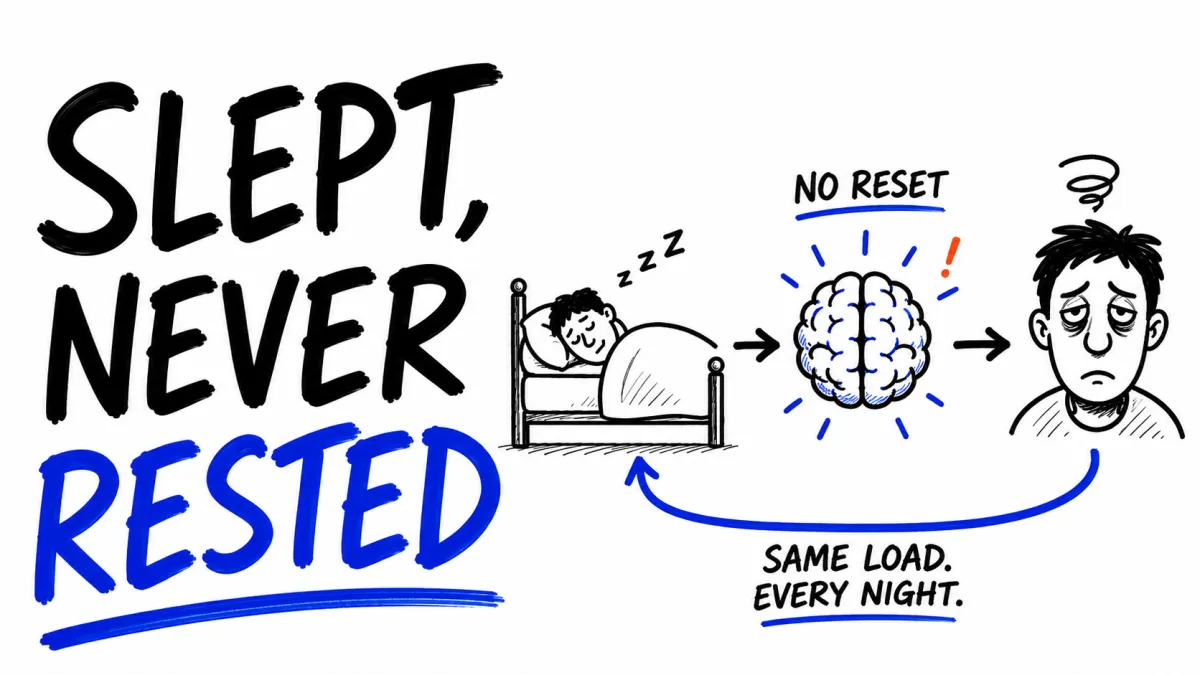
So the integration mechanism cannot run. The same emotional content keeps being replayed without being integrated. This is the neurobiological substrate of nightmares. It is also why clients with unresolved trauma report sleeping for hours and waking exhausted. The body went horizontal. The integration did not happen.
Sleep itself becomes part of the injury.
Sleep as diagnostic marker
For practitioners, this matters clinically. Sleep quality is not a side issue. It is a primary signal.
Light sleep, frequent awakening, vivid distressing dreams, waking unrested — these are the readouts of an integration system that cannot do its job. When you ask a client about sleep, you are asking how their nervous system is processing what is currently active. If the sleep is broken, there is unresolved encoding.
This makes the sleep history one of the most useful clinical instruments available without equipment. It costs nothing. It returns information that is otherwise expensive to gather. And it can be repeated weekly to track movement.
Sleep as resolution signal
And in the other direction. When the encoding is updated through reconsolidation, the integration system is no longer trying to process content it cannot reach. Sleep changes. Within nights, not weeks.
Client’s report sleeping through for the first time in years. They report dreams that feel ordinary. They report waking rested.
This is one of the cleanest behavioural markers we have for whether the work held. Pre-and-post sleep tracking, even self-reported, gives a measurable signal. When the encoding has been updated, the nervous system can resume the overnight work it has been failing to complete.
Why AMR works in waking
Now hold the next idea carefully.
What Affective Memory Resolution does in a session is structurally similar to what REM does at night.
Both create a window in which an emotional memory can be activated without somatic re-engagement. Both allow the memory to be modified. Both leave the memory and remove the charge.
Memory reconsolidation is the biological window during which an activated memory becomes temporarily unstable and open to modification. REM is the nightly version of that window. AMR is the structured, on-demand version.
This is why the protocol is congruent with how the nervous system already works. We are not introducing a foreign mechanism. We are giving the system a clean run at the integration it has been trying to complete. Visual-Spatial Tasking creates the working-memory competition that allows the update to happen without re-traumatisation. The two together are the waking equivalent of an unbroken night of REM.
Why am I always tired but never rested
Why am I always tired but never rested?
Because your sleep architecture is fragmented. The nervous system is not getting the deep, sustained REM cycles it needs to integrate yesterday’s emotional content. Hours of sleep is not the same as restorative sleep.
When the integration mechanism cannot run, you can be horizontal for nine hours and wake as activated as you went down. The fatigue is not laziness. It is the cost of unprocessed load.
How does sleep improve after trauma healing
How does sleep improve after trauma healing?
When the encoding is repaired, the autonomic system can down-regulate at sleep onset. Noradrenaline drops as it should. REM cycles consolidate. The integration mechanism resumes its normal function.
The change is fast. Usually within nights. Clients describe it as the first uninterrupted sleep in years. Dreams become ordinary. Waking is rested. The shift is not a placebo signal — it is the architecture coming back online.
Will my sleep ever go back to normal
Will my sleep ever go back to normal?
Yes, when the encoding that is keeping the system on alert is resolved. Sleep is downstream of nervous system state. Restore the nervous system, and sleep restores with it.
You do not have to fix sleep directly. You fix what is keeping sleep from doing its job. The system is built to integrate. It just needs the encoding repaired so it can run.
What this means for practitioners
If you work with clients, the practical implications are direct.
Take a sleep history at intake. Take it at every progress check. The shape of the client’s sleep is the shape of their nervous system’s overnight work, which is the shape of what is currently active beneath the conversation.
Do not treat sleep as a side complaint. Treat it as a primary signal of how the encoding layer is functioning. When sleep architecture is broken, there is unresolved encoding. When sleep architecture restores, the encoding is integrating.
And if your training teaches the conversation rather than the mechanism, the sleep signal will pass you by. The clinical application of NLP, when grounded in contemporary memory and sleep research, becomes mechanism-first work that can read these signals and act on them. NLP training built on this foundation does not stop at language — it operates on the substrate that language is reporting on.
Where this sits in the series
This is Pillar 5 of the INSPYRD framework. Pillar 3 covered memory reconsolidation as the biological window for updating an emotional memory. Pillar 4 covered trauma as a nervous system injury — an encoding failure under threat. Pillar 5 covers the system that, when functioning, does that integration work overnight automatically. Pillar 6, which comes next, examines submodalities — the visual, auditory, and kinaesthetic structure of the internal representations the nervous system uses to encode and update emotional content in waking work.
Where to take this next
If you train practitioners — clinicians, coaches, NLP practitioners, somatic therapists — the INSPYRD certification is where we teach the full mechanism: memory reconsolidation in waking, the encoding-injury reframe of trauma, and how to read sleep architecture as a clinical signal. The clinical application of NLP grounded in contemporary neuroscience.
About the Author
Allen Kanerva is a trauma intervention trainer and the founder of INSPYRD. A former Royal Canadian Air Force tactical helicopter pilot, UN peacekeeping course director, and co-author of Canadian humanitarian security policy work, he developed Affective Memory Resolution (AMR) and Visual-Spatial Tasking (VST) — a clinical protocol for nervous-system-level trauma resolution grounded in Hebbian learning and memory reconsolidation research. He trains practitioners internationally in NLP, trauma intervention, and mechanism-first change work.
ORCID iD: 0009-0009-1297-3778
Train with INSPYRD → [https://certification.inspyrd.com/]
Work with a coach → [https://go.inspyrd.com/widget/bookings/trauma-consult]
Read about this on our website → [https://inspyrd.com/library/sleep-emotional-memory]
References
Goldstein, A. N., & Walker, M. P. (2014). The role of sleep in emotional brain function. Annual Review of Clinical Psychology, 10, 679–708. https://doi.org/10.1146/annurev-clinpsy-032813-153716
Comprehensive review of the bidirectional relationship between sleep and affective regulation. Synthesises evidence that REM sleep selectively processes emotionally salient material, that noradrenergic suppression during REM is the mechanism underlying overnight depotentiation of affective charge, and that sleep disturbance is both a consequence and a perpetuating factor in mood and anxiety disorders.
Pace-Schott, E. F., Germain, A., & Milad, M. R. (2015). Sleep and REM sleep disturbance in the pathophysiology of PTSD: The role of extinction memory. Biology of Mood & Anxiety Disorders, 5(1), 3. https://doi.org/10.1186/s13587-015-0018-9
Documents the specific REM sleep disturbances observed in post-traumatic stress disorder — fragmented REM, increased REM density, awakenings — and their relationship to impaired fear extinction and emotional memory consolidation. Clinical anchor for the article’s claim that REM architecture is broken in trauma and that this breakage is part of why recovery stalls without intervention at the encoding layer.
Stickgold, R. (2005). Sleep-dependent memory consolidation. Nature, 437(7063), 1272–1278. https://doi.org/10.1038/nature04286
Foundational review establishing that memory consolidation — including the consolidation of emotional memory — is dependent on specific sleep stages, with REM playing a privileged role for emotionally salient and procedural material. Underwrites the article’s baseline claim that the integration of yesterday’s emotional content is a sleep-dependent biological process.
van der Helm, E., Yao, J., Dutt, S., Rao, V., Saletin, J. M., & Walker, M. P. (2011). REM sleep depotentiates amygdala activity to previous emotional experiences. Current Biology, 21(23), 2029–2032. https://doi.org/10.1016/j.cub.2011.10.052
The empirical paper most directly supporting the article’s central mechanism claim. Demonstrates that a night of REM sleep reduces amygdala reactivity to previously emotional images, and that this effect is associated with reduced central noradrenergic activity during REM. The “REM as overnight therapy” mechanism in plain experimental form.
Walker, M. P. (2009). The role of sleep in cognition and emotion. Annals of the New York Academy of Sciences, 1156(1), 168–197. https://doi.org/10.1111/j.1749-6632.2009.04416.x
Walker’s comprehensive review establishing the dual role of sleep in cognitive and emotional processing. Articulates the “sleep-to-remember, sleep-to-forget” model — that sleep both consolidates the informational content of an emotional experience and dampens its affective charge over time. Conceptual scaffold for the article’s account of why a hard day metabolises overnight while a wound does not.
Walker, M. P. (2017). Why we sleep: Unlocking the power of sleep and dreams. Scribner.
Public-audience synthesis of contemporary sleep neuroscience, including chapters on REM as overnight emotional processing and the role of sleep disturbance in psychiatric pathology. Source for the “overnight therapy” framing referenced in the article and for the prognostic claim that restored sleep architecture is one of the cleanest behavioural markers of nervous system regulation.
