Language & Cognitive Framing
In the previous article in this series, I argued that submodalities, the size, distance, brightness, location, and volume of an internal representation, are the structural code the nervous system runs, and that the affective charge of a memory is carried by that structure rather than by its content. That account raised a control question. If submodalities are the code, what directs the code? What instructs the nervous system which structure to run, and when?
The answer is language. And not language as description. Language as instruction.
This is Pillar 7 of the INSPYRD framework.
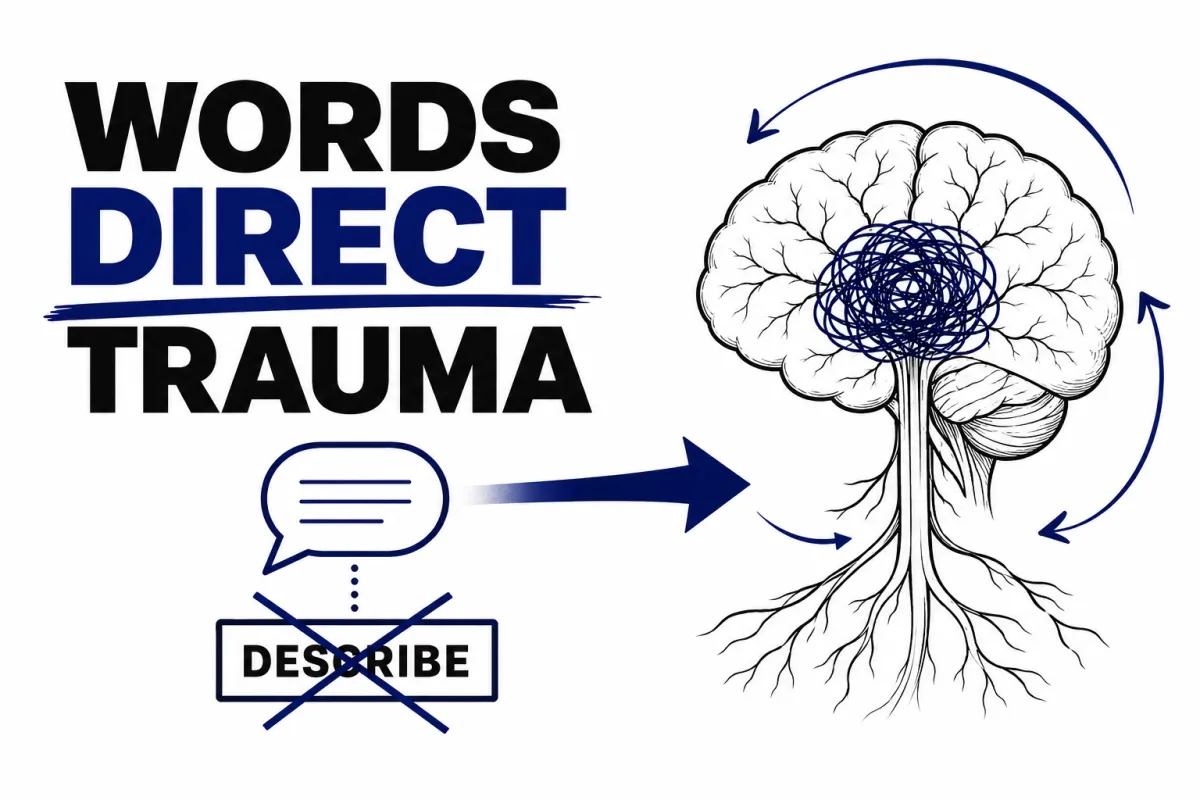
Language does not describe experience. It directs it.
The assumption most people carry is that words report on internal experience. That language comes after the experience and labels it. That is not what happens.
When a client says a memory is "right in my face," the words did not merely describe the structure. Saying it ran it. When a practitioner asks "and where do you feel that now," the question did not observe the sensation. It directed attention and brought the sensation online. Language is not the report on the operation. Language is part of the operation.
This is not a fringe claim. Lakoff and Johnson established that conceptual metaphor structures thought itself. That the language available to a person shapes the cognitive operations they can run. Lera Boroditsky's work on linguistic relativity demonstrated that the structure of a language measurably shapes how its speakers attend, remember, and reason. And Lindquist and colleagues, working from psychological constructionism, showed that language is not a passive label on emotion but an active ingredient in constructing it. The words are inside the process.
The Meta Model: precision
Two language tools are worth naming, and they do opposite work.
The first is the Meta Model, drawn originally from Bandler and Grinder's modelling of master therapists. It is the language of precision. When a client speaks, the surface of what they say has lost information. Something has been deleted, distorted, or generalised on the way to the sentence. "I can't." "Everyone thinks that." "It's hopeless." These are compressed summaries, not the underlying structure.
The Meta Model recovers what was lost. The questions asked recover deleted data
When a person says “ … can't…” We recover data by asking “according to what” or “what would happen if you did?”
When a person says “…Everyone…”We recover data by asking “who, specifically?”
When a person says “…Hopeless …”We recover data by asking “hopeless how?” or “ measured against what?”
This is not interrogation. It is recovery. You are bringing the deep structure back online so you can see what is actually encoded, rather than working from the client's compressed summary of it.
The Milton Model: direction
The second tool runs the other way. The Milton Model, drawn from the modelling of Milton Erickson's hypnotic language, is the language of artful vagueness. Where the Meta Model specifies, the Milton Model deliberately leaves space. "You might begin to notice something change." "As you let that settle in your own way." The language is unspecified on purpose.
The reason vague language is useful: it lets the client's own nervous system fill the space with its own structure. It directs process without dictating content, and it moves underneath conscious resistance because there is nothing specific to resist. One model recovers what is there; the other directs what happens next. A practitioner needs both, and needs to know which one the moment calls for.
Framing
Underneath both tools is a larger principle. Every experience is held inside a frame. A context that determines what the experience means. The same event inside the frame "I failed" means one thing; inside the frame "I found the edge of what I had trained for" it means another. The event did not change. The frame did. And the nervous system responds to the frame, not the raw event.
Tversky and Kahneman demonstrated this empirically in decision research: logically identical choices produce systematically different responses depending on how they are framed. The framing effect is not a quirk. It is evidence that the contextual container is doing real cognitive work. This is what reframing actually is in clinical practice. Not positive thinking, not looking on the bright side. It is changing the contextual container the representation sits in, so that the same content produces a different response.
Where this sits in the work
Affective Memory Resolution (AMR) is the process of resolving emotionally encoded neural patterns that continue to influence physiology, perception, and behaviour. Language is how a practitioner runs that process with precision.
You use Meta Model precision to activate the exact encoded memory. Not a vague summary of it, the actual representation, because vague activation produces vague results. You use Milton Model direction and pacing to keep the client regulated while the reconsolidation window is open. And you use framing to deliver the update, the new meaning, the new context, inside that window. Language is not rapport. Language is the instrument the mechanism is operated with.
What this means for practitioners
If you work with clients, the practical implications are direct.
Treat your own language as an instrument, not as conversation. Every question you ask runs an operation in the client's nervous system. It directs attention, activates structure, sets a frame. A practitioner who chooses language carelessly is operating the instrument carelessly.
Read the frame before you choose the words. The same sentence dropped into two different frames produces two different internal operations. A skilled practitioner is not choosing better words in the abstract. They are reading the client's frame first, then choosing language that operates inside it.
And recognise the gap most training leaves. Most training teaches rapport, warmth, and presence, and stops there. Those things matter, and they are not the same as linguistic precision. Precision is a discipline. It is teachable, and it is the difference between a conversation that feels good and a conversation that changes the encoding. The clinical application of NLP, grounded in the Meta Model, the Milton Model, and framing, is what makes language a mechanism-first instrument rather than a bedside manner.
Where this sits in the series
This is Pillar 7 of the INSPYRD framework. Pillar 6 named the sensory code. Submodalities. Pillar 7 names what directs that code. Language. Pillar 8, which comes next, examines identity and meta-states: because if language frames experience, the frames do not simply sit side by side. They stack. A feeling about a feeling, a belief about a belief, shame about being afraid. The frames build a structure, and the highest structure they build is identity.
Where to take this next
If you train practitioners, clinicians, coaches, NLP practitioners, somatic therapists, the INSPYRD certification is where we teach the Meta Model, the Milton Model, and framing as clinical tools used inside the reconsolidation window. The clinical application of NLP grounded in contemporary language and cognition research.
If you want a lighter introduction, the app walks you through the work experientially. If you want one-on-one work, that option is available with me or one of our coaches.
Before any of that, one question. Of these three, which one matters most for someone you are working with right now?
- Why do the same words land differently on different people?
- Can you talk someone out of a trauma response?
- Or why is precise language so rare in this field?
Comment below. The next article in this series is built on what you tell me.
About the Author
Allen Kanerva is a trauma intervention trainer and the founder of INSPYRD. A former Royal Canadian Air Force tactical helicopter pilot, UN peacekeeping course director, and co-author of Canadian humanitarian security policy work, he developed Affective Memory Resolution (AMR) and Visual-Spatial Tasking (VST). A clinical protocol for nervous-system-level trauma resolution grounded in Hebbian learning and memory reconsolidation research. He trains practitioners internationally in NLP, trauma intervention, and mechanism-first change work.
ORCID iD: 0009-0009-1297-3778. https://orcid.org/0009-0009-1297-3778
Train with INSPYRD → [https://certification.inspyrd.com/]
Experience AMR through the app → [https://inspyrd.com/app-subscribe]
Work with a coach → [https://go.inspyrd.com/widget/bookings/coach-coffee]
Read about this on our site → [https://inspyrd.com/library/language-cognitive-framing]
References
1. Bandler & Grinder (1975a)
Bandler, R., & Grinder, J. (1975). The structure of magic I: A book about language and therapy Science and Behavior Books.
Annotation. The originating text for the Meta Model. Establishes the distinction between the surface structure of what a client says and the deep structure beneath it, and the set of language patterns that recover deleted, distorted, and generalised information. Cited as the primary-source origin of the precision-language tool described in this article.
2. Bandler & Grinder (1975b)
Bandler, R., & Grinder, J. (1975). Patterns of the hypnotic techniques of Milton H. Erickson, M.D. (Vol. 1)Meta Publications.
Annotation. The originating text for the Milton Model. Documents the artfully vague language patterns modelled from Milton Erickson and the rationale for deliberately unspecified language as a tool for directing internal process. Primary source for the direction-language tool described in this article.
3. Boroditsky (2011)
Boroditsky, L. (2011). How language shapes thought. Scientific American, 304(2), 62-65. https://doi.org/10.1038/scientificamerican0211-62
Annotation. Accessible synthesis of the linguistic relativity research programme, demonstrating that the structure of a language measurably shapes how its speakers attend, remember, and reason. Supports the article's claim that language is not a passive label on experience but an active shaper of cognitive operation.
4. Lakoff & Johnson (1980)
Lakoff, G., & Johnson, M. (1980). Metaphors We Live By, University of Chicago Press.
Annotation. Establishes that conceptual metaphor structures thought itself. That the language available to a person shapes the cognitive operations they can run. Underwrites the article's foundational premise that language directs internal experience rather than merely describing it.
5. Lindquist, MacCormack, & Shablack (2015)
Lindquist, K. A., MacCormack, J. K., & Shablack, H. (2015). The role of language in emotion: Predictions from psychological constructionism. Frontiers in Psychology, 6, 444. https://doi.org/10.3389/fpsyg.2015.00444
Annotation. Argues from psychological constructionism that language is an active ingredient in the construction of emotion, not a passive label applied after the fact. Supports the article's claim that the words used in change work are inside the process, not commentary on it.
6. Tversky & Kahneman (1981)
Tversky, A., & Kahneman, D. (1981). The framing of decisions and the psychology of choice. Science, 211(4481), 453-458. https://doi.org/10.1126/science.7455683
Annotation. The foundational empirical demonstration of the framing effect. Logically identical choices produce systematically different responses depending on how they are framed. Provides the experimental grounding for the article's account of framing as a real cognitive operation rather than a figure of speech.
