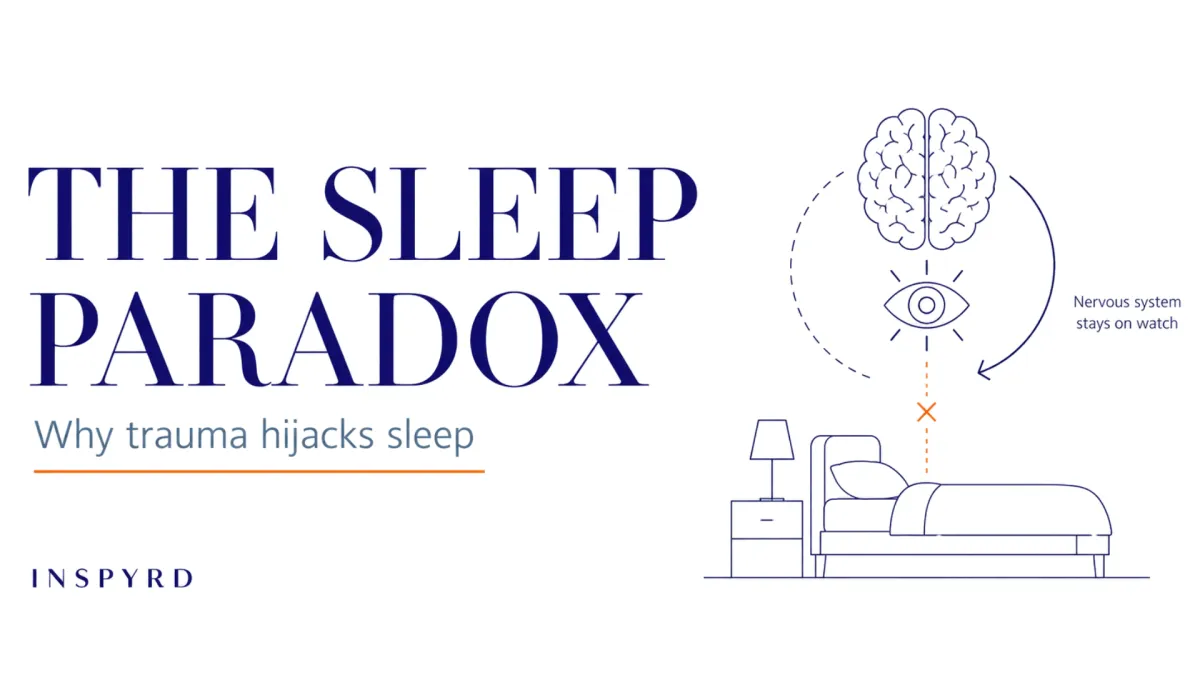
Why You’re Exhausted But Can’t Sleep: How trauma teaches the nervous system that rest is unsafe
The most consistent presentation in trauma-impacted clients is a paradox. They are exhausted to the bone. They cannot sleep.
They have tried what they were told to try. Sleep hygiene. Caffeine restriction. Melatonin. The pill. The standard portfolio produces, at best, partial relief.
Sleep is not a behaviour. It is a state the nervous system has to consent to enter. For trauma-impacted people, consent is the bottleneck.
Sleep is permission, not behaviour
Modern sleep science is clear. Sleep is a biological process governed by neural signals of safety, not by conscious intention. Walker (2017) describes the descending dominance of the parasympathetic branch, the quieting of the locus coeruleus, and the thalamocortical gating of sensory input. None of this is under volitional control.
Sleep is more accurately a permission the nervous system grants. The body must register sufficient safety signals to allow the descent. When those signals are absent or contradicted, sleep is delayed, shallow, or interrupted.
Advice that operates on cognitive content ("clear your mind") or surface routine ("avoid screens") does not address the underlying problem, because the problem is autonomic, not cognitive. You do not decide to fall asleep any more than you decide to digest.
Trauma reorganises the autonomic baseline
Van der Kolk (2014) documented that the body retains the imprint of trauma long after the cognitive narrative has been catalogued. When the nervous system has learned through lived experience that disengagement is unsafe, it reorganises around that fact.
Sympathetic activation runs higher. Cortisol rhythms shift (Yehuda et al., 2015). Amygdala reactivity increases.
Porges' polyvagal frame (2011) makes this concrete. Under perceived safety, the ventral vagal branch supports the calm from which sleep can emerge. Under sympathetic load or dorsal collapse, sleep does not emerge. Trauma-impacted clients live most of their hours in some blend of sympathetic mobilisation and dorsal collapse.
Two clinical sentences follow. Sleep emerges from ventral vagal capacity, not from sympathetic exhaustion. You cannot tire a system into sleep if it has organised around vigilance.
The Sleep Paradox is a self-reinforcing loop
Germain (2013) characterised trauma-related sleep disruption as a loop sustained across four mutually reinforcing levels. Persistent noradrenergic activation from the locus coeruleus fragments REM and destabilises non-REM. Fragmented REM impairs the emotional decoupling function of sleep, leaving affective memories unprocessed. The cumulative deficit reduces prefrontal regulatory capacity the next day. Increased daytime reactivity intensifies the affective load the next night's sleep must attempt to process.
The loop is not broken by adding sleep opportunity. As fatigue increases, regulatory capacity decreases, and the system holds vigilance harder, not softer. "If they were tired enough, they would sleep" misunderstands the biology. The system is organised around protection, not restoration.
Sedation suppresses but does not resolve. Benzodiazepines induce loss of consciousness while suppressing REM and slow-wave sleep (Mellman et al., 1995). What is sedated is not what is dysregulated. The loop reasserts when the medication is withdrawn.
What restores sleep is not a sleep intervention
If the substrate of trauma-related insomnia is unresolved affective memory and the autonomic loop it sustains, the intervention has to operate at the level of affective memory.
Memory reconsolidation theory (Nader and Hardt, 2009) provides the mechanism. When an emotionally encoded memory is reactivated, it enters a window of synaptic lability in which the affective signature can be updated, not merely the conscious interpretation.
Schiller and colleagues (2010) demonstrated this in humans. Conditioned fear memories updated within the reconsolidation window did not return on follow-up.
This is the layer Affective Memory Resolution (AMR) operates within. AMR is not a sleep intervention. It updates the encoding the nervous system is treating as a still-current threat. When the affective memory resolves, the vigilance loop loses its driver. Ventral vagal capacity returns. Sleep does not need to be added or induced. It returns.
Thirty years
I came out of military aviation with my own version of this paradox. Wild nightmares three or four nights a week. Waking states that were a danger to me and to the people closest to me. Medication produced sleep without integration. Therapy made me articulate about a pattern I could not change.
The thing that changed it was structured NLP-based work targeting the encoding, not the symptom. Sleep returned in weeks, not years. Decades later, it has not regressed.
That is a resolution outcome. It is the differentiating outcome of operating at the encoding layer.
Why am I exhausted but can't sleep?
Because exhaustion and vigilance are not opposites. Your autonomic nervous system has organised around the survival job of staying ready. The metabolic exhaustion is real and the alertness is also real, produced by different layers of the same system. Until the affective memory teaching your nervous system that disengagement is dangerous is updated at the encoding layer, hygiene and sedation will at best suppress the surface. They will not return the consent your system has withdrawn. AMR operates at that encoding layer.
Why do I wake up at 3 AM every night?
3 AM falls in the part of the night where sleep architecture transitions through REM. For trauma-impacted systems, REM is when affective material the day suppressed becomes available for processing. If the system cannot process it without entering threat response, REM destabilises and you wake. This is not random. It is your nervous system reaching the threshold of an emotional memory it cannot yet integrate. Sleep aids that suppress REM make the waking less frequent at the cost of leaving the substrate unprocessed.
Will my sleep ever return to normal after trauma?
Yes. Not by managing it as a sleep problem. By treating it as an autonomic indicator and addressing the unresolved affective memory underneath. AMR operates at the encoding layer within the reconsolidation window. When the encoding is updated, the system stops needing to stay on watch, ventral vagal capacity returns, and sleep architecture stabilises. The return of unmanaged sleep is one of the more reliable signs that the regulatory work has produced effect.
What this means for practitioners
Three implications follow.
The assessment frame changes. The question is no longer how to make a tired person sleep. It is what is keeping a vigilant nervous system from consenting to sleep.
The order of operations changes. Regulation begins before bed, not in bed. Reduced stimulation, softer lighting, and decreased cognitive load in the two to three hours before sleep onset support the descending vagal tone sleep requires. Sleep is entered from ventral vagal regulation, not from sympathetic activity.
Orientation beats rumination. Gentle external orientation, soft visual focus, predictable ambient sound, slow proprioceptive awareness, provides the sensory confirmation of safety the system needs. This is sensory intervention into autonomic state, not a cognitive technique. These are first-line. The resolution work is what operates on the affective memory itself, and is the layer the certification teaches.
Where to take this next
If you work with trauma-impacted clients and want to operate at the encoding layer, the Clinical Applications of NLP and Neuroscience for Healing certification teaches AMR. Curriculum and enrolment at certification.inspyrd.com.
For individuals: the INSPYRD Beyond Trauma app is the at-home, private surface for the same mechanism. inspyrd.com/app-subscribe.
About the Author
Allen Kanerva is a trauma intervention trainer and the founder of INSPYRD. A former Royal Canadian Air Force tactical helicopter pilot, UN peacekeeping course director, and co-author of Canadian humanitarian security policy work, he developed Affective Memory Resolution (AMR) and Visual-Spatial Tasking (VST), a clinical protocol for nervous-system-level trauma resolution grounded in Hebbian learning and memory reconsolidation research. He trains practitioners internationally in NLP, trauma intervention, and mechanism-first change work. ORCID ID: 0009-0009-1297-3778
References
1. Germain, A. (2013). Sleep disturbances as the hallmark of PTSD: Where are we now? American Journal of Psychiatry, 170(4), 372–382. https://doi.org/10.1176/appi.ajp.2012.12040432
Establishes sleep disturbance as the hallmark feature of PTSD and frames the self-reinforcing noradrenergic loop central to this article's account of fragmented, non-restorative sleep.
2. Kanerva, A. (2025). INSPYRD Angels Pilot Initiative: A practice-based evaluation of a tf-NLP trauma coaching protocol with survivors of human trafficking [Report/Data set]. Zenodo. ORCID ID: 0009-0009-1297-3778
Included as practice-based internal evidence, not as independent clinical-trial evidence. The report documents observed outcomes in a coached survivor cohort and is used here to illustrate the method’s applied context, not to establish efficacy on its own.
3. Nader, K., & Hardt, O. (2009). A single standard for memory: The case for reconsolidation. Nature Reviews Neuroscience, 10(3), 224–234. https://doi.org/10.1038/nrn2590
Provides the reconsolidation mechanism on which the article's model of lasting change depends. Memories become labile and modifiable when reactivated; the affective signature can be updated within that window.
4. Porges, S. W. (2011). The polyvagal theory: Neurophysiological foundations of emotions, attachment, communication, and self-regulation. W. W. Norton.
Supplies the polyvagal framing used throughout. Sleep emerges from ventral vagal safety, not from sympathetic exhaustion. Cortical instructions to relax have no direct downstream authority over brainstem activation.
5. Schiller, D., Monfils, M.-H., Raio, C. M., Johnson, D. C., LeDoux, J. E., & Phelps, E. A. (2010). Preventing the return of fear in humans using reconsolidation update mechanisms. Nature, 463(7277), 49–53. https://doi.org/10.1038/nature08637
Demonstrates experimentally in humans that fear memories updated within the reconsolidation window do not return on follow-up. The differentiating evidence behind the method.
6. Walker, M. (2017). Why we sleep: Unlocking the power of sleep and dreams. Scribner.
Source for sleep as a state the nervous system must permit, including REM's role in decoupling affective tone from declarative memory. The basis for the permission-not-behaviour framing.
