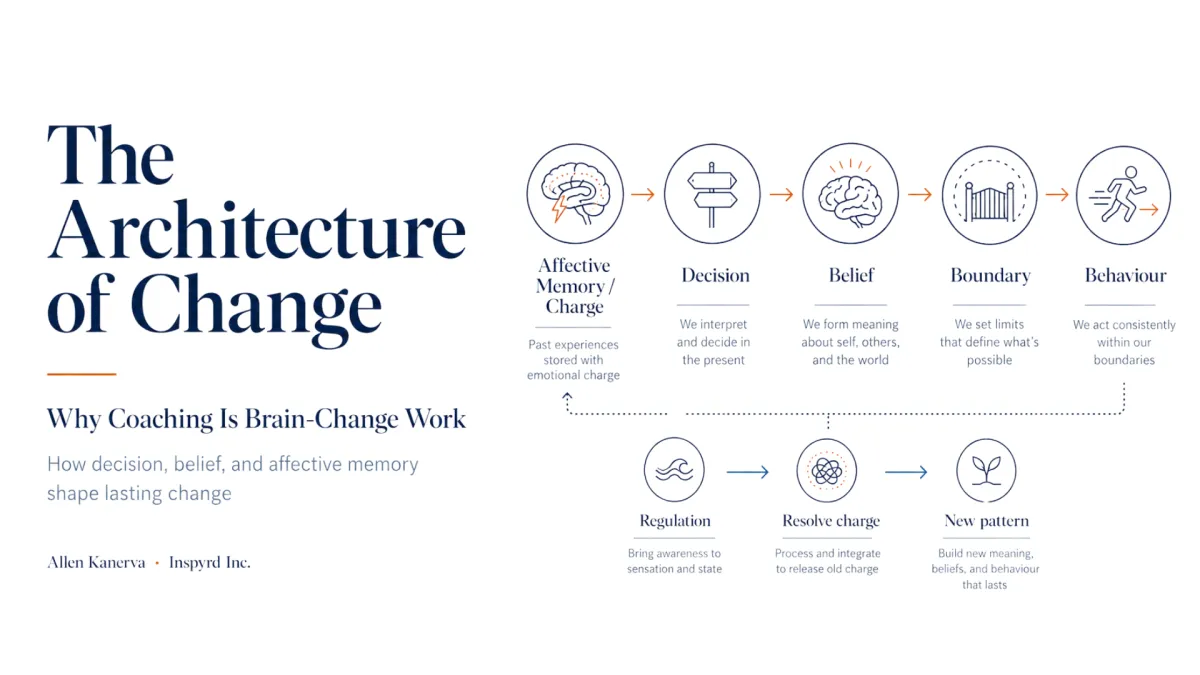
The Architecture of Change: Why Coaching Is Brain-Change Work, and the Conditions Under Which a Nervous System Will Let a Client Become Someone New
A woman sat across from me and said the sentence she had been saying for thirty years. “I am just not the kind of person who can.” She believed it the way she believed the floor would hold her weight. She was not lying. She was not weak. She was doing exactly what her nervous system was built to do. She was behaving inside a boundary she had drawn a long time ago and fired into place every day since.
Most of what the industry calls change work never touches that boundary. It explains it. The client leaves with a better description of the cage and the same cage. This is the techno-rational trap: an explanation satisfying enough to feel like progress and incomplete enough to leave the wiring intact. I have watched insight fail to move people across more than five hundred trauma clients and a decade of clinical work. I want to tell you why it fails, and what moves a person instead.
Change is not a mindset. It is brain change. And a nervous system will only let someone become new under specific conditions. Those conditions are the architecture of change.
Problem states live in the body, not the story
A problem state is not an idea. It is a physiological event. It lives in the sympathetic nervous system, the branch that runs threat. When a client is stuck, the stuckness is not a flaw in their reasoning. It is a charge in their body firing ahead of their thinking. Bessel van der Kolk gave a generation a title for what they were feeling. “The body keeps the score.” Here is where I part company with him, and I do it vehemently. The body keeping the score is real, but it is a symptom, not the trauma. The physical manifestations are the score, the downstream evidence of an injury left unresolved. They are not the injury. Name the symptom as the trauma and you chase the body for the rest of your life. Clear the affective memory underneath it and the score settles on its own.
Lisa Feldman Barrett, the neuroscientist at Northeastern, takes it one layer deeper. “Emotions are not reactions to the world. They are your constructions of the world.” The brain predicts, then it feels. So the charge a client carries is not the event. It is how the body learned to predict the event, encoded and ready to fire.
Every belief was a decision you made once
Identity is informed by belief. We behave as the person we believe we are. And here is the part the mainstream skips: every belief was a decision, made by a real person, at a real moment, in their own history. No one is born believing they are not the kind of person who can. They decided it. Usually young, usually under load, usually in a moment that carried a charge big enough to make the decision stick.
That moment does not vanish. It is held as an affective memory, a memory that carries a latent negative charge. The decision became a belief. The belief drew a boundary. And we behave within our boundaries.
Hebb’s law: what fires together wires together
Donald Hebb wrote the rule in 1949. “When an axon of cell A is near enough to excite a cell B and repeatedly or persistently takes part in firing it, some growth process or metabolic change takes place in one or both cells such that A’s efficiency, as one of the cells firing B, is increased.” The shorthand the field uses is blunter. What fires together wires together.
Read that as a life sentence and you see the problem. Every time the client behaves inside the old boundary, she fires the circuit, and firing it wires it harder. Thirty years of evidence that she is right about herself, manufactured one ordinary day at a time. This is why willpower loses. Willpower asks the strongest wiring in the brain to lose a fair fight to a New Year’s resolution. It will not.
Affective Memory Resolution: clear the charge, not the story
Affective Memory Resolution, AMR, is the coaching technique that works at the layer underneath the behavior. It identifies the target memory, the one carrying the latent negative charge, the memory that holds the experience where the decisions were made that became the beliefs that drew the boundary that informs the identity. Then it takes the charge off, using Visual-Spatial Tasking. We do not reinterpret the event. We do not argue with the belief. We clear the charge that keeps the circuit hot.
There is a mechanism for why this is possible, and it is not new-age, it is reconsolidation. Karim Nader at McGill showed in 2000 that a consolidated memory returns to a labile, changeable state when it is retrieved, and must be restabilized to last. Daniela Schiller and Elizabeth Phelps showed in 2010 that you can use that window to update a fear memory in humans, without drugs, and the fear does not come back. A retrieved memory is not a fixed recording. It is briefly editable. AMR works inside that window.
The conditions under which a nervous system will let a client become someone new
A nervous system guards the old pattern because the old pattern once kept the person safe. It will not surrender it on command. It surrenders it under conditions. First, regulation, the body has to come out of threat before it will let anything be touched. Second, the charge has to come off the target memory, so the boundary stops firing. Only then is there room to install a new pattern and let it wire in through the same Hebbian law that built the old one.
This is why coaching, done correctly, is neuroscientific work. It is not reframing. It is not rah-rah. It is not a better story told louder. It is the deliberate, sequenced clearing of a charge so a nervous system will finally let a client become someone new.
Questions people actually ask
Why doesn’t insight change my behavior?
Because insight lives in the thinking brain and the pattern lives in the body. Understanding why you do something does not remove the charge that fires the behavior. AMR works at the affective layer where the charge is held, which is why clearing it changes behavior when explanation never could.
What is Affective Memory Resolution and how is it different from talk therapy?
AMR is a coaching protocol that locates the affective memory carrying a latent negative charge and clears that charge using Visual-Spatial Tasking. Talk therapy mostly re-describes the memory. AMR resolves the charge at the nervous-system level, using the brain’s own memory-reconsolidation window, so the old pattern stops firing rather than just being better understood.
Can you actually change a belief, or are you stuck with it?
You can change it, because you were not born with it, you decided it. Every belief traces back to a moment held as an affective memory. Clear the charge on that memory and the boundary it created stops enforcing itself, which is the point where a genuinely new belief can wire in.
What this means for practitioners
If your change work stops at insight, you are working one layer above where the problem lives. The leverage is not in the story the client tells. It is in the charge their body holds and the Hebbian circuit that charge keeps firing. Learn to find the target affective memory. Learn to clear it inside the reconsolidation window. Sequence it after regulation, never before. That sequence is the difference between a client who understands their cage and a client who walks out of it.
Where this sits in the series
This is the architecture beneath everything else in the Applications of Neuroscience in Healing series. The Sleep Paradox showed what an unresolved charge does to the body at night. The Architecture of Change names the mechanism that does: decision, belief, boundary, Hebbian repetition, and the affective memory that holds the whole structure in place until the charge comes off.
Where to take this next
If you coach, train, or treat people and you want to work at the layer where change actually happens, the Clinical Application of NLP certification teaches AMR and Visual-Spatial Tasking as a structured protocol. If you are carrying a charge of your own, that is not a character flaw, it is an injury, and an injury can heal. Start by following the series.
About the Author
Allen Kanerva is a trauma intervention trainer and the founder of INSPYRD. A former Royal Canadian Air Force tactical helicopter pilot, UN peacekeeping course director, and co-author of Canadian humanitarian security policy work, he developed Affective Memory Resolution (AMR) and Visual-Spatial Tasking (VST), a clinical protocol for nervous-system-level trauma resolution grounded in Hebbian learning and memory reconsolidation research. He trains practitioners internationally in NLP, trauma intervention, and mechanism-first change work.
ORCID ID: 0009-0009-1297-3778
Explore Certification - https://certification.inspyrd.com/
Chat With Allen - https://go.inspyrd.com/widget/bookings/coach-coffee
References
Hebb, D. O. (1949). The organization of behavior: A neuropsychological theory. Wiley.
Hebb’s original statement of the learning rule that governs how repeated co-firing strengthens a neural connection. It supports the article’s central claim that behaving inside a boundary physically wires that boundary harder over time. This is the mechanism that makes willpower an unfair fight and makes charge-clearing, not repetition, the lever for change.
Nader, K., Schafe, G. E., & LeDoux, J. E. (2000). Fear memories require protein synthesis in the amygdala for reconsolidation after retrieval. Nature, 406(6797), 722-726.
Establishes that a consolidated memory becomes labile again when retrieved and must be restabilized to persist. This is the empirical basis for the claim that a retrieved affective memory is briefly editable, the window AMR operates inside. Without reconsolidation, charge-clearing would have no mechanism.
Schiller, D., Monfils, M. H., Raio, C. M., Johnson, D. C., LeDoux, J. E., & Phelps, E. A. (2010). Preventing the return of fear in humans using reconsolidation update mechanisms. Nature, 463(7277), 49-53.
Demonstrates in humans that updating a fear memory during the reconsolidation window prevents the fear from returning, without medication. It supports the article’s claim that clearing the charge at the affective layer produces durable change rather than temporary relief, and that this is a nervous-system process, not a cognitive one.
Barrett, L. F. (2017). How emotions are made: The secret life of the brain. Houghton Mifflin Harcourt.
Barrett’s constructed-emotion account establishes that the brain predicts and then feels, rather than simply reacting to events. This grounds the article’s point that a client’s charge is an encoded prediction, not the event itself, which is why working at the encoding layer is the right target.
van der Kolk, B. (2014). The body keeps the score: Brain, mind, and body in the healing of trauma. Viking.
The definitive popular account of how trauma registers in the body. The article cites it to mark a sharp disagreement: what the book describes is the body keeping score, which is a symptom of unresolved trauma, not the trauma itself. Presenting the physical manifestations as the trauma confuses the symptom with the cause. AMR targets the cause, the unresolved affective memory, after which the bodily score settles.
