You Do Not Need a PhD to Change a Life
You know the feeling. You are sitting across from someone who has done the work. They have read the books, listened to the podcasts, sat with other practitioners, and they can explain their own pattern more clearly than you can. They know exactly where it started. And still, week after week, nothing moves. The insight is perfect and the life is unchanged.
Here is the harder thing you and I both know. The change was never going to arrive through understanding, because the thing holding that person in place was never stored as understanding in the first place. Imagine having a process you could run, in the same order, with almost anyone, that reaches the layer where the problem actually lives and resolves it there. Because change is not a mystery reserved for people with the right letters after their name. It is a mechanism. Stay with me and be open to the possibility, because what follows will challenge some of what you were taught.
Change is simpler than you were told
Believe it or not, change is simple. All of us carry beliefs. Our beliefs set the boundaries we live inside, and we behave inside those boundaries. That can sound like identity, like it is just who we are. It is not. When we came out of the womb we had none of these beliefs. So somewhere between the womb and now, we decided to believe them.
Most of those decisions were made in emotional moments, the good ones and the bad ones. The limiting ones came from a moment that demanded a fast adaptation for survival. A five-year-old who learns that speaking up brings punishment decides, in that instant, that it is safer to stay small. That decision, and the belief and the boundary built on top of it, may still be running the show twenty or thirty years later. The structure that once kept a child safe is now the exact structure that keeps an adult stuck and struggling. This is good news for anyone who helps people, because a structure that was built can be rebuilt.
The six steps that actually move someone
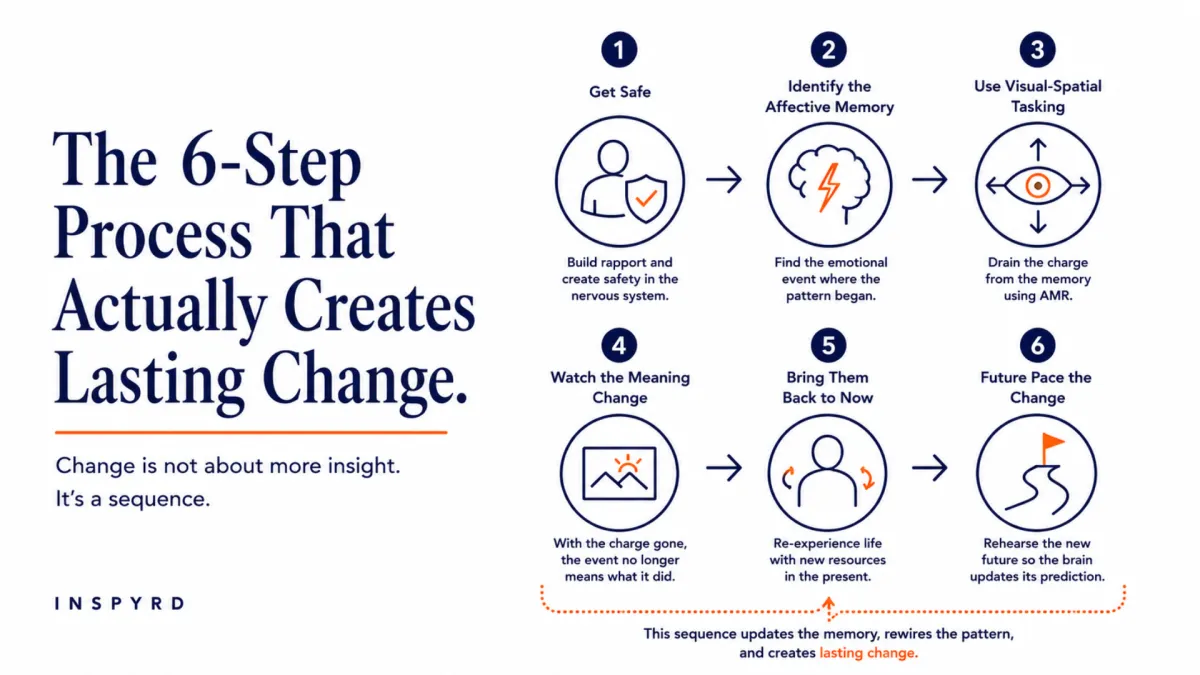
Here is a process for making meaningful, long-lasting change. Six steps, in order.
Step one, get in rapport and get the client safe. Nothing useful happens in a threatened nervous system. Stephen Porges built the polyvagal framework around exactly this, that a person has to be in a physiologically safe, ventral state before the deeper work is even possible. So the first move is not a technique. It is safety.
Step two, identify the affective memory. This is the memory where the decision, the belief, and the boundary first originated. Not the story the person tells about their life, the specific emotional event underneath it.
Step three, use an intervention that runs on high levels of visual-spatial tasking. In my world that is Affective Memory Resolution, and every AMR intervention leans heavily on visuospatial technique. Held in the right way, this drains the latent negative emotional charge out of the affective memory.
Step four, watch the meaning change. Once the charge is gone, the event no longer means what it meant. The same memory is still there in full detail, but it stops firing the old alarm, so the mind is free to give it a new meaning on its own.
Step five, bring the person back to now. Have them re-experience the events of their life carrying the new resources they just acquired, so the change is not an idea about the past but a felt difference in the present.
Step six, and this one is massively important, future pace the change with gusto. This step is built on the work of Lisa Feldman Barrett. Our brains are predictive machines. They forecast our future behavior from our past. When a person is stuck, their brain is using the old, charged memory to predict that they will be stuck again tomorrow. Once you release that charge, the brain has room for what we call behavioral flexibility, and the more you rehearse that flexible future, the more the prediction updates. We do step six with gusto because prediction is not decoration. It is the mechanism that carries the change forward.
Why this is neuroscience, not positive thinking
None of this is wishful. It sits on top of some of the most established findings we have.
Start with Donald Hebb, writing in 1949. His rule is that when one cell repeatedly helps fire another, "some growth process or metabolic change takes place" that strengthens the link between them. People say practice makes perfect. The uncomfortable corollary is that when we practice a bad pattern, we make it perfectly actionable too. Trauma and limiting patterns are Hebb's rule running in the wrong direction, a circuit wired hard through repetition.
And the repetition starts early. We imprint our first patterns before the age of seven, before the reticular activating system has fully come online to filter anything out. We rehearse them through the modeling years from eight to fourteen. We socialize them through puberty, roughly fourteen to twenty-one. Then we carry the whole inherited structure into our careers and our relationships as adults. This is why you cannot simply decide your way out. Cognition is not the layer the pattern lives on.
The layer it lives on can still be edited, and this is the finding that makes the whole formula work. Karim Nader and Joseph LeDoux showed in 2000 that "fear memories require protein synthesis in the amygdala for reconsolidation after retrieval." Retrieve an emotional memory and, for a brief window, it becomes unstable and must be written back to storage. Whatever is true during that window is what gets saved. Bruce Ecker and his colleagues took that discovery into the therapy room and made the same point
for clinical change: symptoms rooted in emotional memory dissolve when the memory is reactivated and updated during that window, not when it is argued with. Visual-spatial tasking is how you hold the memory open and drain its charge at the same time, so the version that reconsolidates is the calm one.
The part that will make some people uncomfortable
Notice what is not on that list. It does not require a master's degree. It does not require a PhD. It does not require a command of Adlerian, Jungian, or Freudian theory. It does not require you to memorize the anatomy of the brain or name its regions.
It requires a series of techniques, executed in order. Keep the client safe and in a parasympathetic state. Identify the affective memory. Run a visual-spatial technique with a high success rate at removing latent emotional charge. Come back to now. Future pace the change. Then repeat the repetitions until the new prediction holds.
I know that registers as heresy in a field that sells credentials. I am not saying training does not matter. I am saying capability and credential are two different things, and the person in front of your client does not care which graduate school you did or did not attend. They care whether the alarm is still firing when they wake up tomorrow. For a coach, this is the most freeing news there is. Your effectiveness is a learnable skill, not a decade of school. And effectiveness is your livelihood, because change that holds is what makes a client come back, refer their friends, and gladly pay for the result.
Frankl, Barrett, and the last freedom
Viktor Frankl wrote that everything can be taken from a person but one thing, "the last of the human freedoms, to choose one's attitude in any given set of circumstances." He was pointing at the space between what happens to us and how we answer it.
Lisa Feldman Barrett would extend him. If the brain constructs the present partly from what it has stored, then the last of the human freedoms may be the freedom to resolve the past, so the brain has better material to predict from the next time the stimulus arrives. That is the whole game in one line. Change the stored charge, and you change the prediction. Change the prediction, and you change the behavior. This is not a mindset trick. It is habit formation, performance change, and healing, all running on the same neuroscience, and all reachable through six repeatable steps.
FAQ
Do I need a degree in psychology to help people create real change?
No. Real change comes from a sequence of techniques, keeping the client safe, finding the affective memory, discharging it with visual-spatial tasking during a reconsolidation window, and then future pacing the result. That skill is trainable and does not depend on a graduate degree, though it does depend on doing each step cleanly and in order.
Why do my clients understand their problem but still cannot change?
Because understanding operates at the layer of story, and the pattern is encoded at the layer of affective memory, below language. Insight leaves the charge intact, so the old
prediction keeps firing. Change comes from updating the memory itself, not from explaining it more accurately.
What is the fastest way to make a breakthrough actually last?
Future pace it, hard and repeatedly. The brain is a predictive organ, so after you release the emotional charge you have to rehearse the new, flexible future until the brain adopts it as its default forecast. The breakthrough opens the door, and the repetition is what keeps it open.
What this means for practitioners
If you are helping people, or you want to start, treat change as a mechanism you can operate rather than a gift you either have or you do not. Learn to read the nervous system and get a client safe first. Learn to find the affective memory instead of managing the surface complaint. Learn one clean visual-spatial technique and run it well during the window when the memory is live. Then future pace with gusto and stack the repetitions. Do those things in order and your outcomes stop depending on luck or rapport alone. That reliability is what separates a hobby from a practice, and a struggling coach from one who earns a living changing lives.
Where this sits in the series
Earlier episodes named the injury and the mechanism. The Common Thread showed that the treatments that actually resolve trauma are all quietly doing visual-spatial tasking. Stop Asking Why showed that insight at the wrong layer keeps people stuck. This piece hands you the operating manual, the six steps that turn that mechanism into a repeatable practice, and makes the case that you can learn to run them without a wall of diplomas.
Where to take this next
If you want to become a coach, or you already coach and you want your work to actually hold, this is the skill worth building, and it is what I train and mentor practitioners to do inside INSPYRD. To learn more, download our free ebook, INSPYRD Healing: The Journey from Tragedy to Triumph, and see the mechanism laid out from the inside. Then come find the training, and if you are ready to go further, my mentorship is where new and practicing coaches get their client work reviewed case by case. Come find the work at INSPYRD.
About the Author
Allen Kanerva is a trauma intervention trainer and the founder of INSPYRD. A former Royal Canadian Air Force tactical helicopter pilot, UN peacekeeping course director, and co-author of Canadian humanitarian security policy work, he developed Affective Memory Resolution (AMR) and Visual-Spatial Tasking (VST), a clinical protocol for nervous-system-level trauma resolution grounded in Hebbian learning and memory reconsolidation research. He trains practitioners internationally in NLP, trauma
intervention, and mechanism-first change work.
ORCID ID: 0009-0009-1297-3778.
Zenodo: https://zenodo.org/communities/inspyrd
References
Barrett, L. F. (2017). How emotions are made: The secret life of the brain. Houghton Mifflin Harcourt.
Bolte Taylor, J. (2021). Whole brain living: The anatomy of choice and the four characters that drive our life. Hay House.
Ecker, B., Ticic, R., & Hulley, L. (2012). Unlocking the emotional brain: Eliminating symptoms at their roots using memory reconsolidation. Routledge.
Frankl, V. E. (2006). Man's search for meaning. Beacon Press. (Original work published 1946)
Hebb, D. O. (1949). The organization of behavior: A neuropsychological theory. Wiley.
James, T., & Woodsmall, W. (1988). Time line therapy and the basis of personality. Meta Publications.
Nader, K., Schafe, G. E., & LeDoux, J. E. (2000). Fear memories require protein synthesis in the amygdala for reconsolidation after retrieval. Nature, 406(6797), 722-726.
Porges, S. W. (2011). The polyvagal theory: Neurophysiological foundations of emotions, attachment, communication, and self-regulation. W. W. Norton.
