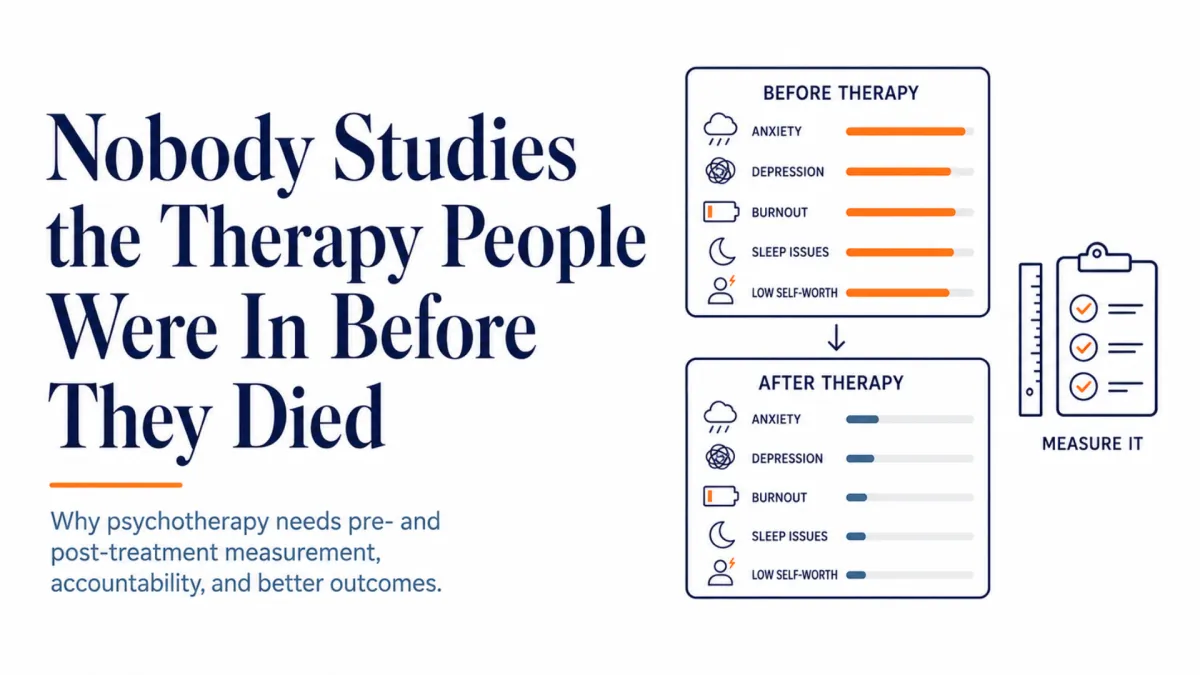
Nobody Studies the Therapy People Were In Before They Died
In the last article I opened with Dr. Martin Seligman, who described the state of psychotherapy in North America as not good enough. He said that in 2004. My point was that it is 2026 and it is still not good enough. I want to carry on with that theme.
If you are a highly traumatized or highly depressed or highly anxious person, you know how long you have suffered. I would bet you have tried several different treatments. And I am fairly confident the original diagnosis came from a family doctor, who — well intended — used your symptoms as the diagnostic for your mental suffering. Symptoms are critical. But there are psychometric tools that would have made that diagnosis better.
You and I both know that if you are stuck or struggling, whatever language you want to put to it, you are suffering. And there is a massive body of literature saying that when you suffer psycho-emotionally your sleep is impacted, and when your sleep is impacted long enough you start manifesting disease.
So I want to talk about something that probably sits outside the world of a client who is struggling. I want to talk about why so few psychometric assessments are done before a person enters therapy, and again at some reasonable point in the journey, to demonstrate their healing.
Last time I used a broken arm. Instead of ordering an X-ray, setting the arm based on what the image showed, letting the requisite time pass, and re-imaging to confirm it had healed before physiotherapy, the doctor analyzed your symptoms. Pain meds for the pain. Sleep meds to help you sleep. The injury itself never addressed, and the degree of healing never measured.
By and large, that is how the current state of psychotherapy treats mental illness.
What gets measured gets done
In my own obsession with helping people overcome trauma, I have been fixated on three things: creating results, measuring those results, and replicating them. The literature now indicates a growing number of modalities with greater than 90% success rates and little to no recurrence.
What would be meaningful to people suffering with depression, anxiety or trauma-related illness is if this industry — from legislators to insurers to colleges to
practitioners — embraced the kind of process that helped rebuild Japan after the Second World War.
That process was led by W. Edwards Deming, an American statistician, educator and management consultant, recognized as the father of quality management. His own standout contributions were the Fourteen Points, the System of Profound Knowledge, and the Shewhart cycle he refined into PDSA. The quality culture he seeded in Japan from 1950 onward is the soil Kaizen grew in, and Six Sigma arrived later, at Motorola in 1986.
Plan-do-check-act — the version Japanese executives recast from Deming's 1950 seminars — presupposes the industry has a plan to help those who are suffering. Then it delivers the therapies: that is the do. Then we check the efficacy of what was delivered. Deming preferred to call it PDSA — plan, do, study, act. If we actually studied the delivery of many, many therapies, we would find efficacies far below 50% with massively high recurrence, especially in trauma. The act means iteratively changing the process to create ever-increasing efficacy. Mental health care has improved in places, but it is not running an iterative cycle. If it were, cognitive behavioural therapy for trauma would have improved radically over the last three decades.
That dovetails into Kaizen: continuous incremental improvement by everybody — legislators, insurers, colleges, practitioners. Flexible, people-centred, bottom-up, ongoing. It is how you build a culture. And Seligman spoke plainly to the culture of psychotherapy when he said it is not good enough.
Six Sigma works the other way. It identifies and eliminates defects using data. Extend that into psychotherapy and we would have to gather data — and we should be able to, in a world with this much technology. Pre and post data alone, on any given subject, would be massive. Where Kaizen is bottom-up and people-centred, Six Sigma is structured, top-down and project-based, with longer timelines, built to address complex quality problems.
Together, applied to psychotherapy with rigour, they would change outcomes for suffering clients immensely.
Measure what works, not just what fails
So why measure at all?
Because the modalities running greater than ninety percent efficacy with almost no recurrence have common themes running through them.
In our own work, in the field of Affective Memory Resolution, we know that when you target an affective memory from the past — one carrying a latent negative emotional charge that is being pulled into the present and denying the client their future — and you use a technique that includes visual-spatial tasking with short-term working memory, you get spectacular results. The results hold. Recurrence is very low.
The reason is that the technique invokes the reconsolidation of that memory into what I coin a coherent memory. A coherent memory can be recalled clearly, concisely and in detail, without any inappropriate or unwarranted negative emotional response.
You might ask what inappropriate or unwarranted means. Let me give you an example.
Any parent reading this will understand that nothing is more traumatizing than losing your child. I had that experience. I held my first son while he passed away, thirty-four years ago. And I can tell that story clearly, coherently and in detail, without any inappropriate or unwarranted negative emotion.
At Christmas we all think about him. On his birthday, I think about him. And yes, I would like to have a thirty-four-year-old son, and I do not.
The emotion is not gone. It is appropriate, it is warranted, and the event is in the past where it belongs. That is the driver.
So we need to measure the modalities that create that result, person by person. We do not want to only measure the failures. We want to measure what works, so that clients get directed to the modalities with high efficacy and limited — perhaps even no — recurrence.
How do we measure
Look at only three mental health issues — depression, anxiety, and trauma-related conditions — and there is already an abundance of reputable, internationally recognized, easily administered psychometric assessments.
Let me address two objections up front: no time, and no resources. If anyone argues that this is why we do not run rigorous assessment, then from my point of view they are making that argument because they do not want to be measured.
For depression there is the Patient Health Questionnaire — the PHQ-9, or the PHQ-2 for rapid screening — or the Beck Depression Inventory. For anxiety there is the Generalized Anxiety Disorder 7-item scale, the GAD-7, alongside the Personality Assessment Inventory and the multiphasic personality inventories.
In trauma there is the Clinician-Administered PTSD Scale for DSM-5, CAPS-5, considered the gold standard structured interview — a comprehensive assessment of symptom frequency, intensity and duration, both quantitative and qualitative. For self-report severity monitoring there is the PTSD Checklist for DSM-5, the PCL-5, and instruments that are less used but highly effective, like the PSSI-5, developed by Edna Foa at the University of Pennsylvania and catalogued in the assessment library of the VA's National Center for PTSD.
We could list dozens. For veracity these should be administered by psychometric assessors; for clinical excellence they can be administered by clinicians; and for long-term understanding they can be self-administered by clients.
Walking the talk
When I started coaching people with trauma I was using NLP. Then I read a 2009 study out of the Department of Psychiatry at the University of Oxford, describing a mechanism called visual-spatial tasking of the short-term working memory, with massive results. So I reviewed and analyzed and studied what I was doing — and I did the same with the other high-efficacy modalities. All of them included visual-spatial tasking.
Our own modality we call Affective Memory Resolution, and the key to resolving an affective memory is visual-spatial tasking while that memory is labile.
But saying that is not enough. Measuring it is critical. Here is how I measure my work.
I gather five levels of evidence with every trauma client I coach. Five.
The first is the Zimbardo Time Perspective Inventory, created by Dr. Philip Zimbardo of Stanford University and presented in The Time Cure, co-authored with Richard and Rosemary Sword.
The second is the PSSI-5, in a format we have digitized for ease of use. The instrument runs 24 items, with the twenty symptom items scored zero to four for a severity range of zero to eighty. All of my clients score in excess of 25 at intake — I have not had a regular coaching client who scored lower. Nine out of ten no longer meet diagnostic criteria afterward, with severity scores below 10 out of 80. That is reflected in the pilot study with women who had exited human trafficking: an 86.6% reduction in symptoms and, more importantly, ten of the eleven women who completed the programme no longer meeting diagnostic criteria. Those assessments were conducted by an independent third party.
Third is behavioural evidence. My clients are severely traumatized, and most have been through two, three or four other forms of therapy before they reach me. They arrive with negative behaviours driven by the degree of their trauma, and the evidence is that those behaviours stop. The most profound one they nearly all share is sleep — difficulty falling asleep, waking several times, getting less than seven and a half hours, and what sleep they do get is not restorative. There is a full range of others: avoidance, anger, an inability to concentrate. There are also behaviours they want and are not doing — socializing, sleeping, being in a good relationship. We monitor those pre and post.
Fourth is a modified activity card from the corporate coach Marshall Goldsmith, which I learned from his book Triggers. It covers self, relationships and career, and what makes it unique is the lead question: "Did I do my best to…" — for example, "did I do my best to find meaning and purpose today?" — with the client ranking their effort from zero to ten. The answer is qualitative and self-reflective rather than a moment-in-time quantification.
Fifth, I gather anecdotal evidence every session. In the first session I identify several things I believe are significant for that client — sleep patterns, relationship with a partner, capacity at work — and I check in on them every time.
The road forward
Staying with Seligman: if psychotherapy is not good enough, then some form of Kaizen and Six Sigma mashup applied to the industry, where we measure what is working, identify the defects, and make iterative changes, is an absolute requirement.
So where does the impetus come from? It can come from the top down and it can come from the bottom up.
Somewhere between 3,000 and 3,500 Canadian men take their own lives each year. I have looked, and I have never seen a study that interviewed the families of those men and asked what therapies they were in thirty or sixty days before they died. That would be valuable data. We would quickly start identifying the processes — and the practitioners — whose outcomes are not good. The Italian economist Vilfredo Pareto observed that roughly 20% of Italy's population held 80% of its land. It was the quality engineer Joseph Juran who generalised that into the management principle now bearing Pareto's name — a vital few accounting for most of the results, good and bad. That is a useful heuristic here.
Maybe the families of those three thousand men need to stand up and say we need to do a better job. Better assessment, pre and post. An environment free of stigma. That comes from the bottom up, and if it is advocated correctly it starts coming from the top down as well. That vice is what reaches the three layers in the middle.
Clinicians running 30, 40 or 50% efficacy with high recurrence should be subject to retraining or realignment. Go back to the broken arm: imagine if 70% of broken arms never healed. Red flags would be going up everywhere.
Right now therapists are not motivated to measure. If they have extraordinary results they are not permitted to advertise them, and if they do not have extraordinary results their client queues are still full and they are still making good money whether or not clients heal. Other than personal morals and ethics, there is no motivation to introduce rigorous assessment.
Colleges are not motivated either — to teach it, or to enforce it through their ethics, education protocols, policies and procedures. They have ethical violations and other forms of violation, but there is no benchmark saying a clinician treating trauma must document a greater than 50% or 75% success rate or go back for more training.
And the insurance layer is the most contradictory of all.
You might think an insurer would want to reduce its exposure to mental illness, and would therefore be all over assessment, weeding out weak modalities and ineffective practitioners, because they are a financial burden on them.
The opposite is true. If an insurer specified that a person with trauma must undergo a particular modality, and that modality delivered a negative result, the insurer could carry vicarious liability for having recommended it. More importantly, at the end of the day all costs — plus a significant profit — are borne by the people and companies buying the insurance. So insurers are not motivated toward shorter durations, higher efficacy and lower recurrence. That would reduce their margin. Greater volumes of physician time, medication and time off work all contribute to a greater margin.
The energy to change this has to come from the top and from the bottom. The three layers in the middle have no motivation, in Seligman's language, to make therapy good enough.
How do I know if my therapy is actually working?
You should be assessed at multiple levels, and you should know in advance what those levels are. All of my clients know they will be assessed across the five described above. More importantly, I ask the client the reverse question: how will you know your therapy is working? What is your expectation for when your life is no longer dictated by the event that traumatized you? That answer becomes part of the behavioural evidence.
Why do I feel the same after years of therapy?
It feels that way because the affective memory was never resolved.
Every memory has a process of getting to resolution. A memory born out of a tragic event, where the amygdala was put on high alert and years or decades later is still scanning for a danger that no longer exists — that is an affective memory. You feel the same because the work you did, the therapy you were in, did not address that foundational layer.
So every day you pull that latent negative emotional charge into your current experience. Your amygdala scans for danger, keeps you on high alert, and floods you with cortisol, adrenaline, noradrenaline and other chemicals. The approach may also have had low efficacy structurally, it may have been delivered ineffectively, and progress was never measured along the way, so nothing was ever changed. So yes — the client is stuck, years of therapy later.
What test should a therapist give me before and after treatment?
For depression, the PHQ-9 or the Beck Depression Inventory. For anxiety, the GAD-7. For trauma, the CAPS-5 as a structured interview, or the PCL-5 or PSSI-5 for self-report severity monitoring. All are internationally recognized and easily administered. You are entitled to ask which one your clinician uses, when they administer it, and what your scores were.
What this means for practitioners
I cannot imagine being a clinician carrying eighty or a hundred clients in a traditional psychotherapy clinic, knowing that six or eight or twelve months from now those clients still will not be sleeping through the night, and their health is going downhill.
It would be better to measure what you are actually doing. Not just recording anecdotal evidence — measuring it in some meaningful way, with recognized psychometric assessments.
And if you are not getting seventy, eighty, ninety percent success with little to no recurrence, go and learn different techniques. Look at the literature. Look for the techniques with greater than ninety percent success. Be curious. Find the ones that include visual-spatial tasking. And maybe, inside the modality you already work in, you can introduce visual-spatial tasking into what you do. I guarantee it will increase your effectiveness.
If you run an evidence-proven practice, where you do rigorous assessments that are internationally recognized, and you can point clients to external research supporting your claims, you can confidently answer any question a client asks you. That is the position worth being in.
Where this sits in the series
The last article argued that trauma-informed describes a posture rather than a result, and that the delta between feeling safe and being healed is not measured. This one asks the next question: who is accountable for that delta, and what would it take to build a system that iterates toward better outcomes instead of repeating the same ones for thirty years.
Where to take this next
If you are carrying something that talk and time have not touched, you are entitled to see your change measured rather than merely felt. If you are a practitioner who wants to work with evidence rather than in the dark, the same invitation stands. Reach out through INSPYRD.
About the Author
Allen Kanerva is a trauma intervention trainer and the founder of INSPYRD. A former Royal Canadian Air Force tactical helicopter pilot, UN peacekeeping course director, and co-author of Canadian humanitarian security policy work, he developed Affective Memory Resolution (AMR) and Visual-Spatial Tasking (VST) — a clinical protocol for nervous-system-level trauma resolution grounded in Hebbian learning and memory reconsolidation research. He trains practitioners internationally in NLP, trauma intervention, and mechanism-first change work.
ORCID ID: 0009-0009-1297-3778
References
Blevins, C. A., Weathers, F. W., Davis, M. T., Witte, T. K., & Domino, J. L. (2015). The Posttraumatic Stress Disorder Checklist for DSM-5 (PCL-5): Development and initial psychometric evaluation. Journal of Traumatic Stress, 28(6), 489–498. https://doi.org/10.1002/jts.22059
The validation study for the PCL-5, the self-report instrument named here for severity monitoring. Twenty items scored 0–4, total range 0–80, five to ten minutes to complete. Research to date supports a cut-off between 31 and 33 as indicative of probable PTSD. It is distributed free by the VA's National Center for PTSD, which is directly relevant to this article's contention that cost is not a real barrier to measurement.
Deming, W. E. (1986). Out of the crisis. Massachusetts Institute of Technology, Center for Advanced Engineering Study.
Deming's principal statement of the management philosophy that reshaped Japanese industry, containing the Fourteen Points and the Seven Deadly Diseases. It is the source for this article's central borrowing: that outcomes are produced by systems rather than by individual effort, and that a system which does not measure itself cannot improve itself. The argument applied here to psychotherapy is Deming's argument, transposed.
Deming, W. E. (1993). The new economics for industry, government, education. Massachusetts Institute of Technology, Center for Advanced Engineering Study.
The better source for the two ideas this article leans on hardest. Chapter 4 sets out the System of Profound Knowledge; Chapter 6 contains the section titled "The Shewhart PDSA Cycle." This is where Deming's own formulation of plan-do-study-act is published, as distinct from the PDCA variant that circulated without him.
Foa, E. B., McLean, C. P., Zang, Y., Zong, J., Rauch, S., Porter, K., … Kauffman, B. (2016). Psychometric properties of the Posttraumatic Stress Disorder Symptom Scale Interview for DSM-5 (PSSI-5). Psychological Assessment, 28(10), 1159–1165. https://doi.org/10.1037/pas0000259
Establishes the psychometric properties of the instrument used as the second of the five levels of evidence described here. The PSSI-5 comprises 24 items — 20 assessing DSM-5 symptom criteria plus 4 measuring distress and interference — with symptom items rated zero to four for a total severity range of zero to eighty. A validated, published, internationally available instrument exists and is inexpensive to administer, which removes any credible "no time, no resources" objection to measuring trauma outcomes before and after intervention.
Goldsmith, M., & Reiter, M. (2015). Triggers: Creating behavior that lasts — becoming the person you want to be. Crown Business.
Source of the Daily Questions practice adapted as the fourth level of evidence in this article. Goldsmith's insight is that questions phrased actively — "Did I do my best to…?" — move accountability from circumstance to effort, where a passive question ("Were you happy today?") invites the respondent to rate their environment instead. The reframe is credited to Kelly Goldsmith. It is included here because self-report only becomes useful evidence when the question is built to elicit effort rather than mood.
Holmes, E. A., James, E. L., Coode-Bate, T., & Deeprose, C. (2009). Can playing the computer game "Tetris" reduce the build-up of flashbacks for trauma? A proposal from cognitive science. PLOS ONE, 4(1), e4153. https://doi.org/10.1371/journal.pone.0004153
The Oxford study that first pointed me toward visual-spatial tasking. Using the trauma film paradigm, forty participants viewed a twelve-minute film of real injury and death, then after a thirty-minute break either played Tetris for ten minutes or sat quietly. Flashbacks were logged daily for a week. The Tetris group had significantly fewer involuntary flashbacks while
deliberate recall stayed intact. The authors propose that visuospatial tasks compete for resources with visuospatial images inside the memory window — the mechanism underneath visual-spatial tasking, and the reason the highest-efficacy modalities share a common ingredient rather than arriving at their results by accident.
James, E. L., Bonsall, M. B., Hoppitt, L., Tunbridge, E. M., Geddes, J. R., Milton, A. L., & Holmes, E. A. (2015). Computer game play reduces intrusive memories of experimental trauma via reconsolidation-update mechanisms. Psychological Science, 26(8), 1201–1215. https://doi.org/10.1177/0956797615583071
The follow-up that extends the 2009 finding from a newly formed memory to an established one. Here the memory is deliberately reactivated first, returning it to a labile state, before the visuospatial task is applied. This is the experimental analogue of what happens in clinical practice, where the memory being worked with is years or decades old, and it supports the article's claim that visual-spatial tasking works while a memory is labile — whichever route brought it to that state.
Juran, J. M. (1975). The non-Pareto principle; Mea culpa. Quality Progress, 8(5), 8–9.
Juran's public correction of his own naming. Pareto observed a distribution of wealth; Juran generalised it into the management principle of the vital few and named it after him, then conceded in print that the attribution was a mistake of his own making. Cited here because the principle is used in this article as a heuristic for locating the practitioners and modalities producing most of the poor outcomes, and the provenance should be stated accurately.
Nader, K., Schafe, G. E., & LeDoux, J. E. (2000). Fear memories require protein synthesis in the amygdala for reconsolidation after retrieval. Nature, 406(6797), 722–726. https://doi.org/10.1038/35021052
The foundational demonstration that a consolidated memory returns to a labile state when it is retrieved, and must be restabilised through new protein synthesis in the amygdala. This is the biological basis for the claim made here that an affective memory can be resolved rather than merely managed: if retrieval reopens the memory, then what happens during that window determines what gets stored back.
Seligman, M. E. P. (2004). The new era of positive psychology [Address]. TED.
Source of the "not good enough" verdict that opens both this article and its predecessor. Asked by a CNN producer to describe the state of psychology in one word, Seligman answered "Good." In two words, "Not good." In three, "Not good enough." The significance is the speaker: a past president of the American Psychological Association assessing his own discipline. The argument here is that the verdict has gone unanswered for twenty-two years because the field has no iterative mechanism for acting on it.
Zimbardo, P. G., & Boyd, J. N. (1999). Putting time in perspective: A valid, reliable individual-differences metric. Journal of Personality and Social Psychology, 77(6), 1271–1288. https://doi.org/10.1037/0022-3514.77.6.1271
The validation paper for the Zimbardo Time Perspective Inventory, the first of the five levels of evidence described here. Fifty-six items across five factors: past-negative, past-positive, present-hedonistic, present-fatalistic, and future. It is included in this protocol because trauma distorts a person's relationship with time — the past will not stay past and the future closes down — and the ZTPI measures that distortion directly rather than inferring it from symptom counts.
Zimbardo, P. G., Sword, R. M., & Sword, R. K. M. (2012). The time cure: Overcoming PTSD with the new psychology of time perspective therapy. Jossey-Bass.
The clinical application of the time perspective work to PTSD, and the source through which the ZTPI entered this practice. Written with Richard and Rosemary Sword from their clinical caseload in Hawaii, it sets out how a distorted time perspective can be reshaped, and why measuring it before and after treatment gives a clinician something more informative than a symptom tally.
