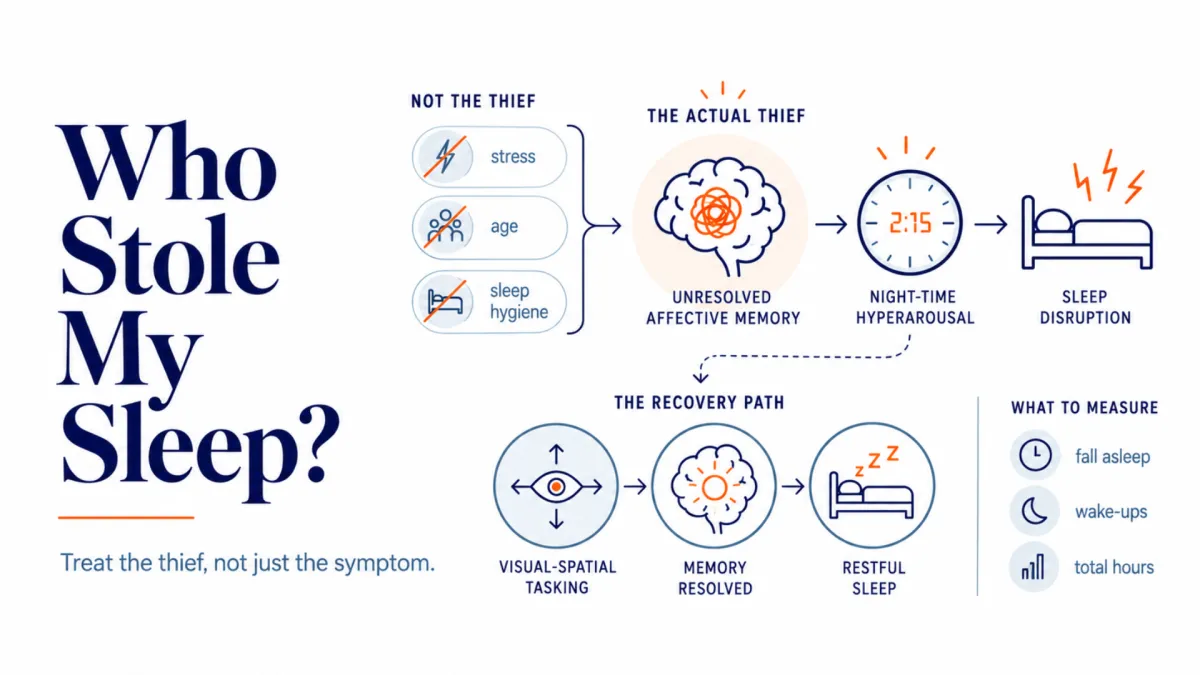
Who Stole My Sleep?
You know how it feels when you can't fall asleep. The bigger problem is that no matter how many visits to the doctor you've made, no matter how many meds you're taking, how much marijuana you're taking, or how much alcohol you're drinking, if you don't have some sort of assistance, you can't fall asleep. The ability to fall asleep has been stolen from you. And you know how frustrating that is. You toss, you turn, you kick your blankets, you get up, you turn on lights, you go for a walk, you come back, you do all sorts of things at a time of night that don't feel good.
You and I both know that when your sleep has been stolen long enough, other parts of your life start to unravel. You're mentally tormented. You can't concentrate. You're emotionally less stable. And if that goes on long enough, your body starts paying a price. All because somebody or something stole your sleep.
Now, I've been working with people a long time, and this isn't just a common thread. It's a hundred percent accurate representation of what's happening when people have a certain psycho-emotional issue.
The Wrong Thieves
The number of reasons I've heard for why people can't sleep is extraordinary. I especially like the one that says, "I'm a night owl." Or, "My mattress isn't good enough." Or, "The lights from the building keep my room too bright." Those aren't the thief.
A Night in the Room
Imagine you go to bed tonight, and you've read the literature, so you go to bed at 10 o'clock because they tell you that's when there's a rush of melatonin. And let's say you take it even further. You don't watch your phone or the TV for an hour before bed because they're too bright, and you keep the temperature of the room a little cool. You've done everything right. But you're lying there, staring at the ceiling. Then you flick over onto your side, kick the covers off, and flip to the other side. You feel the anxiety starting to build, and the anger, because you can't get to sleep. You look over at the clock. Half an hour's gone by. You toss and turn, and another half hour goes by. Now it's 11:30, and you still haven't fallen asleep.
Waking at 2:15 and the Anger That Follows
And then, as if a miracle happens, you sleep. You sleep for two hours and fifteen minutes. You look at the clock when you wake up, and it's 2:15 in the morning. And you ask yourself why. To the best of my knowledge, nobody wakes up in the middle of the night grateful.
Most people wake up in the middle of the night and get angry. That anger is part of the sympathetic nervous system, and it comes with a cascade of chemicals that don't let you sleep well. Then you look at the clock, you might grab your phone, a lot of people turn on a light and stand up and go for a walk, and this whole sequence absolutely prevents falling back asleep.
The Thief in the Dark Gets Misnamed
And there, in the darkness of the night, the thief gets named. It's their teenage child giving them a hard time. Or their boss putting pressure on them. Or some payment that needs to be made. And while that might be a thief, there's normally a bigger thief, because millions of people have all of those same issues and sleep through the night just fine.
The Actual Thief
The thief is unresolved, intense, negative emotional events, or traumas, from your past. The thief is not the events themselves. It's how your mind, specifically your fight, flight, or freeze mechanism, and your amygdala, reacted to those events, and continues to carry the negative emotional charge from those events into the present moment.
How You Get It Back
The best way to be able to fall asleep, and to stay asleep, is to seek out and resolve the affective memories from your past that are significantly negative, emotional, or traumatizing. And the best way to resolve them is with therapy methods that include visual-spatial tasking.
What changes: the latent emotional charge no longer exists. The amygdala is no longer scanning for the danger that existed in those historic events. Your fight, flight, or freeze mechanism, your amygdala, believes you are safe to fall asleep. And during REM sleep, where you have what I call metaphorical dreams, the content and context of your memories disconnect from the latent charge. The memories can then leave your short-term working memory and move into coherent, long-term storage.
My Own Nightmares, Before and After
My personal journey, prior to healing my trauma, was nightmare after nightmare after nightmare. My nightmares were, to my mind, unique. Three-quarters of them required me to get into action. I've heard it called holographic nightmares, where I am in the event and I must act. And when I acted, I was a risk to myself and others, because I was in a somnambulistic state, unaware of the reality around me.
Now I sleep like a baby. No nightmares, ever. And yet I have intense, detailed recall of those traumatizing events, because they are now coherent, long-term memories. Anybody who's listened to me for any length of time has heard me tell the story of the loss of my first son, or the death of my friends in the Hercules crash. I tell those stories clearly, coherently, in detail, with no inappropriate or unwarranted emotional response. And I sleep like a baby.
Treat the Thief, Not the Symptom
So the symptom might be the inability to fall asleep. Most practitioners want to manage that symptom through medication, breathwork, or meditation. But the way to actually ameliorate the symptom is by resolving the affective memory.
What Is Actually Stealing My Sleep If It's Not Stress or Age?
Stress can certainly steal your sleep, because it activates your fight, flight, or freeze, your amygdala center. But it's not your age. I'm seventy-one. I sleep like a baby. My father-in-law is eighty. He sleeps like a baby. My sister is eighty. She sleeps like a baby. It's not our age. Unresolved negative emotions, what I call affective memories, carrying a latent emotional charge that triggers inappropriate scanning for danger in this moment, when there is no danger, is what's stealing your sleep.
Can You Ever Get Years of Lost Sleep Back?
Here I would refer you to Matthew Walker and his book, Why We Sleep. The short answer is no. The longer answer is that you can reverse some of the damage from not sleeping.
Why Don't Sleep Aids or Sleep Hygiene Fix This?
Because they don't fix the root cause. If you have a cut on your arm and it's infected, you can put a Band-Aid on it, after Band-Aid, after Band-Aid, and it's not going to heal. You have to resolve the infection. Sleep meds or sleep hygiene are literally the Band-Aid, treating the symptom, the cut, and not dealing with the root cause of why it isn't healing, which is the infection.
Try This Tonight
Let me leave you with a challenge. When you go to sleep tonight, be aware of how long it takes you to fall asleep. It's actually a fun exercise. I count how many parasympathetic-activating breaths I take before I'm sound asleep. I've never counted to ten.
Where This Sits in the Series
This is Episode S2 E39 of the Applications of Neuroscience in Healing series, the second of a five-part arc on sleep and unresolved trauma. It follows S2 E38 (Sleep Is the Key Indicator of Unresolved Trauma and the Healing Solution) and precedes three more episodes taking this argument further.
Where to Take This Next
If you work with trauma-impacted clients and want to operate at the encoding layer, the Clinical Applications of NLP and Neuroscience for Healing certification teaches AMR and visual-spatial tasking. Curriculum and enrolment at certification.inspyrd.com.
For individuals: the INSPYRD Beyond Trauma app is the at-home, private surface for the same mechanism. inspyrd.com/app-subscribe.
About the Author
Allen Kanerva is a trauma intervention trainer and the founder of INSPYRD. A former Royal Canadian Air Force tactical helicopter pilot, UN peacekeeping course director, and co-author of Canadian humanitarian security policy work, he developed Affective Memory Resolution (AMR) and Visual-Spatial Tasking (VST), a clinical protocol for nervous-system-level trauma resolution grounded in Hebbian learning and memory reconsolidation research. He trains practitioners internationally in NLP, trauma intervention, and mechanism-first change work.
ORCID ID: 0009-0009-1297-3778
References
Nader, K., & Hardt, O. (2009). A single standard for memory: The case for reconsolidation. Nature Reviews Neuroscience, 10(3), 224-234. https://doi.org/10.1038/nrn2590
Provides the reconsolidation mechanism behind the article's central claim: an affective memory's latent emotional charge can be removed while the memory is reactivated and labile, after which it can be stored as a coherent long-term memory rather than remaining a live threat signal.
van der Helm, E., Yao, J., Dutt, S., Rao, V., Saletin, J. M., & Walker, M. P. (2011). REM sleep depotentiates amygdala activity to previous emotional experiences. Current Biology, 21(23), 2029-2032. https://doi.org/10.1016/j.cub.2011.10.052
The empirical mechanism behind the article's claim that REM disconnects the content and context of a memory from its emotional charge. Demonstrates that REM sleep reduces amygdala reactivity to previously emotional material.
Pace-Schott, E. F., Germain, A., & Milad, M. R. (2015). Sleep and REM sleep disturbance in the pathophysiology of PTSD: The role of extinction memory. Biology of Mood & Anxiety Disorders, 5(1), 3. https://doi.org/10.1186/s13587-015-0018-9
Documents the fragmented, disrupted REM architecture seen in unresolved trauma, consistent with the article's account of why an unresolved affective memory keeps interrupting sleep rather than letting it complete its usual processing.
Walker, M. (2017). Why We Sleep: Unlocking the Power of Sleep and Dreams. Scribner.
The book the article refers readers to directly on the question of whether lost sleep can be recovered. General grounding for the article's account of melatonin timing and sleep architecture.
