Why You Can't Fall Asleep (And How You Can Learn To)
You know how it feels: you're exhausted, you're craving sleep, and part of you still doesn't want to go to bed. You've tried to fall asleep night after night after night, and sometimes it takes hours of agonizing tossing and turning. You and I both know that's causing you real problems, and that the frustration keeps building.
Now imagine, just for a moment, that when you're exhausted you actually look forward to going to bed, because falling asleep easily and effortlessly is absolutely possible. Before I get to how, let me explain what's actually keeping you from sleep in the first place.
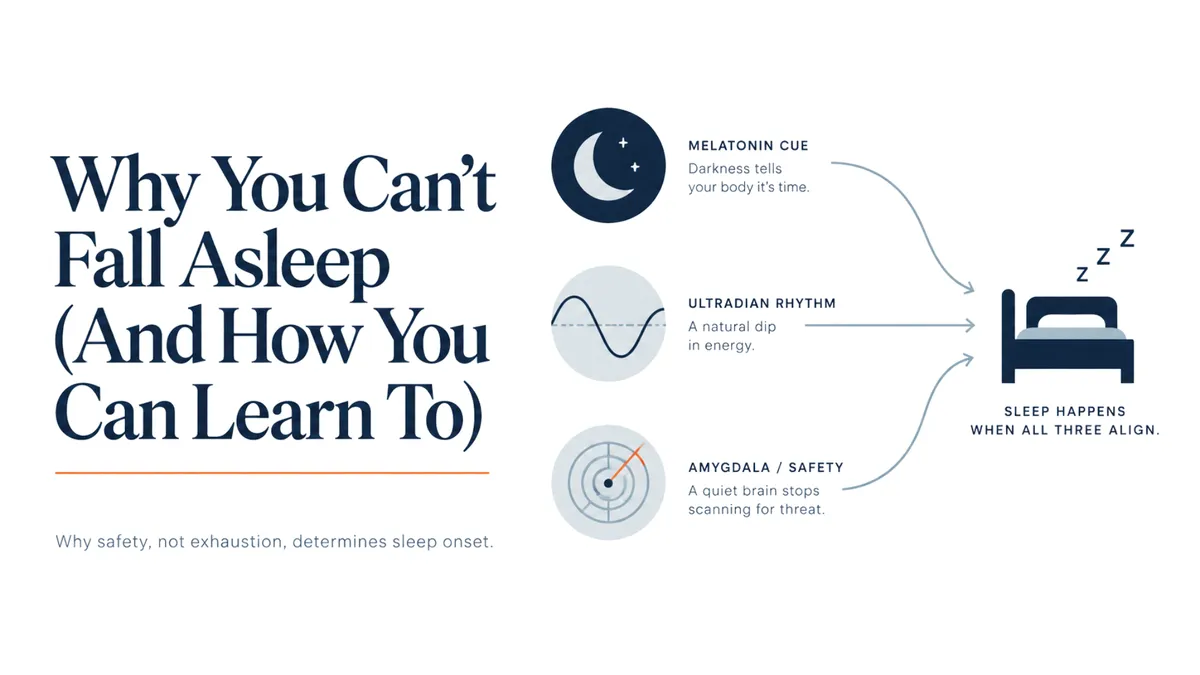
Three Things Have to Happen at Once
Sleep isn't something you decide to do. A number of human conditions have to come together to facilitate it, and you need to know that sleep both allows your body to recover and rejuvenate, and is critical to your mental and emotional state.
First, we have a circadian cycle, a twenty-four hour cycle during which the brain produces a sequence of chemistry appropriate to the phase of the day. At night, getting ready for sleep, it produces melatonin, and melatonin is the trigger that allows you to fall asleep.
Second, we have another cycle called an ultradian cycle. This one runs about ninety to one hundred minutes long, and we go through it all day and all night. During an ultradian cycle we have higher periods of energy and consciousness, and lower periods of energy and consciousness. To fall asleep, we need to be in the lower-energy part of that cycle, and our body needs to be producing melatonin.
Third, and this is the piece most people miss: our unconscious mind, the part that's constantly scanning our environment, has to perceive us as safe. If any one of these three pieces gets interrupted, falling asleep becomes difficult.
What You Actually Experience Instead
Here's what actually happens when this breaks down. You're not calm and drowsy. You're lying there wide awake, and despite knowing you're exhausted, you're genuinely alert, because you are.
Now that you're alert and can't fall asleep, you're probably getting moderately irritated, or you might be getting outright angry. So you toss and turn, which increases your heart rate, and while you're tossing and turning with an increased heart rate, you're also
raising your body temperature. Increased heart rate and increased body temperature are not, under normal circumstances, signals of safety.
Why Your Amygdala Won't Stand Down
If you have memories from your past that carry a significant, latent negative emotional charge, and those memories haven't been resolved, they can leave your fight, flight, or freeze mechanism, specifically your amygdala, scanning for danger constantly.
So when you lie down to sleep, that part of your mind recognizes that falling asleep means becoming very vulnerable, and it's still scanning for danger. It produces chemicals like noradrenaline that prevent the melatonin from working, and that keeps you on high alert exactly when you need your system to stand down.
Why the Standard Advice Falls Short for Some People
There's a lot of good advice out there for falling asleep: counting sheep, getting off your screens early, breathing exercises, other sleep hygiene routines. These have some real efficacy, and they may work fine for people whose sleep issues are really about changing gears, moving into parasympathetic sleep mode.
For people with unresolved memories, what I call affective memories, these techniques will not work. The secret is to resolve the affective memory itself.
What Changes Once the Memory Resolves
Imagine you resolved the memories from your past that keep your fight, flight, or freeze mechanism on low, medium, or high alert. Now, when it's time for bed and your amygdala scans your surroundings, it's scanning for safety in this moment, not scanning for threats from a year ago, five years ago, ten years ago, or more. And as it scans your environment and finds no threats, it doesn't go into high-alert mode. The melatonin you're producing now has the effect it's supposed to have. Lie down and wait long enough, and you'll settle into the lower-energy part of your ultradian cycle and fall asleep.
I'm also a fan of breathing techniques, specifically the ones that quiet the sympathetic nervous system and stimulate the parasympathetic nervous system, moving you from fight, flight, or freeze into rest and digest. I encourage everyone to use those kinds of techniques when they lie down to sleep, because they help the perception of safety and help the internal body processes along. Like anything, the more you practice, the better you get.
So here's what retraining yourself actually looks like: step one is resolving the unresolved affective memories, at the encoding layer, not managing them. Step two is falling asleep at a similar time every night, so your body relaxes and produces melatonin on a consistent schedule. But step two only works reliably once step one is done. Without it, you can turn off your computer early, dim the lights, do every breathing exercise available, and it's still very hard to turn off an amygdala that's guarding against threats from your past.
My Own Nights, Before and After
I'll tell you what this looked like for me. In the early 1990s I had what I'd describe as screaming nightmares, four, five, six nights a week. After a while, I didn't want to go to bed and face those demons. So I did one of two things: I'd stay up past midnight, to one or two in the morning, getting things done, telling myself the story that I was just being creative, which wasn't true. Or I'd go to bed at a reasonable time, ten-thirty or eleven, and have a dreadful time tossing and turning.
Today, I use the breathing techniques, and because I've cleared my own affective memories, I fall asleep easily within a minute and a half to five minutes. I've worn sleep monitors to verify that. I'm fortunate enough to sleep a minimum of four ultradian sleep cycles, six hours, and normally five, seven and a half hours.
Why Am I Exhausted and Still Can't Fall Asleep?
The answer isn't simple, but it's simple enough: part of your brain doesn't feel safe enough to let you fall asleep, and that part lives in your sympathetic nervous system. If you've had traumas or very negative events in your past, those are probably still unresolved, and resolving them at the encoding layer, not just managing the symptom, is what lets that part of your brain stand down.
Will Sleep Hygiene and Relaxation Techniques Fix This?
They can genuinely help. Turning off your computer early, getting into a relaxed state, listening to binaural beats, doing cyclic sighing or other breathing techniques that stimulate the parasympathetic nervous system all put you in a much better place. But it's very hard to turn off an amygdala that's still holding threats from your past on high alert. For that, sleep hygiene and breathing techniques aren't enough on their own. The affective memory driving the alert has to be resolved at the encoding layer.
What Actually Happens in the Brain When Someone Finally Falls Asleep Easily?
Three things line up at once: the circadian cycle is producing melatonin on schedule, the ultradian cycle has moved into its lower-energy phase, and the amygdala has scanned the environment and found no threat worth guarding against. When an unresolved affective memory has been the thing keeping that third piece from ever settling, resolving it at the encoding layer is what lets all three come together the way they're supposed to.
Where This Sits in the Series
This is Episode S2 E40 of the Applications of Neuroscience in Healing series, the third of a five-part arc on sleep and unresolved trauma. It follows S2 E38 and S2 E39, and precedes two more episodes taking this argument further.
Where to Take This Next
If you work with trauma-impacted clients and want to operate at the encoding layer, the Clinical Applications of NLP and Neuroscience for Healing certification teaches AMR and visual-spatial tasking. Curriculum and enrolment at certification.inspyrd.com.
For individuals: the INSPYRD Beyond Trauma app is the at-home, private surface for the same mechanism. inspyrd.com/app-subscribe.
About the Author
Allen Kanerva is a trauma intervention trainer and the founder of INSPYRD. A former Royal Canadian Air Force tactical helicopter pilot, UN peacekeeping course director, and co-author of Canadian humanitarian security policy work, he developed Affective Memory Resolution (AMR) and Visual-Spatial Tasking (VST), a clinical protocol for nervous-system-level trauma resolution grounded in Hebbian learning and memory reconsolidation research. He trains practitioners internationally in NLP, trauma intervention, and mechanism-first change work.
ORCID ID: 0009-0009-1297-3778
References
Rossi, E. L. (1982). Hypnosis and ultradian cycles: A new state(s) theory of hypnosis? American Journal of Clinical Hypnosis, 25(1), 21-32. https://doi.org/10.1080/00029157.1982.10404061
Extends Kleitman's roughly ninety-to-one-hundred-minute Basic Rest-Activity Cycle to waking consciousness, establishing the ultradian mechanism the article describes as one of the three conditions that has to align for sleep onset.
Nader, K., & Hardt, O. (2009). A single standard for memory: The case for reconsolidation. Nature Reviews Neuroscience, 10(3), 224-234. https://doi.org/10.1038/nrn2590
Supports the article's central claim: an affective memory carrying a latent emotional charge can be resolved while reactivated and labile, which is the mechanism behind why resolving the memory, not managing the symptom, is what lets the amygdala stand down at bedtime.
van der Helm, E., Yao, J., Dutt, S., Rao, V., Saletin, J. M., & Walker, M. P. (2011). REM sleep depotentiates amygdala activity to previous emotional experiences. Current Biology, 21(23), 2029-2032. https://doi.org/10.1016/j.cub.2011.10.052
Documents the amygdala's role in scanning for threat from past emotional material, and how that reactivity can be reduced, consistent with the article's account of the amygdala's safety verdict as the third condition for falling asleep.
Balban, M. Y., Neri, E., Kogon, M. M., Weed, L., Nouriani, B., Jo, B., Holl, G., Zeitzer, J. M., Spiegel, D., & Huberman, A. D. (2023). Brief structured respiration practices enhance mood and reduce physiological arousal. Cell Reports Medicine, 4(1), 100895. https://doi.org/10.1016/j.xcrm.2022.100895
Source for the specific breathing technique the article names, cyclic sighing, which this trial found produced the greatest reduction in physiological arousal of the techniques
tested, supporting the article's claim that these techniques quiet the sympathetic nervous system and help the perception of safety.
Walker, M. (2017). Why We Sleep: Unlocking the Power of Sleep and Dreams. Scribner.
General grounding for the article's account of the circadian cycle and melatonin's role as the trigger for sleep onset.
