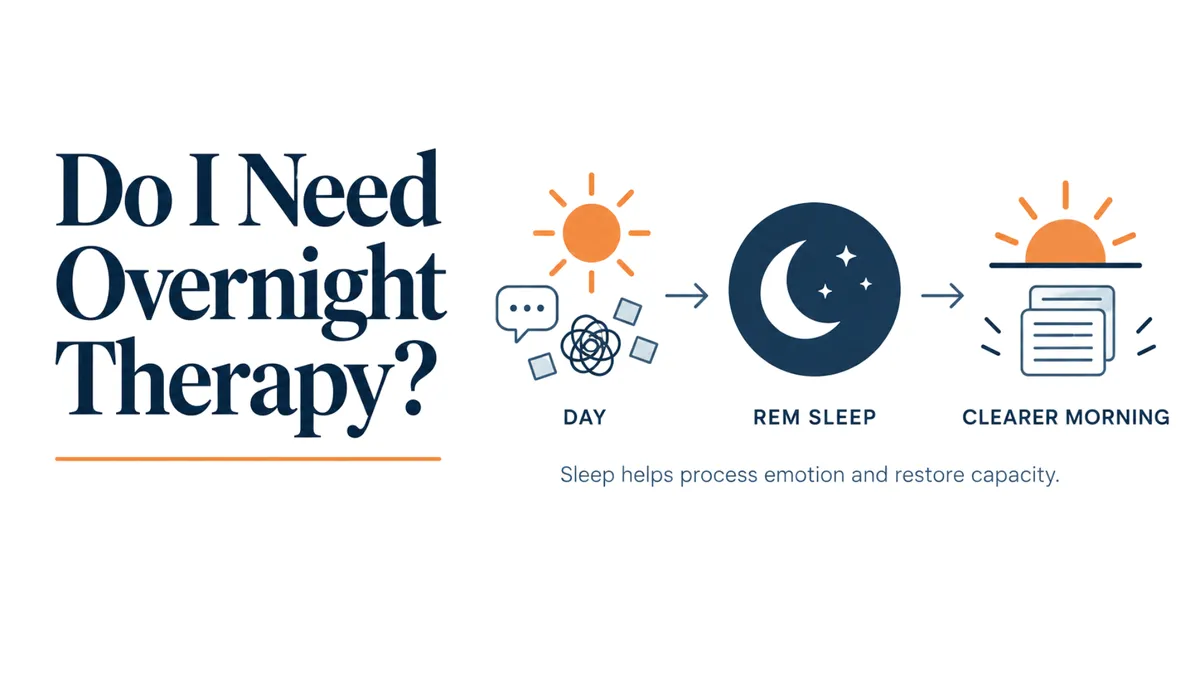
Do I Need Overnight Therapy?
You know how you look forward to falling asleep, especially after a productive day, when you've done the kind of work that leaves you exhausted in that good way. You also know you're not sure what goes on during the night. Some nights you sleep through. Some nights you don't.
The bigger problem is that on the nights you don't sleep through, you're missing a key part of your biological requirements. We know the body has to recover every day, and the same is true for the mind. There's actually a name for it. It's called overnight therapy, and all of us get it every night, if we sleep through the night.
What a Bad Night Costs You
You and I both know that after a bad night's sleep we can literally be an emotional train wreck the next day. Go a week without sleep and we start becoming really edgy and hard to be around. Now imagine that happening for a month, or for six months.
And you and I both know what happens when events from the past keep getting replayed in our mind, no matter if they happened a week, a month or a year ago. We keep carrying yesterday into today, and it stops us from accessing our future. It really starts to weigh us down. It impacts us, our families, our friends and our careers.
So I also want you to imagine that you get to a place where you fall asleep easily, like we talked about in the last episode, and where you actually sleep six to seven and a half hours every night and wake up rested, ready to take on the world. That's actually possible.
Where Overnight Therapy Happens
Overnight therapy occurs several times a night, in a very specific phase of sleep. Throughout the entire day, both day and night, we move in ninety to one-hundred-minute cycles called ultradian cycles. When we're sleeping, these cycles take us from light sleep into deep sleep.
As we exit deep sleep, we go into rapid eye movement sleep, REM. It's here that a lot of the overnight therapy happens.
During REM sleep, the emotions of the events of our day are disconnected from the content and context of the memory. Across the night, the memory can be moved from short-term memory into long-term, coherent memory. This is critical, because our short-term memory is finite in size. If this offloading from short-term to long-term memory doesn't happen, we wake up with less capacity to face the day.
The Signs It's Working, and the Signs It Isn't
So you know your overnight therapy is working because, first and foremost, you sleep through the night. You wake up ready to take on the tasks of the day. You're emotionally stable. You're excited and motivated.
On the contrary, when it's not working, you'll be woken up three or four times a night, specifically as you exit deep sleep and enter REM sleep. And the short-term memory doesn't get moved over into long-term storage.
Now, during these wake-ups, you might wake up with a nightmare or a night terror, or you might just be caught up in a cycle of ruminating on a single negative subject. All of it keeps replaying without resolution.
If this is happening to you, then you have unresolved affective memories carrying latent negative emotional charges. To the best of your brain's ability, they can't be released from your short-term memory, and instead you're woken up three, four, five times a night.
How One Bad Night Feeds the Next
So here you are, being woken up three or four times a night, and when you do get woken up, I'm going to bet you're not in a good mood. It's bad enough that the nightmare or the night terror woke you up, or the intrusive thought you're ruminating on. But now that you're in a bad mood, you're actually accelerating, intensifying, the sympathetic response. And the reason you got woken up during REM sleep was that the unresolved affective memory would not let the REM process happen.
By being woken up in the middle of the night, that memory stays in your short-term memory.
And of course, the first thing that happens the next morning is you think about the nightmare you had, which activates the memory again. Then somebody might ask you how you slept, and you tell them, bloody awful. If they ask why, you tell them about the nightmare or the night terror you had, reactivating the memory once again.
While it's a serious problem for you, it's also a sign that part of you is trying to protect you from some threat from your past.
So, Do You Need Overnight Therapy?
So you might ask, as the title does: do you need overnight therapy?
Unequivocally, the answer is yes. Now, you might be resistant to the word therapy. But what we're talking about here is the most natural of processes, and all healthy, well-rested people have it every night. Without it, things can get really, really out of control.
You might start having intrusive thoughts throughout the day. You might not have the ability to deal with multiple tasks. Your amygdala, the main activator of fight, flight or freeze, may be scanning for danger all day long, and that's exhausting, mentally and physically. You may be overly assertive, even aggressive, with friends, family and peers. And you may have difficulty concentrating.
People like Gabor Maté will tell you that trauma, when it's left unresolved long enough, will manifest as physical symptoms as well, like chronic fatigue, chronic pain, fibromyalgia and IBS.
So overnight therapy is not an option. Without it, we start to degrade very, very quickly, mentally and physically.
Why Medication Doesn't Reach the Cause
Of course, the solution most people go to is Western, or allopathic, medicine, which uses pharmacology to mask the symptoms. The symptom is not being able to sleep, so you get a sleep medication. Or if you have fibromyalgia or chronic pain, you get pain medication.
While these are great remedies to ameliorate symptoms, they don't deal with root causes. The root cause is an affective memory that remains unresolved.
What Actually Works
So what works well? Simply put, we need to get to the root cause of the persistent low-to-medium activation of the sympathetic nervous system. Trauma intervention modalities, significant emotional event intervention modalities, or adverse childhood experience intervention modalities that can target and identify the affective memory that needs resolution are best.
And when we say resolved, let me be clear. We're talking about resolving the memory so it moves into coherent long-term storage. Coherence means that any lessons that needed to be received from that experience have been received in a positive, implementable way. It means the latent negative emotional charge that was associated with that memory no longer triggers your fight, flight or freeze mechanism. And therefore you don't get woken up three or four times a night during REM sleep.
When an affective memory has been resolved, it can be retold clearly, coherently and in detail, without any inappropriate or unwarranted negative emotional response. There's no somatic response to that memory either.
I Keep Waking Up Several Times a Night. Should I Get Help?
I would highly encourage anybody who's being woken up several times a night to recognize that they're not getting the overnight therapy they require. Medications will ameliorate the symptoms but won't resolve the root cause, so find a practitioner who can resolve the affective memories. And let me be clear here again: clearing an affective memory isn't six or twelve months of psychotherapy. Research from King's College London found that a brief protocol of two to four sessions outperformed trauma-focussed CBT for veterans with PTSD.
What Is Overnight Therapy, and Do I Already Get It?
If you're waking up several times a night, probably every one to two hours, then you're not getting overnight therapy. And you need it.
Do I Need Therapy If My Sleep Already Feels Fine?
I think that's a question you need to answer for yourself. The clearest indicator is if you continue to drag a negative past into the present moment, denying yourself the experience of the moment and potentially not allowing yourself to connect to an abundant future. If that's you, then yes, please seek therapy.
Where This Sits in the Series
This is Episode S2 E41 of the Applications of Neuroscience in Healing series, the fourth of a five-part arc on sleep and unresolved trauma. It returns to the overnight-therapy mechanism first laid out in S2 E20 (Sleep, REM, and the Repair of Affective Memory), follows S2 E40 (Why You Can't Fall Asleep), and precedes the final episode of the arc.
Where to Take This Next
If you work with trauma-impacted clients and want to operate at the encoding layer, the Clinical Applications of NLP and Neuroscience for Healing certification teaches AMR and visual-spatial tasking. Curriculum and enrolment at certification.inspyrd.com.
For individuals: the INSPYRD Beyond Trauma app is the at-home, private surface for the same mechanism. inspyrd.com/app-subscribe.
About the Author
Allen Kanerva is a trauma intervention trainer and the founder of INSPYRD. A former Royal Canadian Air Force tactical helicopter pilot, UN peacekeeping course director, and co-author of Canadian humanitarian security policy work, he developed Affective Memory Resolution (AMR) and Visual-Spatial Tasking (VST), a clinical protocol for nervous-system-level trauma resolution grounded in Hebbian learning and memory reconsolidation research. He trains practitioners internationally in NLP, trauma intervention, and mechanism-first change work.
ORCID ID: 0009-0009-1297-3778
References
Walker, M. P., & van der Helm, E. (2009). Overnight therapy? The role of sleep in emotional brain processing. Psychological Bulletin, 135(5), 731-748. https://doi.org/10.1037/a0016570
The source of the term the article is built around. Proposes that REM sleep reprocesses the day's emotional experiences so the memory is kept while its emotional charge is reduced, which is the article's account of emotion being disconnected from the content and context of a memory overnight.
van der Helm, E., Yao, J., Dutt, S., Rao, V., Saletin, J. M., & Walker, M. P. (2011). REM sleep depotentiates amygdala activity to previous emotional experiences. Current Biology, 21(23), 2029-2032. https://doi.org/10.1016/j.cub.2011.10.052
The empirical test of the overnight-therapy model. Demonstrates that REM sleep reduces amygdala reactivity to previously emotional material, supporting the article's claim that REM is where much of the overnight therapy happens.
Pace-Schott, E. F., Germain, A., & Milad, M. R. (2015). Sleep and REM sleep disturbance in the pathophysiology of PTSD: The role of extinction memory. Biology of Mood & Anxiety Disorders, 5(1), 3. https://doi.org/10.1186/s13587-015-0018-9
Documents the fragmented, disrupted REM sleep seen in unresolved trauma, consistent with the article's account of repeated wake-ups around REM when an unresolved affective memory won't let the process complete.
Sturt, J., Rogers, R., Armour, C., Cameron, D., De Rijk, L., Fiorentino, F., Forbes, T., Glen, C., Grealish, A., Kreft, J., Meye de Souza, I., Spikol, E., Tzouvara, V., & Greenberg, N. (2023). Reconsolidation of traumatic memories protocol compared to trauma-focussed cognitive behaviour therapy for post-traumatic stress disorder in UK military veterans: A randomised controlled feasibility trial. Pilot and Feasibility Studies, 9(1), 175. https://doi.org/10.1186/s40814-023-01396-x
The King's College London veterans study the article refers to. A brief memory-reconsolidation protocol, delivered in two to four sessions, outperformed trauma-focussed CBT in UK veterans (48% versus 16% no longer meeting PTSD criteria at 20 weeks), supporting the article's point that clearing an affective memory does not require months of psychotherapy.
Maté, G. (2003). When the Body Says No: The Cost of Hidden Stress. A. A. Knopf Canada.
Grounds the article's reference to Gabor Maté and the claim that trauma left unresolved long enough can express itself as physical illness.
Walker, M. (2017). Why We Sleep: Unlocking the Power of Sleep and Dreams. Scribner.
General grounding for the article's account of sleep architecture and REM's role in emotional processing.
