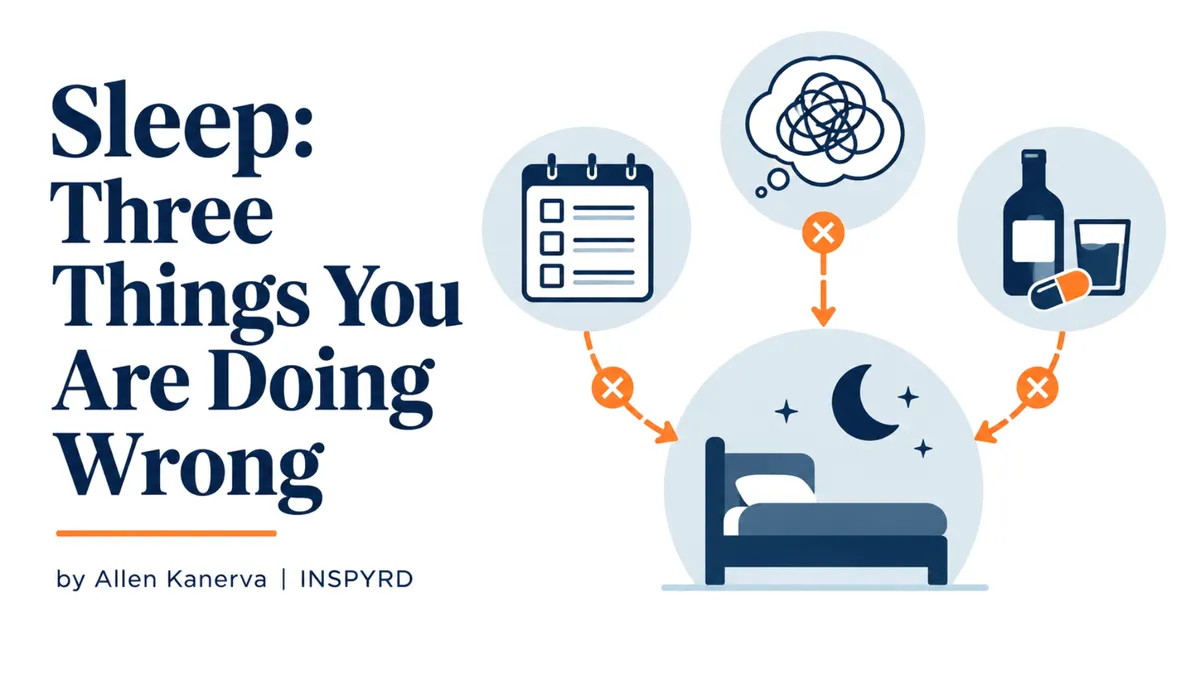
Sleep: Three Things You Are Doing Wrong
Sleep is such a profound subject in our culture today, and more specifically, the lack of it.
The entrepreneurial movement of the late eighties and early nineties worshipped people who could run on three, four or five hours of sleep. That mythology directly affected hundreds of thousands of people who weren't sleeping, and I think, more importantly, it affected their partners and their children.
So if you're someone who sleeps less than six hours a night, or you're a clinician whose clients name the inability to stay asleep as one of their primary concerns, this will be important.
There are three things that make sleep almost impossible, and I'm amazed that my smartest clients do all three. I'm going to go through them with you. And if you've had difficulty falling asleep, or you wake up multiple times through the night, you're my kind of people. What do I mean by that? You're exactly the kind of people I can help.
And you know who you are. You've tried harder to sleep. You've tried self-medicating with alcohol, marijuana, mushrooms.
You've tried 432-hertz music. Maybe you've gone the prescription route.
And sleep still eludes you.
Now, you're intelligent. You're an achiever, and this is just another challenge, so you go headfirst into it, as if willpower or some act of discipline will actually get you to sleep better.
And in the end, paradoxically, you activate the very systems inside you that prevent you from falling asleep and staying asleep.
Wrong Thing Number One: One More Thing Before Bed
Here's wrong thing number one. It's the one most high achievers do, the highly intelligent people who are out to maximize their lives.
I call it the one more thing before I go to bed.
Why is one more thing dangerous? In my experience, fewer than about 5% of the people who do one more thing are doing something that stimulates their parasympathetic nervous system, the rest-and-digest side.
The one more thing is normally done out of stress and duress.
It's another thing you HAVE to get done and off your checklist so that you can earn the right to sleep.
That is stress inducing. When you do it, you're activating the exact opposite side of the nervous system from the one you need to fall asleep. Even at a very low level, you're activating your sympathetic nervous system, and that system produces a cascade of chemicals that makes falling asleep almost impossible.
In doing the one more thing, you become very cognitive. You're thinking through the problem or the issue you're going to accomplish, and you're also thinking about why you have to do it. And have to is spelled with a capital H, a capital A, a capital V and a capital E.
It's the language of pressure, and potentially of guilt.
Then, when you finish, there is rarely relief, and rarely a movement into parasympathetic. That's been my experience, and it's what hundreds of clients have told me. Instead, there's a triggered response: what can I get done next?
That triggered response makes the person more alert and more cognitive, scanning for opportunity and weighing the potential benefits, and the risks of not taking it.
This is unequivocally not the mindset that brings on sleep.
Wrong Thing Number Two: A Different Bedtime Every Night
The second wrong thing is going to sleep at a different time every night.
Of course, there's a techno-rational explanation for all our behaviour. When I ask my clients why they don't go to sleep at the same time every night, they always have a, quote unquote, valid reason.
However, when you talk to highly successful people, they have equally compelling arguments for why they do go to sleep at the same time every night.
And the people with those compelling arguments often bring the neuroscience of sleep into them.
So, at a very high level, we have two really important cycles. The first is the circadian cycle, which runs 24 hours. It's massively influenced by the rising and setting of the sun, and by the chemistry our body produces at those two points.
Going to bed at a regular time and waking at a regular time helps our body produce melatonin, serotonin and cortisol at the appropriate times every day.
Here, consistency leads to health, mental vibrance and a host of other benefits.
The second cycle is the ultradian cycle. It runs between 90 and 100 minutes, and it goes on all day long. We're very alert at one point in the cycle, and 45 to 50 minutes later we're more sluggish, even a little drowsy, while we're awake.
And while we sleep, that cycle carries us from light sleep, where we toss and turn a little, might even sit up or open our eyes, into deep, deep sleep 45 to 50 minutes later. As we exit that deep sleep, we go into rapid eye movement sleep, REM. And REM is critical to your overnight therapy.
So really smart people who techno-rationally argue for going to sleep at 9:00 one night, 10:00 the next, 11:00 the night after and two in the morning after that are actually fighting their natural rhythms, both circadian and ultradian. And it's not healthy.
Wrong Thing Number Three: Missing the Window, Then Fighting the Night
So here's the third wrong thing really smart people do. Maybe I should say smart, motivated go-getters.
Their process, and the techno-rational explanations for it, actually moves them into low-to-medium-level sympathetic arousal.
Some of their motivation comes from pain: the pain of not having, the pain of not accomplishing, the pain of not being worthy. So when they get motivated to do things like the one more thing before bed, they're actually in their sympathetic nervous system. And while they're in it, getting one more thing done, they miss the window where sleep occurs naturally. These are the melatonin cycles before midnight.
Now they've got one more thing done, they've pushed through the melatonin cycles, and they lie in bed tossing and turning.
I've rarely, if ever, met a client who got to this point and was happy to be tossing and turning. You know it yourself if you've been there. You get animated, irritated, angry.
And that further exacerbates the inability to fall asleep.
So let's say you're fortunate enough to fall asleep 40, 60 or 70 minutes later. You go into the deep sleep of an ultradian cycle, and then, as you're coming out of that cycle through REM, you get woken up.
And when you're woken up, you get even more animated.
You reach for your phone to see what time it is. You turn on the light. You get up and go get a glass of water.
The negative emotion, plus the brightness of the phone, plus getting in motion, which raises your pulse and increases your body temperature, literally denies you the ability to fall asleep in the next ten minutes.
And you know the kind of emotions you have when this happens to you.
What All Three Have in Common
So what do all three of these have in common? They're about managing our emotional states.
Program the one more thing earlier in the evening.
Program your bedtime for the same time at least six out of seven nights a week. Give yourself a treat if you want to stay up late on Saturday night.
And when you get woken up in the middle of the night, be grateful. I'm not kidding.
That wake-up is a call to action, but not action in that moment. It's telling you that you have unresolved negative emotions and past experiences that need to be resolved. Thank your unconscious mind for waking you up to alert you to the need to heal them.
Keep the lights off and do a breathing exercise, like cyclic sighing, or simply breathe in through your nose and out through your mouth. Focus deeply on your breathing, and make sure your exhale is longer than your inhale. This will stimulate your ventral vagus nerve.
And count the number of breaths you take before you fall asleep.
What's the Biggest Mistake People Make Trying to Fix Their Sleep?
They believe that taking action will help them fall asleep. The action they actually need to take is to create the conditions where their unconscious mind believes they're safe to sleep. To do that, they need to be in parasympathetic, accepting the day's end, letting go of any naggy thoughts, and simply allowing themselves to fall asleep safely.
Can You Force Yourself to Relax Before Bed?
I hear people say, I tried to force myself to relax. If there was ever anything contradictory, it's putting force myself and relax in the same sentence. It's not possible. When you feel you have to force yourself to do anything, you're in your sympathetic nervous system, which again produces the wrong chemistry for sleep.
I Wake Up at the Same Time Every Night With the Same Memory. What Should I Do?
I keep getting asked this. I get woken up at the same time every night, 3:30, with the same memory. Should I just ignore it and persevere, or should I reach out and get help? Please, please, please reach out and get help. Whatever is waking you up regularly in the middle of the night can be resolved, and you can learn to sleep through the night, six to seven and a half hours, every night.
Where This Sits in the Series
This is Episode S2 E42 of the Applications of Neuroscience in Healing series, the fifth and final episode of a five-part arc on sleep and unresolved trauma that began with S2 E38 (Sleep Is the Key Indicator of Unresolved Trauma and the Healing Solution). It follows S2 E41 (Do I Need Overnight Therapy?) and returns to the REM and overnight-therapy mechanism first laid out in S2 E20.
Where to Take This Next
If you work with clients whose primary concern is sleep and want to operate at the encoding layer, the Clinical Applications of NLP and Neuroscience for Healing certification teaches AMR and visual-spatial tasking. Curriculum and enrolment at certification.inspyrd.com.
For individuals: the INSPYRD Beyond Trauma app is the at-home, private surface for the same mechanism. inspyrd.com/app-subscribe.
About the Author
Allen Kanerva is a trauma intervention trainer and the founder of INSPYRD. A former Royal Canadian Air Force tactical helicopter pilot, UN peacekeeping course director, and co-author of Canadian humanitarian security policy work, he developed Affective Memory Resolution (AMR) and Visual-Spatial Tasking (VST), a clinical protocol for nervous-system-level trauma resolution grounded in Hebbian learning and memory reconsolidation research. He trains practitioners internationally in NLP, trauma intervention, and mechanism-first change work.
ORCID ID: 0009-0009-1297-3778
References
Phillips, A. J. K., Clerx, W. M., O'Brien, C. S., Sano, A., Barger, L. K., Picard, R. W., Lockley, S. W., Klerman, E. B., & Czeisler, C. A. (2017). Irregular sleep/wake patterns are associated with poorer academic performance and delayed circadian and sleep/wake timing. Scientific Reports, 7, 3216. https://doi.org/10.1038/s41598-017-03171-4
Supports wrong thing number two. Students with irregular sleep schedules had melatonin onset roughly two and a half hours later than students on regular schedules, consistent with the article's point that a regular bedtime and wake time keeps the body's chemistry on time.
Chang, A.-M., Aeschbach, D., Duffy, J. F., & Czeisler, C. A. (2015). Evening use of light-emitting eReaders negatively affects sleep, circadian timing, and next-morning alertness. Proceedings of the National Academy of Sciences, 112(4), 1232-1237. https://doi.org/10.1073/pnas.1418490112
Supports the article's point about the brightness of the phone. Reading on a light-emitting device before bed suppressed evening melatonin by about 55%, delayed melatonin onset by more than an hour and a half, and lengthened the time it took to fall asleep by roughly ten minutes compared with a printed book.
Balban, M. Y., Neri, E., Kogon, M. M., Weed, L., Nouriani, B., Jo, B., Holl, G., Zeitzer, J. M., Spiegel, D., & Huberman, A. D. (2023). Brief structured respiration practices enhance mood and reduce physiological arousal. Cell Reports Medicine, 4(1), 100895. https://doi.org/10.1016/j.xcrm.2022.100895
The source of the cyclic sighing technique the article recommends. Five minutes a day of exhale-emphasised breathing reduced respiratory rate and improved mood more than mindfulness meditation, supporting the article's point that a longer exhale moves the nervous system toward rest.
Walker, M. P., & van der Helm, E. (2009). Overnight therapy? The role of sleep in emotional brain processing. Psychological Bulletin, 135(5), 731-748. https://doi.org/10.1037/a0016570
The source of the term overnight therapy. Proposes that REM sleep reprocesses the day's emotional experiences, which is why the article calls REM critical and treats a wake-up during REM as a signal worth attending to.
Pace-Schott, E. F., Germain, A., & Milad, M. R. (2015). Sleep and REM sleep disturbance in the pathophysiology of PTSD: The role of extinction memory. Biology of Mood & Anxiety Disorders, 5(1), 3. https://doi.org/10.1186/s13587-015-0018-9
Documents the fragmented, disrupted REM sleep seen in unresolved trauma, consistent with the article's account of waking as you come out of deep sleep through REM, and of the repeated same-time wake-up as something that can be resolved.
Walker, M. (2017). Why We Sleep: Unlocking the Power of Sleep and Dreams. Scribner.
General grounding for the article's account of circadian and ultradian cycles and the move from light sleep through deep sleep into REM.
