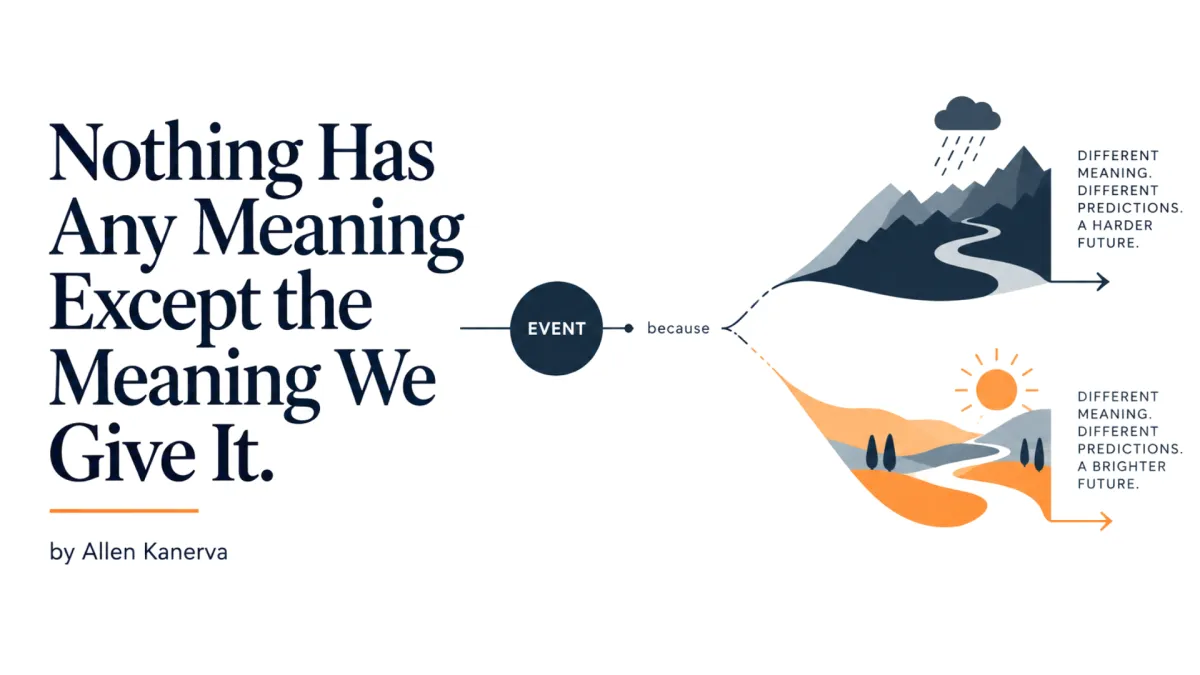
Nothing Has Any Meaning Except the Meaning We Give It
I am absolutely serious when I say that nothing has any meaning except the meaning we give it. Somehow I knew that intuitively.
The Meaning We Gave Our Son's Life
As an adult, I experienced a profound loss. My first wife and I were expecting our first son. It was 1992. At 32 weeks he was diagnosed with a hypoplastic left ventricle, and that ventricle of his heart was only 8% developed.
The reality was that as long as he remained in the womb, he would live. But as soon as he was born, a clock would start ticking.
What meaning should a parent give to an event like that? That's a profound question.
We decided to celebrate his life. We invited friends and family to join us immediately after the birth. Some flew from as far away as Ontario to be with us in British Columbia.
Our son was held by our friends and family. He was loved unconditionally, and he loved unconditionally. He had a bath. He breastfed. He had a bowel movement. And I thought he smiled.
The meaning we gave his life was that it was perfect, just short.
The choice to give that meaning to that event probably saved my life, because I could have chosen to be angry, to be mean, and potentially to drink excessively. None of that happened. Today that event, and the meaning I give it, is the unshakable foundation for what I do and for what I'm about to share.
The Last of the Human Freedoms
In Man's Search for Meaning, Viktor Frankl called it "the last of the human freedoms": the freedom "to choose one's attitude in any given set of circumstances." The corollary is that nobody can take that freedom from you. Equally important, you can give it away to others, to your detriment. The choice is an innate gift we are given at birth.
Today's Meaning Is Tomorrow's Prediction
The meaning we give things today becomes part of our brain's predictive mechanism for the future. Lisa Feldman Barrett has articulated, from the research, that our brain is a prediction machine. That machine is informed by our history. It shapes how we react in the present, and it generates our predictions about the future.
That machine is powerful, and it operates beyond your consciousness. As its predictions repeat over time and become narrower and narrower, we begin to lose choice and behavioral flexibility.
Because, and That Means
A few very basic words we use when we give meaning to things create massive psychological impact: the word "because" and the phrase "that means."
"Because" creates an implied cause-and-effect relationship. A person may say, "This is happening to me because," and whatever comes after the "because" is external to them: an event, somebody's actions, something somebody said to them.
"That means" is equally powerful. It is the linguistic marker for a complex equivalence. A person might say, "Did you see the way they looked at me? That means they don't think much of me."
When I lost my son, instead of choosing the meaning we did, I might have started talking like this: "I lost my son because the medical community failed us. I can't go to work because I'm so mentally distraught, and that means I'll probably lose my career, my house, everything."
Those are two radically different directions.
Is It True That Nothing Has Any Meaning Except the Meaning We Give It?
Unequivocally, yes. You can cognitively choose the meaning of something that has happened to you. And you can also choose to work with a therapist or coach who knows how to work with affective memories.
Why Can't I Change the Meaning of Something That Happened Years Ago?
We chose the meaning of my son's passage in the depth of those emotions. Had we spent one, two or three years in a negative emotional hell and then tried to dig our way out, deciding cognitively to change the meaning would have been challenging, if not impossible. The event would have become an affective memory carrying a latent negative emotional charge, triggering unwarranted emotions and predictions in the present. At that point, the only way to heal is to go back to that affective memory and resolve it, which releases the charge and gives the event new meaning.
Why Is Language So Important in NLP?
The second letter in NLP stands for linguistic, and the third for programming. That implies our behavior is programmed, and that a large part of the programming is language. First it needs to be understood. Then we learn to manage or change it, so that a person becomes whole and shows behavioral flexibility.
What This Means for Practitioners
If you're a practitioner, I'd encourage you to learn the Meta Model, based on the work of Virginia Satir, and the Milton Model, based on the work of Milton Erickson. They'll give you highly functional language recognition skills, and tools to work with the meaning underneath your client's words: when they say "because," "that means" or "which is why," when they use universal quantifiers like "always" or "never," and when they use nominalizations.
Where This Sits in the Series
This is Episode S2 E43 of the Applications of Neuroscience in Healing series, and the first episode after the five-part sleep arc (S2 E38 to S2 E42). It builds directly on S2 E37 (Our Brains Are Prediction Machines), applying that predictive model to the meaning we assign to events and the language we assign it with.
Where to Take This Next
What meaning have you given an event in your life, and is it still serving you? Tell me in the comments.
If you're a practitioner who wants to work with the meaning underneath your client's words and the affective memory that holds it, the Clinical Applications of NLP and Neuroscience for Healing certification teaches the Meta Model, the Milton Model and AMR. Curriculum and enrolment at certification.inspyrd.com.
For individuals: the INSPYRD Beyond Trauma app is the at-home, private surface for the same mechanism. inspyrd.com/app-subscribe.
About the Author
Allen Kanerva is a trauma intervention trainer and the founder of INSPYRD. A former Royal Canadian Air Force tactical helicopter pilot, UN peacekeeping course director, and co-author of Canadian humanitarian security policy work, he developed Affective Memory Resolution (AMR) and Visual-Spatial Tasking (VST), a clinical protocol for nervous-system-level trauma resolution grounded in Hebbian learning and memory reconsolidation research. He trains practitioners internationally in NLP, trauma intervention, and mechanism-first change work.
ORCID ID: 0009-0009-1297-3778
References
Frankl, V. E. (2006). Man's search for meaning. Beacon Press. (Original work published 1946)
The source of the article's central claim about choice. Frankl names the freedom to choose one's attitude in any given set of circumstances as the last of the human freedoms, which the article extends: no one can take that freedom from you, but you can give it away.
Barrett, L. F. (2017). How emotions are made: The secret life of the brain. Houghton Mifflin Harcourt.
Supports the article's account of the brain as a prediction machine informed by history. It is the basis for the claim that the meaning given to an event in the moment becomes part of what the brain predicts from, and the direct link back to S2 E37.
Bandler, R., & Grinder, J. (1975). The structure of magic I: A book about language and therapy. Science and Behavior Books.
The original statement of the Meta Model, including cause-and-effect, complex equivalence, universal quantifiers and nominalizations, the patterns the practitioner section asks readers to learn to recognise.
Bandler, R., & Grinder, J. (1975). Patterns of the hypnotic techniques of Milton H. Erickson, M.D. (Vol. 1). Meta Publications.
The original statement of the Milton Model, the second language model the practitioner section recommends.
