Your Best People Have Stopped Getting Better
You know the person. Experienced, reliable, the employee everybody turns to. And at some point you become aware that they are not getting better.
The bigger problem is that nobody notices. They are not failing. They are just as good as they were five years ago. Not better. Just good. So what does it cost an organisation when its most experienced people stop improving?
In his 2017 TED talk, the surgeon and writer Atul Gawande said, "It's how good you're going to be that really matters." Most assessments are a moment in time: are they good enough or not?
Look at the trend line
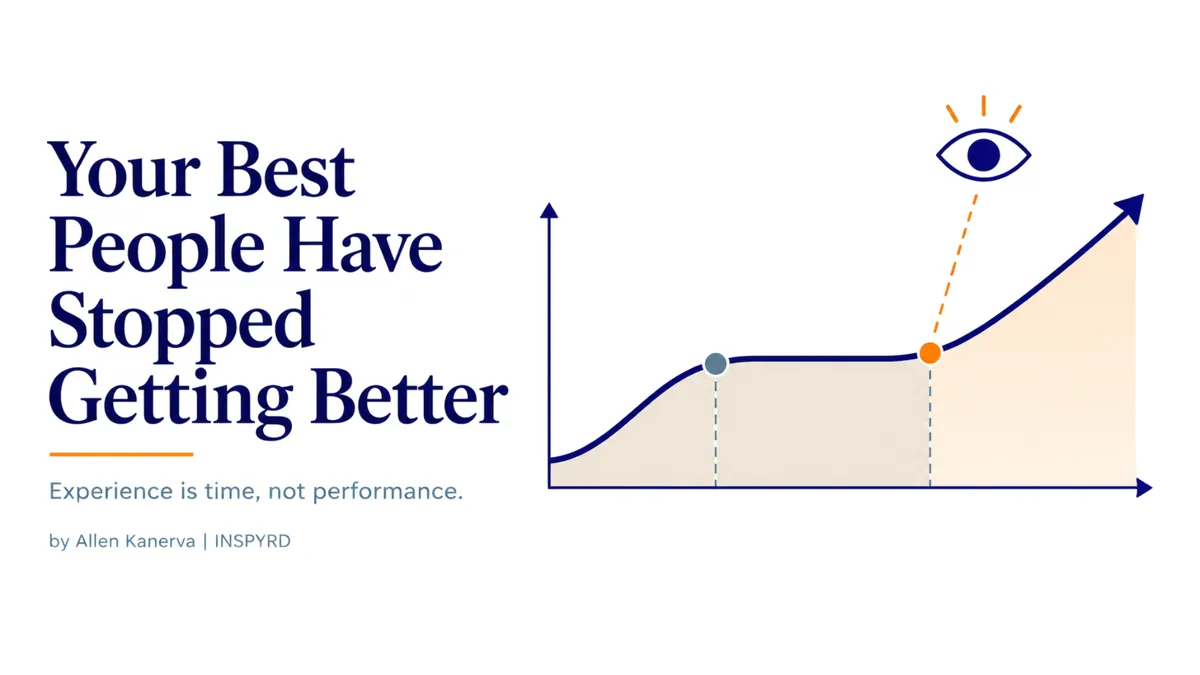
Look at the trend instead. For some of us the overall trend line is in decline. For some it stays the same. And for some it rises.
The ups and downs matter because good judgment usually comes from mistakes, and mistakes come from bad judgment. The person who gets stuck gets stuck emotionally in the bad decision and can't let it go.
Experience measures time, not performance
Plateaus are normal. But experience is a measurement of time, not of performance.
Gawande entered practice in 2003. His complication rates fell year on year, then levelled off after about five years. In his words, "I wasn't getting any better anymore." Then he asked: "Is this as good as I'm going to get?"
A 2005 systematic review in the Annals of Internal Medicine found that in many studies, doctors with more years in practice delivered lower-quality care, not higher. The family doctor treating my brother's trigeminal pain could not work it out. It was a young intern who diagnosed it correctly.
School or sport?
Gawande describes two views. In the school view, we train until we meet the criteria, graduate, and then manage our own improvement. In the sports view, athletes are always looking to improve, and every athlete has a coach.
My son Andrew played high-level field hockey in Vancouver, and his team used him as a defender. At a national team identification camp, the national coach, Robin, walked over and asked why he was playing defence. "This is where my coach assigns me," Andrew said. Robin told him, "You're not a defender. You are a forward." In November of grade 12 he made the national team, and that year he became its starting centre.
Why they can't see it themselves
People inside the work can't see their own work. That is not a flaw. It is a positional problem, and in NLP we teach three perceptual positions. Position one is looking through your own eyes. Position two is looking through the eyes of the other person. Position three is the neutral observer, the fly on the wall, and that is where the insights come.
A great coach works from position three. Gawande calls coaches "your external eyes and ears, providing a more accurate picture of your reality." He didn't like being observed.
In my military career we were constantly observing each other. If anyone in the crew performed below the standard, we debriefed, then scheduled a training flight to go and practise the skill.
A plateau is rarely a skill gap
Often a plateau is not a skill gap at all. People know exactly what to do, but they can't pull the trigger.
An opportunity takes them to the boundary of their confidence. There, affective memories emerge: memories with an unresolved negative emotional charge, still encoded, that stop the person moving forward. A cognitive conversation cannot resolve them.
So much of our coaching work resolves affective memories from early childhood. Once they are resolved, the brain, a prediction machine, predicts new possibilities and new behavioural flexibility. I can't remember a single client whose plateau came from a lack of ability or skill.
What this means for employers
Training adds knowledge. It does not move a person off a plateau.
That person may not feel comfortable telling a peer support group, "I'm not performing and I don't know why." They may avoid the EAP and psychotherapy, because the message underneath therapy is that something needs to be fixed. Perhaps that is why use of both is so low.
Coaching sits in between. When you say you have a coach, there is a presupposition in the statement: you are trying to improve. The best hitters in baseball go into slumps. Their batting coaches make adjustments, and they get back in the game.
Why have I stopped improving at work even though I'm experienced?
Experience is tenure. Improvement means new learning, applying it, and becoming a reflective practitioner. What holds us back is behaviour that comes from unresolved affective memories, and working with those memories is the solution.
Do high performers really need a coach?
Unequivocally yes. They know a coach's attention to detail is pivotal. Muhammad Ali dominated boxing, and he still had several coaches, most famously Angelo Dundee.
What's the difference between training and coaching for employees?
Training is about learning new skills. Coaching identifies what works, what doesn't, and what needs to be working, then builds a protocol to take the client from their present state to their desired state. The best evidence is behavioural: is the coached person behaving in a way that serves them and the company?
What this means for practitioners
If you want to become an extraordinary coach, understand the neuroscience of affective memories, including adverse childhood experiences, and learn how to help people resolve them.
Even coaches need coaches. We plateau too. In my trainings, an assistant will sometimes ask at the break, "I noticed you did this. When did you start, and what is it for?" Often I am totally unaware of it. I am intensely grateful for that observation.
Where this sits in the series
This episode opens a ten-part series on coaching as the missing middle between peer support and EAP or psychotherapy, and on what employers lose when unresolved affective memories hold their people in place. Next week: having a coach is not the same as needing a therapist.
Where to take this next
For organisations with 50 or more staff: download the INSPYRD white paper, The Hidden Cost of Unresolved Negative Emotions in the Global Workforce.
For individuals: if you recognised yourself in this, book a free coffee chat.
About the Author
Allen Kanerva is a trauma intervention trainer and the founder of INSPYRD. A former Royal Canadian Air Force tactical helicopter pilot, UN peacekeeping course director, and co-author of Canadian humanitarian security policy work, he developed Affective Memory Resolution (AMR) and Visual-Spatial Tasking (VST). It is a clinical protocol for nervous-system-level trauma resolution grounded in Hebbian learning and memory reconsolidation research. He trains practitioners internationally in NLP, trauma intervention, and mechanism-first change work.
ORCID ID: 0009-0009-1297-3778
References
Choudhry, N. K., Fletcher, R. H., & Soumerai, S. B. (2005). Systematic review: The relationship between clinical experience and quality of health care. Annals of Internal Medicine, 142(4), 260–273.
Gawande, A. (2017). Want to get great at something? Get a coach [Video]. TED. https://www.ted.com/talks/atul_gawande_want_to_get_great_at_something_get_a_coach
