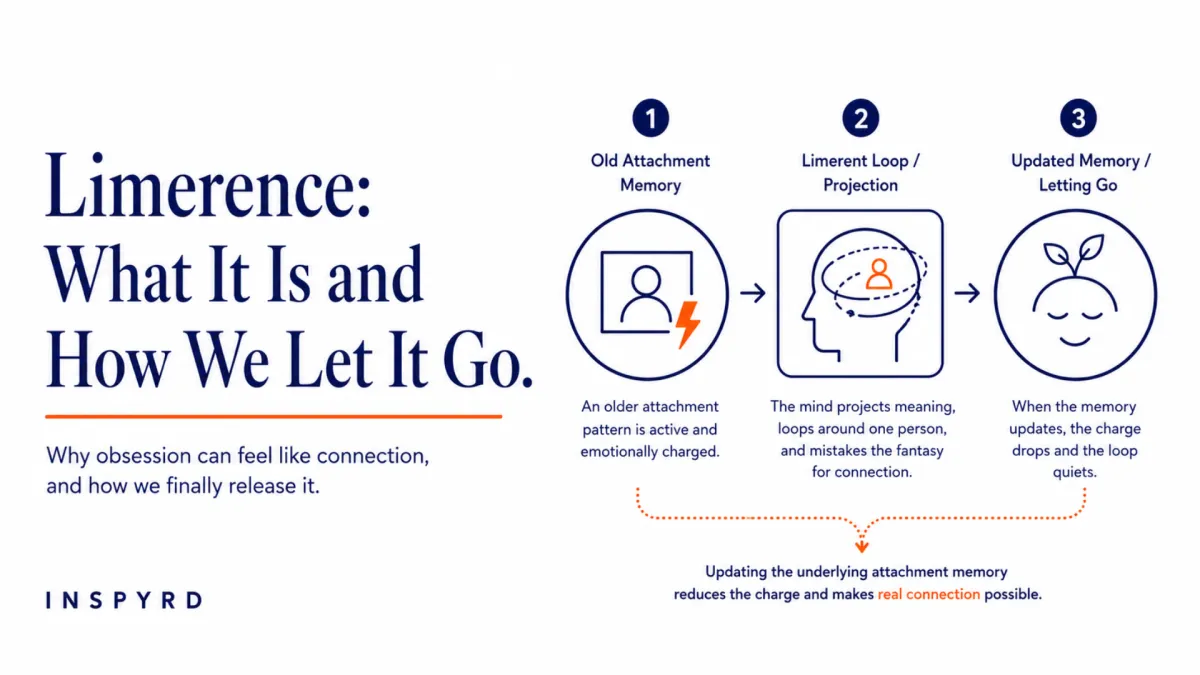
Limerence: What It Is and How We Let It Go
You know the feeling. The phone is face down on the table and you cannot stop turning it back over. There is a warmth in the chest and a pull low in the stomach, a faint electrical hum that runs underneath the whole day, and every bit of it is pointed at one person who is not in the room. You replay the last thing they said. You rehearse the next thing you will say. Whole hours disappear into a film that only ever plays inside your own head, and the person starring in it has no idea they were cast.
Here is what almost nobody tells you. The person you cannot stop thinking about is rarely the real source of the feeling. Most of the charge is older than they are. It was pointed at someone else long before it found them.
There is a name for this, and most people have never heard it. Two of the most widely watched explainer videos on the subject have reached millions between them, one framing the feeling through the body, the other tracing it back to childhood, because the moment you have the word, you cannot unsee the pattern in your own history. The word is limerence. This piece is about what it actually is, why the usual advice to notice it and talk yourself down works for an afternoon and then quietly stops, and what it takes to let it go at the layer where it is actually stored. Not managed. Let go.
What limerence actually is
The term belongs to Dorothy Tennov, a psychologist who spent the 1970s interviewing hundreds of people about being in love and found the textbooks had no word for the state they kept describing. In her 1979 book Love and Limerence she named it and listed its parts: "intrusive thinking about the object of your passionate desire," an "acute longing for reciprocation," and a dependency of mood on that person's actions. She called the person the limerent object, because the state has less to do with them than with the position they occupy in your mind.
Read that once and you will think it is just a crush, and you are half right. The overlap is nearly total. The difference is the obsessive gravity of it, and one thing more. Limerence is when you are more attached to the idea of a person you carry in your head than to
the actual person in front of you. It is the choice, usually not a conscious one, to protect the fantasy version over the real relationship. It is getting quietly irritated at the real person for failing to say the line the imagined one would have said.
Here is the part that stops people cold. If you did not get enough secure attachment early, it is entirely possible that most of the romantic feeling you have had in your life was limerence, and that genuine connection has only ever arrived in flashes. Not because something is wrong with you. Because the counterfeit is easier to run, and nobody ever showed you the difference.
It is not attraction, and it is not connection
The first thing limerence disguises itself as is desire. You think, I am simply attracted to this person, I cannot get them out of my mind. It feels like the most physical thing in the world. It is almost entirely mental.
The clearest way to see it is in the body. Real sexual attraction is imminent and grounded. It needs a nervous system calm enough to feel it, because arousal is a low-priority system that only comes online once the body decides it is safe. Limerence is the opposite state. It is heady, racing, and anxious. It is the energy that makes you want to send twenty-five texts in a row. That is not desire. That is a threat system in fight-or-flight, wearing desire as a costume. One widely shared account describes it exactly: sleeping with someone more than once and getting anxious for the sex to be over, so as to get back to the part of the mind that was imagining them wanting her. The fantasy was the main event. The real person was fodder for it.
The neuroscience is not soft. Helen Fisher put people who had just fallen in love into a brain scanner and found the activity not in some tender emotional center but in the ventral tegmental area, the dopamine-driven reward circuit that also drives craving for cocaine and nicotine. Romantic obsession, in her words, is "one of the most powerful brain systems we humans have evolved," and it runs on the machinery of wanting, not the machinery of bonding. Wanting is not loving. Limerence is wanting that has slipped its leash.
The fantasy is doing a job
Limerence feels like it falls out of the sky, like the glow around the person is a fact about them. It is not. It is manufactured, and it is manufactured for a reason. There is always a function.
Consider one account of catching it in the act. A woman notices mild limerence for someone she barely knows, and pays attention to how she is picturing him. Not at eye level, the way they had actually spoken, but literally up and to the right, above her. When she sits with that image, she finds the feeling it produces: protected, able to relax, able to trust that someone wiser has the lead for a while. Then she runs the experiment.
She moves the internal image down, into the place where she pictures people she feels responsible for, and the feeling changes on the spot to tension and low anxiety. The limerence had been protecting her from a specific truth, that no one is actually going to take the lead for her, and that the responsibility is hers.
Hold onto that moment, because it is the hinge of this whole article. She changed where the picture lived in her mind, and the feeling in her body changed to match. She did it by accident, with her own intuition, and she is describing, without the vocabulary for it, the exact leverage point the effective trauma treatments use on purpose.
Where the charge actually comes from
Now go back further than the person, further than the fantasy, to where the charge was first laid down. Think about the first adult outside your home who made you feel like the center of someone's attention. A teacher who lit up when you walked into the room. A friend's mother whose kitchen felt safer than your own. A babysitter who actually listened. For a child who did not get enough of that at home, one of those small moments, twenty minutes of being truly seen, can become a landmark that never fades. You can be decades older and still feel the exact warmth of leaning into that person on that afternoon.
Here is the pattern underneath it. A child who is not the center of anyone's world in a good-enough way will go looking for a home in other people. That search does not switch off in adulthood. It only changes targets. Limerence is that childhood search running on a grown body. The limerent object is a stand-in for a bond that was supposed to form early and did not. On the most useful estimates, eighty to ninety percent of the charge is old, and maybe ten percent is the actual person in front of you. Which quietly rewrites the sentence you have been telling yourself. Not "this person completes me," but "I have an old attachment reaching for completion, and I happen to like the way this person carries themselves."
This is where the shame can come off, and it should. The pull is not proof that you are obsessed. An old attachment system is searching. It is not proof that you are needy. A part of you is still reaching for a bond it never got and had every right to. It is not proof that you are broken. You adapted, the way any child adapts to a home without enough safety in it. Every one of those reframes points at the same thing, and it is the thing that matters most about this whole topic: what is driving limerence is not a character flaw. It is a memory. And a memory is the one thing here that can actually be changed.
Where the usual tools stop
The mainstream toolkit for limerence is genuinely useful, and it deserves an honest hearing. There is the attachment work: understand your style, see the pattern, know your triggers. There is the somatic work: drop into the body, notice what is actually there
rather than the story about it. There is the communication work, appreciating a person only for what observably happened. And there is the inner-child work, the journaling prompts that ask what your younger self actually needed and how the adult you might provide it. All of it helps.
All of it is also coping. It is insight and it is rehearsal, and it operates on the surface of the problem. The tell is in the honesty of the people who teach it. One admits plainly, "I still actively fight with myself all the time. I love my fantasy connections." Another describes years of asking one person after another to fill the role his parents never did, and watching it fail every time. That fight does not end, because the memory generating the fantasy is never actually updated. You get better at catching it. You do not stop producing it. Insight arrives at the wrong layer, because the thing driving limerence was never a thought you can argue with. It was encoded below language, and you cannot reason your way out of an encoding.
The layer limerence is actually stored on
So what is that encoding, exactly. It is an affective memory, a childhood attachment template, and the brain uses it to build the present before the present even arrives. This is Lisa Feldman Barrett's work on constructed emotion. The brain does not passively receive the person in front of it. It constructs your experience of them out of material it already holds. The glow is not coming off the limerent object. It is being projected onto them from your own stored template of what a certain kind of person will finally make you feel. Safe. Chosen. Worth staying for.
That template was written the way all deep learning is written. Donald Hebb described the rule in 1949: when one neuron repeatedly takes part in firing another, "some growth process or metabolic change takes place" that strengthens the link. A childhood spent reaching for a bond that never quite arrived builds a circuit that lights up hard at the fantasy of finally getting it. The circuit fires, dopamine follows, and the story writes itself onto whoever is standing nearby. You are not falling for the person. You are falling for a prediction your own nervous system generated and then handed to them to hold.
And here is the opening. A memory is not a fixed recording. When an emotional memory is reactivated, it becomes briefly unstable and editable before it re-stores itself. Karim Nader and Joseph LeDoux showed this at the cellular level in 2000, in a paper whose title is the finding: "fear memories require protein synthesis in the amygdala for reconsolidation after retrieval." Retrieve the template and, for a short window, it must be written back to disk. Whatever is true during that window is what gets saved.
How we actually let it go
Now put the two pieces together. Move an internal image and feel the charge shift. That is a reconsolidation window, opened by accident and used by instinct. The encoded
picture is reactivated, its visual-spatial properties are altered, and the affective charge moves with it. It is a crude, intuitive version of the mechanism that sits underneath every high-efficacy trauma treatment.
That mechanism has a name and a research base. In 1997 Jackie Andrade, David Kavanagh and Alan Baddeley found that distressing mental images became weaker when the person performed a competing visual-spatial task, reporting that "images were less vivid with concurrent eye-movements and with a concurrent spatial tapping task that did not involve eye-movements." The image and the competing task cannot both fully occupy working memory at once. Load the workspace while the memory is live, and the memory dims and becomes editable at the same time. This is visual-spatial tasking, and it is the core of the work I train, Affective Memory Resolution.
Applied to limerence, the move is not to catch the fantasy for the ten-thousandth time and wrestle it down. It is to bring the old attachment memory into active recall, hold it in the reconsolidation window, and update the encoding itself using rigorous visual-spatial tasking, so the version that re-stores no longer carries the charge. You are not managing the pull. You are changing the memory that produced it. When that template stops firing on cue, the childhood search quietly stands down, and for many people it is the first time real connection is even possible, because the workspace it needs is finally empty.
FAQ
Why do I keep falling into obsession with people who are not even available?
Because the obsession is not really about them. It is an old childhood attachment memory reaching for a bond it never got, and unavailable people are the perfect screen to project it onto, because they never break the fantasy by becoming fully real. It stops for good not by force of will but by updating that affective memory at the encoding layer during a reconsolidation window, which is what Affective Memory Resolution does with visual-spatial tasking.
Is limerence a trauma response?
Very often, yes. For people who did not get enough secure attachment early, limerence is that unmet childhood need running on an adult, with most of the charge coming from the past rather than the present person. Because it is an encoded affective memory rather than a present-day fact, it responds to memory-level work, updating the encoding while it is reactivated and briefly editable, rather than to insight alone.
How do I get over limerence for good instead of just catching it?
Catching it is a coping skill, and coping skills have to be run forever because the memory underneath is untouched. Getting over it for good means reactivating that
memory and updating it while it is briefly editable, using visual-spatial tasking to drain its charge so it re-stores as neutral. That is a physical change in the encoding, not a change in the story you tell yourself, which is why it holds.
What this means for practitioners
If you work with clients on attachment, notice how much of the standard protocol is insight and rehearsal, and how reliably clients report that they can see the pattern clearly and still feel it just as strongly the next morning. That gap is the encoding layer announcing itself. The limerent template is an affective attachment memory, and it responds to the same mechanism that resolves trauma. Reactivate it, load working memory with a demanding visual-spatial task during the labile window, and update it at the source. Attachment insight tells the client what the pattern is. Visual-spatial tasking is what changes it. Treat the insight as the map and the mechanism as the intervention.
Where this sits in the series
Earlier episodes drew the line between managing a charge and resolving it. The Common Thread named the shared engine underneath the treatments that actually work, visual-spatial tasking during a reconsolidation window. This episode points that engine at something most people would never file under trauma. Limerence is an encoded childhood attachment memory, built by the same rule and updatable by the same mechanism. The glow, the obsession, the fantasy that keeps you lonely, all of it sits on a layer that can be rewritten.
Where to take this next
If you recognized yourself in this, the important thing to know is that the pull is not your character and it is not your fate. It is a memory, and memories can be updated. Resolution is a matter of a short series of sessions, not a lifelong fight with yourself. If you are a practitioner who wants to work at the layer where limerence and attachment patterns are actually stored, rather than talking around them, the INSPYRD training in NLP and Affective Memory Resolution is where that skill is built. Come find the work at INSPYRD.
About the Author
Allen Kanerva is a trauma intervention trainer and the founder of INSPYRD. A former Royal Canadian Air Force tactical helicopter pilot, UN peacekeeping course director, and co-author of Canadian humanitarian security policy work, he developed Affective Memory Resolution (AMR) and Visual-Spatial Tasking (VST), a clinical protocol for nervous-system-level trauma resolution grounded in Hebbian learning and memory reconsolidation research. He trains practitioners internationally in NLP, trauma intervention, and mechanism-first change work.
ORCID ID: 0009-0009-1297-3778
References
Tennov, D. (1979). Love and limerence: The experience of being in love. Stein and Day.
Bowlby, J. (1988). A secure base: Parent-child attachment and healthy human development. Basic Books.
Fisher, H. E. (2004). Why we love: The nature and chemistry of romantic love. Henry Holt.
Barrett, L. F. (2017). How emotions are made: The secret life of the brain. Houghton Mifflin Harcourt.
Nader, K., Schafe, G. E., & LeDoux, J. E. (2000). Fear memories require protein synthesis in the amygdala for reconsolidation after retrieval. Nature, 406(6797), 722-726.
Hebb, D. O. (1949). The organization of behavior: A neuropsychological theory. Wiley.
Andrade, J., Kavanagh, D., & Baddeley, A. (1997). Eye-movements and visual imagery: A working memory approach to the treatment of post-traumatic stress disorder. British Journal of Clinical Psychology, 36(2), 209-223.
