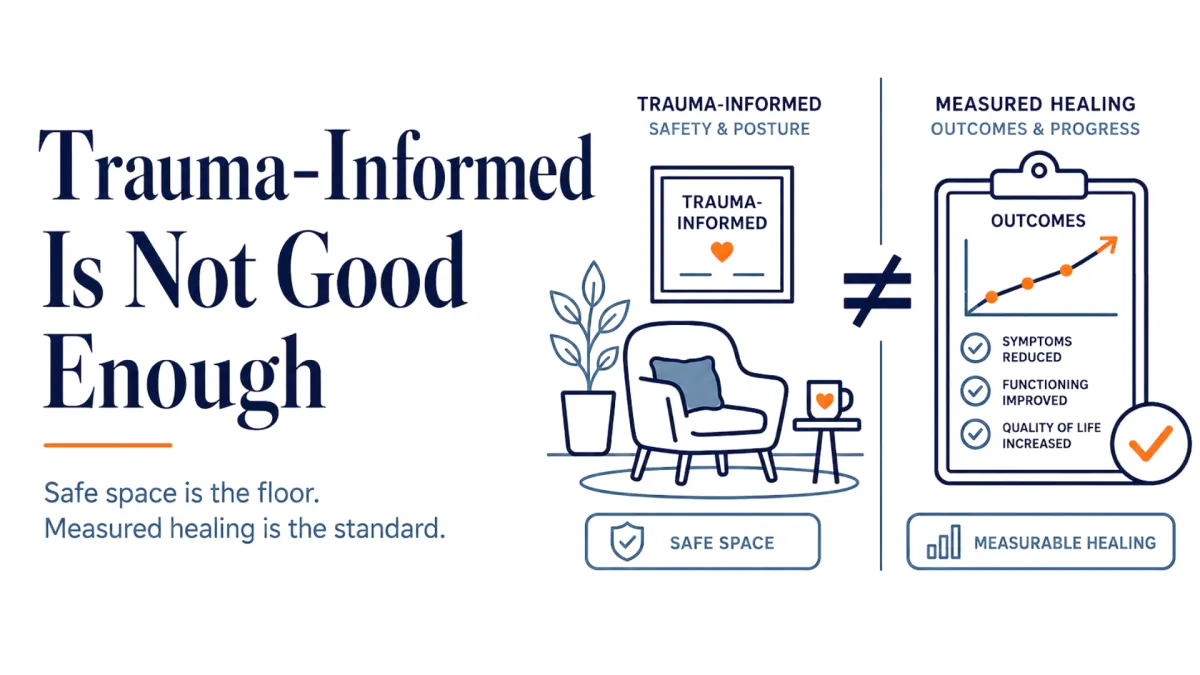
Trauma-Informed Is Not Good Enough
"Good." Then "not good." Then "not good enough." That was Martin Seligman, a past president of the American Psychological Association, on the state of his own field.
Notice what your body does in a good therapy room. Your shoulders come down from around your ears. Your breath drops out of your chest and into your belly. The chair takes your weight, and for the first time in a long while, you are not braced for the next impact.
The clinician's voice is even and unhurried. You hear the phrase you were hoping to hear, the one that is meant to settle you: this is a safe space, and I am trauma-informed.
Then you see it. A certificate on the wall, a badge on the website, in the same confident font as the diploma beside it. Trauma-Informed. It looks like a qualification. It reads like a promise.
Here is the question almost no one asks in that room.
When you walk back out onto the street, will the trauma be any smaller than it was when you walked in? Feeling safe is not the same as being changed. This piece is about the distance between comfort and cure, and about why that distance is almost never measured. Consider it the second half of a conversation I started in the last article, where I argued that being trauma-informed is not a unique ability. Here I want to show you what sits in the gap the label leaves behind.
Seligman told that story to open one of his best-known talks. A CNN producer asked him to describe the state of psychology in a single word, and he said good. In two words, not good. In three, not good enough. Then, before he explained the not good enough, he did something honest. He gave the field its due. Working on the disease model, psychology had made real advances, learning to name, classify, and treat disorders that once went unnamed and untreated. The trauma-informed movement belongs to that lineage. It made rooms safer and clinicians gentler. What it has not done, what the disease model still struggles to do, is demonstrate that the person actually left healed. That unproven result is the not good enough. That is the gap this article is about.
What trauma-informed actually names
Strip the term down and trauma-informed describes a posture, not a result. It means the clinician holds a safe space, builds rapport, reads the person in front of them with
sensory acuity, and knows how to bring an activated nervous system back down out of fight or flight and into the parasympathetic state where a person can think and feel at the same time. Those are real skills, and they matter. A frightened nervous system cannot do deeper work, so this is the ground everything else stands on.
But look at that list again. Holding safe space, rapport, sensory acuity, and nervous-system regulation are not the specialty of a subset of trauma clinicians. They are the floor. They are what anyone who publicly holds themselves out as a trauma clinician should already be doing on the first day, with the first client, before they ever take a fee.
Try the same move in any other profession and hear how strange it sounds. You walk into a dojo and the sensei introduces himself as self-defense informed. You go looking for a dentist and her opening line is that she is oral health informed. You would blink. Of course he is. Of course she is. That is the profession, not a distinction within it. Announcing the baseline as a credential does not raise the clinician above the field. It quietly lowers what we expect the field to deliver.
This is where the label starts to do harm. A person searching for help does not read trauma-informed as table stakes. They read it as an edge. They assume the badge means this clinician is better at the thing they actually came for, which is getting the trauma to stop running their life. The word informed gets silently upgraded, in the reader's mind, into the word effective. Nothing in the literature earns that upgrade.
The line between informed and healed
So let me draw the line clearly. Trauma-informed answers one question: how will this room feel? Will I be safe, respected, met with care, protected from being re-traumatized while I am here? Trauma healing answers a completely different question: will I leave different? Will the memory that hijacks my body lose its charge? Will the symptom that has organized my life for years actually be gone, and stay gone?
Those are not two points on the same scale. They are two different scales. You can score a perfect ten on the first and a zero on the second. You can feel safe, seen, and soothed for two years of weekly sessions and still carry the identical trauma out the door at the end. Comfort is not the deliverable. Resolution is. The trouble with the current model is that it has become very good at the first scale and stopped measuring the second one at all.
What the evidence says, and what it does not
I went looking for the study that would prove me wrong. I wanted the paper showing that trauma-informed clinicians produce better outcomes than clinicians who simply do competent, regulated, respectful work without the label. It does not appear to exist. In 2025 the Agency for Healthcare Research and Quality published a systematic review of trauma-informed care and concluded that the evidence was insufficient to determine its effect on any patient outcome. Not a weak effect. Insufficient evidence to say there is any effect at all. A 2025 editorial in American Family Physician and a systematic review of reviews in The Permanente Journal arrived at the same uncomfortable place.
Read that carefully, because it is the whole argument in one sentence. The most widely promoted credential in the trauma field has no published evidence that it improves the one thing patients are paying for. It is a description of good conduct in the room. It is not a predictor of results. If you have a study that shows otherwise, I will read it tonight and correct this in public. Until then, the honest position is that trauma-informed is a posture that has been quietly oversold as a competency.
What the listings actually say
To see how this plays out in the open, I read the way trauma clinicians describe themselves to the public. I read about ninety trauma therapist listings on Psychology Today across three cities, from my own Guelph to Toronto and Vancouver. One in five advertised being trauma-informed. Not one advertised a measurable result. Zero.
Sit with that. Add the near cousins, trauma-focused and trauma-sensitive, and the posture cluster reaches about a quarter of the sample. Only about twelve percent made any outcome claim at all, and those were soft: lasting change, going beyond symptom management, helping people overcome. But a measurable result, a success rate, a symptom-reduction figure, a count of clients who fell below a diagnostic threshold, appeared exactly nowhere. In a field that calls its methods evidence-based, the evidence is absent from the storefront.
Two clinicians went further and advertised against the outcome, describing themselves as a gentle counterpoint to a culture that expects trauma to be resolved. That is an honest posture, and I respect the candor. But notice what it means that a clinician can market not resolving your trauma as a feature, while no one in the sample markets against being trauma-informed. The badge is safe to wear. The result is the thing everyone has quietly agreed to stop promising.
One pattern gives the game away. The busier and more competitive the market, the more the label appeared. Vancouver used trauma-informed at more than double the rate of my smaller home market. When a term shows up most where clinicians are fighting hardest to stand out, it is functioning as a differentiator, a badge that signals belonging, rather than as a description of what happens to the patient. That is marketing behavior, not clinical evidence.
The platform itself makes the contradiction impossible to miss. Psychology Today's own editorial guidance, printed on every one of those directory pages, tells prospective clients to seek out a trauma-informed provider. A few paragraphs later, the same guidance states plainly that PTSD cannot be cured, and recommends ongoing maintenance sessions to keep symptoms manageable. So the largest therapist directory in the world sells the trauma-informed label at the top of the funnel while telling clients, in its own copy, that resolution is not on the table. Read those two passages back to back and the whole model is laid bare in a single page.
The part I will call criminal
There is a deeper reason no one can tell you whether trauma-informed clinicians heal more. Almost no one in psychotherapy measures healing in the first place. Reviews of measurement-based care, the simple practice of giving a validated instrument at the
start of treatment and again later to see whether anything moved, report that fewer than one in five clinicians use it. By discipline it is worse: roughly eighteen percent of psychiatrists, eleven percent of psychologists, and fourteen percent of masters-level clinicians. As few as five percent use it at every session, the way it is meant to be used. Most trauma work is guided by a conversational interview and a clinical hunch, and nothing else.
Set that beside what we do for the rest of the body. If you break your arm, no one asks the arm how it feels about its progress. They X-ray it. They see the exact break, they choose the intervention that fits that break, they set it, and when they believe it has healed they X-ray it again to confirm. Only then do you go into rehabilitation, and rehabilitation has its own measures. Assessment, matched intervention, confirmation, follow-up. That is the ordinary standard of care for a bone.
Now hold trauma to that same standard and watch it fail. A clinician who advertises being trauma-informed and doing evidence-based interventions will, in the ordinary case, run no formal pre-intervention psychometric assessment, gather no post-intervention evidence, and produce no data at the end. Some work with the same client for years with no objective marker that anything has improved, and no one asks them to show their work. We would never accept a broken arm treated for a decade by feel, with no first X-ray and no last one. In any other branch of medicine the failure to assess before and confirm after would be indefensible. I do not think that word is too strong for trauma either.
A critique of the field, not of the people in it
I want to be careful here, because most trauma clinicians are conscientious, warm, and genuinely devoted to the people they serve. The problem is structural, and it sits above any individual. This is why Seligman's verdict matters. When a past president of the American Psychological Association takes stock of his own discipline and concludes it is not good enough, he is not insulting the clinicians in it. He is describing a system that has learned to describe care instead of measuring it.
The trauma-informed badge is a symptom of exactly that system. It rewards posture over proof. It lets a field that cannot show its outcomes feel credentialed anyway. And it quietly moves the goalposts, so that making the room feel safe becomes the whole job, and whether the person is actually free of the thing that broke them becomes an unasked, unmeasured question.
What healing looks like when you are willing to measure it
There is another way to work, and it starts by refusing to move the goalposts. At INSPYRD the trauma-informed skills are assumed, not advertised. Of course the room is safe. Of course the nervous system comes back into the parasympathetic before we go near a memory. That is the floor. The work happens above it, at the encoding layer, where the memory is actually stored. Affective Memory Resolution and Visual-Spatial Tasking are built on memory reconsolidation and Hebbian learning, and they aim at resolution rather than management: getting the charge out of the memory so the symptom does not come back.
And because the claim is a result, it gets measured like a result. We assess before, we gather several kinds of evidence after, and we report the numbers. In an independently assessed pilot with survivors of human trafficking, run with the charity Rising Angels, participants averaged an 86.6 percent reduction in PTSD symptom severity, and ten of the eleven fell below the diagnostic threshold. Clinicians trained in the protocol across Canada and the United States report success rates above ninety percent. Those numbers are open to scrutiny precisely because they exist. That is the whole difference. You can argue with a number. You cannot argue with a posture, because a posture never made a claim you could test.
Is a trauma-informed therapist better at healing trauma?
There is currently no published evidence that a trauma-informed clinician produces better healing outcomes than a competent clinician without the label. Trauma-informed describes how safe and respectful the room will feel, which is important but is the baseline for any trauma work. Healing happens at the encoding layer where the memory is stored, and whether a given approach reaches that layer is a separate question the label does not answer.
Why do I feel safe in therapy but never actually get better?
Because safety and change are two different outcomes, and most therapy measures neither. Feeling calm and understood keeps your nervous system regulated, which is necessary but not sufficient. If no one is resolving the memory at the level it is stored, and no one is measuring whether your symptoms have actually dropped, you can feel supported for years while the underlying trauma stays intact.
Should a trauma therapist measure my symptoms before and after treatment?
Yes, and you are entitled to ask for it. A validated psychometric assessment at the start and again later is how you and the clinician can both see whether anything moved, the same way an X-ray confirms a bone has healed. Fewer than one in five clinicians currently do this, so asking the question is a fair way to tell a results-oriented practice from a posture-oriented one.
What this means for practitioners
If you work with trauma, stop selling the floor as the ceiling. Assume the trauma-informed skills and compete on the thing that actually helps the person: the result. Give a validated instrument before you begin and again when you believe the work is done. Keep the data. Let it embarrass you when it should, and let it vindicate you when it does. The clinicians who start measuring now will be the credible ones in five years, when the field is finally forced to show its outcomes. The badge on the wall will not save the practice that cannot produce a single number.
Where this sits in the series
This is the companion to the previous article, which asked why trauma-informed is treated as a unique ability when it is really the entry requirement. That piece named the problem. This one measures it, and points to the missing standard of care hiding underneath the language. Together they make one argument: the trauma field has confused a good bedside manner with a cure, and the fix is not a better label. It is a number.
Where to take this next
If you are carrying something that talk and time have not touched, you do not need another safe room. You need the memory to lose its grip, and you deserve to see that change measured, not just felt. Reach out to us.
If you are a practitioner who is tired of working in the dark, the same invitation stands. Reach out through INSPYRD, and let us show you what happens when the work aims at resolution and is willing to be counted.
About the Author
Allen Kanerva is a trauma intervention trainer and the founder of INSPYRD. A former Royal Canadian Air Force tactical helicopter pilot, UN peacekeeping course director, and co-author of Canadian humanitarian security policy work, he developed Affective Memory Resolution (AMR) and Visual-Spatial Tasking (VST), a clinical protocol for nervous-system-level trauma resolution grounded in Hebbian learning and memory reconsolidation research. He trains practitioners internationally in NLP, trauma intervention, and mechanism-first change work.
ORCID ID: 0009-0009-1297-3778
References
Agency for Healthcare Research and Quality. (2025). Trauma-informed care: A systematic review. https://www.ncbi.nlm.nih.gov/books/NBK614499/
American Family Physician. (2025). Trauma-informed care: Evidence and pragmatic approaches [Editorial]. https://www.aafp.org/pubs/afp/issues/2025/1100/editorials-trauma-informed-care.html
American Psychological Association. (2025, January). Measurement-based care: A transformative approach to treatment. Monitor on Psychology. https://www.apa.org/monitor/2025/01/measurement-based-care-transforms-treatment
Lewis, C. C., et al. (2019). Implementing measurement-based care in behavioral health: A review. JAMA Psychiatry, 76(3), 324-335.
Seligman, M. E. P. (2004). The new era of positive psychology [Address]. American Psychological Association / TED.
The Permanente Journal. (2024). Effectiveness of trauma-informed care implementation in health care settings: Systematic review of reviews and realist synthesis. https://www.thepermanentejournal.org/doi/10.7812/TPP/23.127
