The Power of Process: A Gold Seal Approach
The definition of treatment is a therapeutic agent, a therapy or procedure used to treat a medical condition. Post-traumatic stress is defined as a medical condition. It appears in the DSM-5. It's a label. I don't like labels. I've always believed the label is more beneficial to the person who gives it, the labeler, than to the person who receives it. And I often hear people who come to work with me start identifying with the label. "I am traumatized."
So I'd like to talk about what a gold standard, high-efficacy treatment might look like, what it might sound like, what it might feel like to administer.
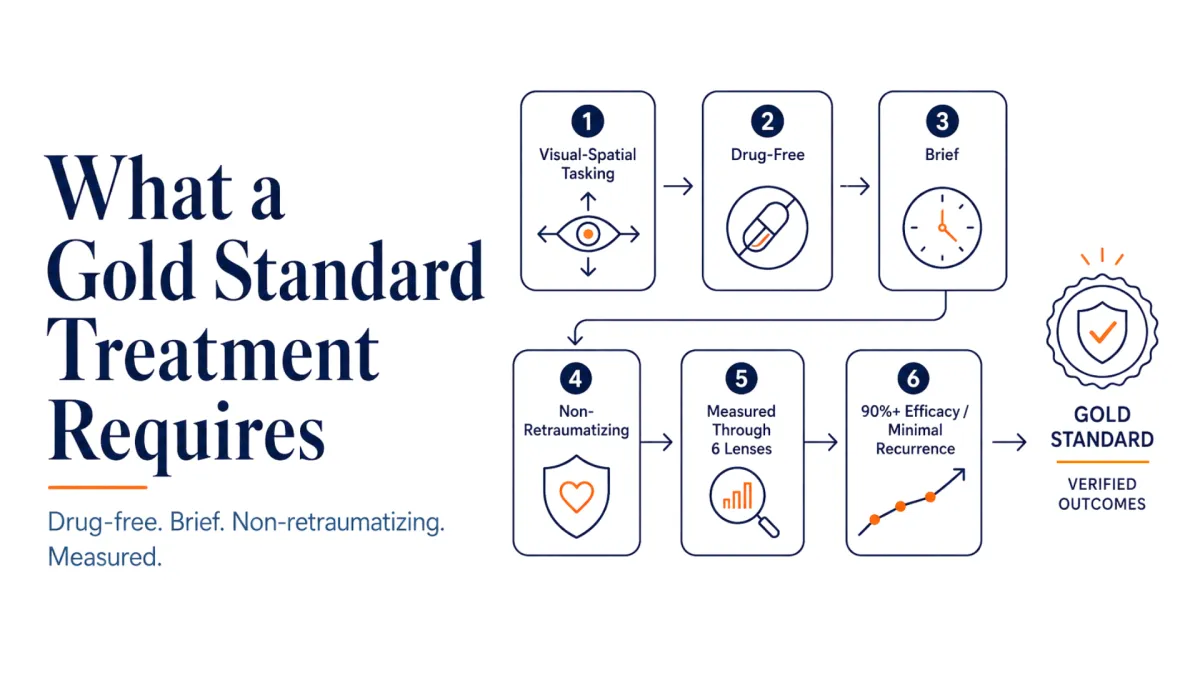
What a gold standard treatment actually requires
A gold standard should be based on the neuroscience of visual-spatial tasking. I'll describe that in a moment, in depth.
It should also be drug-free. I worked for victim services for about a two-year period, and I would see people who'd been traumatized on the weekend, say Saturday or Sunday, and I wouldn't see them until Tuesday or Wednesday. They hadn't slept for two or three nights. We'd do the trauma intervention, and they'd sleep that night. So they don't need sleeping drugs. It can be drug-free.
The intervention should be brief and non-retraumatizing. You're all NLP people. You know how brief NLP interventions can be, and you know you can do them in a non-retraumatizing way. You know that with your skill set you can keep people safe. We're taught that at the very fundamental level of NLP.
Now, I've introduced something into my practice that I teach, and I call it evidence proven, and we prove our evidence with every client. It's not evidence-based. That's not what we say. We say evidence proven. It is evidence-based in the research too, but I resist "evidence-based," because some clinicians use that term when the evidence is ten, twenty, thirty years old. Cognitive behavioral therapy for trauma, when you run the research review, shows less than 50% efficacy with 80% recurrence. So yes, they have success. It's evidence-based. But the evidence is poor.
If you ask me about the different modalities, I can tell you the evidence-based efficacy rates. Prolonged exposure runs around 50%, with high recurrence. EMDR is around 65%. There's a cluster of modalities around that 60% range, and many of those have high recurrence too. Then there's a group of interventions running over 90% efficacy with almost no recurrence. High efficacy and minimal to no recurrence have to be part of a gold standard.
Where the protocol came from
In my pursuit of NLP, I first studied it in 1990 in Vancouver, with Marilyn Atkinson at the Erickson Institute. I didn't have the moral courage then to help people who'd been traumatized. In the 1990s I was going through my own trauma. I would have five or six or seven screaming nightmares a week. I was 190 pounds; my first wife was 130. I'd wake up in the middle of one of these holographic dreams and have to get into action. I'd grab her by the wrist and run. Can you imagine waking up at two or three in the morning, being dragged out of bed and down the hall by this maniac who's traumatized? I've been there, done that.
In this pursuit, when I decided in 2015 to redo all my certifications, I went back to Tad James's group. I did my Practitioner. I did my Master Practitioner here in Canada, with one of Tad James's master trainers. I did hypnosis training here in Canada too. I did my trainer's training with Tad's group. In that whole period I read voraciously about trauma interventions for eighteen months. Everything came back to NLP.
In that journey I read a book by Phil Zimbardo, the former head of the American Psychological Association and head of psychology at Stanford University. It's called The Time Cure, and it still sits on the bookshelf behind me. He has a survey that measures how we access events of our past: past positive, past negative, how much fatalistic thought we have, meaning how much control we believe we have. He measures hedonism, which isn't a place in Jamaica, it's how much pleasure we're having in the moment. And our future orientation.
When I saw those five areas, and I was studying with Tad, I took Tad's Breakthrough model and overlaid it on Phil Zimbardo's. What popped off the page was a protocol with a beginning, a middle and an end, and the opportunity to bring evidence-based thinking into an evidence-proven protocol. So I called it PACE. It stands for Protocol for Achieving Coaching Excellence.
My wife is also an NLP master practitioner, and she and I have used that protocol for twelve years. I don't know how many clients that would be; they're in the thousands. We've also taught that protocol to 300 clinicians, who've used it tens of thousands of times.
Six lenses of evidence
The evidence I gather when I do this starts with a Trauma Impact Profile. It's based on the Veterans Administration's trauma assessment. That's number one, because I do trauma. But if you're working with depression or anxiety or motivation or anything else, you could build your own scale here.
The second piece of evidence I gather is a Time Balance Profile. This is based on Zimbardo's work.
The third is an Adversity and Resilience Profile, a survey based on adverse childhood experiences. Those of you who use the ACE know it started as a ten-item questionnaire and then went to a twenty-two-item questionnaire, and it was a moment-in-time question: did you experience this, yes or no. It was binary, and it gave you a score. We've evolved that. We measure it at the beginning: did this happen to you, yes or no, and then how is that impacting your life today, on a scale of zero to ten. That's subjective, but it gives us a measurement. Then at the end of our work we ask the same question again: as you think about that event now, how is it impacting you? We get a delta between those two scores.
We also use Marshall Goldsmith's personal assessment tool. It's called an activity card. If you don't know Marshall Goldsmith, I highly recommend you read his book Triggers.
We do behavioral evidence, which is a core piece of Tad's Breakthrough and timeline work. And then we do anecdotal evidence, every session we run with a client.
Every one of my clients is assessed through six lenses, and we gather that evidence with every client. What does that do for us? When I meet with a client and say, "I have a 92% success rate," and they say, "Really?", I say, "Yes, here's the evidence." Later I'll share evidence at this level from a pilot study I ran with women who had exited human trafficking.
The shape of the work: chaos theory and ultradian cycles
The PACE protocol has a structure. Why do we have a structure? My experience coaching was that the body of NLP is so big, with so many moving parts.
Some people like strategies. If you're a Bandler fan, you like certain modalities. If you're a Tad fan, you like timeline work. If you're an Ericksonian, you like hypnosis. We have so many amazing tools, and our clients present themselves so complex, that matching our tools to the complexity of the client can be challenging.
So I thought to myself, when I saw this overlay, what would I do in step one? Step one, I want to do a rigorous assessment of where the client is today. And I mean rigorous. And then I want to bypass the reticular activating system and get deep inside the unconscious mind to look for the root problems, because clients are going to have a presenting problem, but we want to get to the root problem.
There's science in the structure. The first piece of science is chaos theory. If you look at our protocol from a distance, it has a shape, a form. We meet the client where we meet them, and in the first two sessions we go deeper into the darkness. In the fourth session we bring them out to positive states. In the fifth session we go further, we anchor and lock in their new values, beliefs, boundaries and behaviors. In the sixth session we acknowledge that, we prove it with the evidence. So we meet them where they are, we go into the deep, dark places to heal, and then we come out and re-establish positivity and a direction for their life. That's the overall protocol.
Every session runs the same way. Chaos theory says what you see from a hundred miles, you see from ten miles, you see from ten thousand feet. Zoom in on an individual session and we meet the client where they come in, we go in and do some work in the
deep, dark recesses of the unconscious mind, and at the end of the session we bring them up to an elevated state with new behaviors, boundaries and beliefs, and then set them free. Same structure. Zoom in even closer, and every technique within every session within the overall protocol has the same shape and form. We meet the client where we meet them, we go in, we do the work, we bring them out to a higher state, and then we move on. That's the chaos of it, the structure of chaos.
And then we use ultradian cycles intensely. Every session is two hours long, because I want to capture a complete ultradian cycle. I learned this from Milton Erickson, who ran ninety-minute sessions for the same reason, and who used to watch for the moment a client yawned.
I like to work every two or three days with a client. Why every two or three days? Because of memory consolidation and reconsolidation. An experience you're having right now sits in your short-term working memory. Tonight, when you go to bed, you'll enter one of those ultradian cycles, and that memory will move from short-term working memory into long-term memory. It becomes a coherent long-term memory. That's the process of consolidation. If you recall this later, maybe talking to a friend about it, you will have reactivated that memory, and it's back in your short-term working memory. That night, in one of your ultradian cycles, you'll move it back into coherent long-term memory. Every time a memory is activated and reconsolidated, it reconsolidates newly. That's a key piece to know for helping people heal.
What actually makes a trauma treatment "gold standard"?
A gold standard has to rest on real neuroscience, specifically visual-spatial tasking. It has to be drug-free, brief and non-retraumatizing. And it has to run over 90% efficacy with almost no recurrence, not the 50 to 65% range that most established modalities, including prolonged exposure and EMDR, fall into.
Why does trauma work need a fixed structure instead of just responding to the client?
Because NLP has so many moving parts that matching the right tool to a complex client, in the moment, is genuinely hard. The PACE protocol solves that with a structure drawn from chaos theory: the same shape repeats at the level of the six-session arc, a single session, and a single technique within that session, meeting the client where they are, going into the difficult material, and bringing them back out to an elevated state before moving on.
How do you actually know if trauma treatment is working?
You measure it, not once but through six lenses: a trauma impact profile, a time balance profile, an adversity and resilience profile, a behavioral evidence log, an activity card, and anecdotal evidence, gathered with every client. In a pilot with fourteen women who had exited human trafficking, that measurement showed 90.9% of completers below diagnostic threshold, verified by an independent third-party assessor.
What this means for practitioners
We have six steps in our protocol, and the way we teach it is: we teach the protocol theory, why a protocol at all, we teach the structure, and we teach the pieces inside it.
There's a lot inside that protocol from outside of formal NLP. We have a lot of breath work in there. We do some things from various schools of NLP. We do some meditation. We do a lot of eye movement work, the newer science of eye movement.
There's a lot in there, but we always tell people: take this protocol and put your own magic in it. If you have a specialty, maybe you're a somatic healer, bring your gifts inside this shape, inside this form, to enhance it and make it yours.
What happened with fourteen women who had exited trafficking
I was fortunate enough to work with an agency that helps women who have exited human trafficking. We did a pilot study with fourteen women. We started in late 2024. It finished in 2025. The results were stunning.
I used my protocol, but in a highly structured form. Each person got the identical protocol: step one, step two, step three, step four, step five, step six. Identical. They couldn't get extra time. They couldn't do anything different. I hired a third-party psychometric assessor to do their pre- and post-assessments.
There were fourteen trafficked women. They ranged from 23 to 52 years old. Their mean age was 39.2. Four were unemployed or on social assistance, and this becomes important in a moment. Ten were employed or at school, or a combination of the two. All had experienced multiple prior therapies without success.
On their initial assessments, on the Trauma Impact Profile, which has a maximum score of 80: anything over 23 is diagnosed as PTSD, anything under 10 is below diagnostic criteria. Under 10, you're trauma free. 10 to 23, you're coping. Over 23, you have PTSD. Their initial individual assessment range was 14.2 to 75 out of 80. That's a person who's out of control. The mean of their initial surveys was 45.9 out of 80. This was a highly, highly traumatized group.
We used a third-party independent psychometric assessor. We did the five two-hour sessions rigorously. The mean duration of the work with the women, plus a two-week break before the exit interview, was 34 days. Anybody who knows psychotherapy for PTSD knows that 34 days, from a score in excess of 23, up to 75, down to below 10, is warp speed. This is faster than light. Most people are in therapy for trauma for 26 to 52 weeks, or two, three, four years.
Here are the results. Three women withdrew; eleven completed the program. The three who withdrew were on social assistance. They weren't working and weren't going to school. I'm not a sociologist, but that may be important for somebody else to study.
Of the eleven who completed the program, ten out of eleven scored below the minimum criteria of 10, the diagnostic threshold. One woman experienced minimal change. Ten successes out of eleven is 90.9% efficacy. Of the women who completed the program and were below the diagnostic score of 10, their mean was 2.1 out of 80. Across the full group of completers, the published pilot data show an average 86.6% reduction in symptom severity.
In terms of studies, that's extraordinary. Please understand, it's a pilot study. It's not rigorous research. It wasn't controlled with a waiting list. But it tells you the veracity and the efficacy of what we do in NLP. The full pilot report is on Zenodo, the research repository operated by CERN in Switzerland, for anyone who wants to read it.
Where this sits in the series
The last article argued that psychotherapy needs the same measurement discipline that transformed manufacturing: assess, deliver, check, iterate. This one shows what that discipline looks like built directly into a protocol, from the neuroscience it rests on, to the chaos-theory structure that holds it together, to the third-party assessment that verified it against the hardest population I have worked with.
Where to take this next
If you are a practitioner who wants a structure like this instead of a toolkit without one, or you are someone who has been through treatment that never actually resolved what happened to you, reach out for a coffee.
About the Author
Allen Kanerva is a trauma intervention trainer and the founder of INSPYRD. A former Royal Canadian Air Force tactical helicopter pilot, UN peacekeeping course director, and co-author of Canadian humanitarian security policy work, he developed Affective Memory Resolution (AMR) and Visual-Spatial Tasking (VST) — a clinical protocol for nervous-system-level trauma resolution grounded in Hebbian learning and memory reconsolidation research. He trains practitioners internationally in NLP, trauma intervention, and mechanism-first change work.
ORCID ID: 0009-0009-1297-3778
References
Felitti, V. J., Anda, R. F., Nordenberg, D., Williamson, D. F., Spitz, A. M., Edwards, V., Koss, M. P., & Marks, J. S. (1998). Relationship of childhood abuse and household dysfunction to many of the leading causes of death in adults: The Adverse Childhood Experiences (ACE) Study. American Journal of Preventive Medicine, 14(4), 245–258. https://doi.org/10.1016/S0749-3797(98)00017-8
The foundational ACE study, cited here as the research base for the Adversity and Resilience Profile, the third of the six evidence lenses described in this article. Felitti and Anda's cohort of over 17,000 patients established a dose-response relationship between adverse childhood experiences and adult health outcomes, using a binary yes/no exposure count. This article's protocol extends that binary model into a 0–10 self-rated impact score, taken before and after treatment to produce a measurable delta rather than a static count.
Goldsmith, M., & Reiter, M. (2015). Triggers: Creating behavior that lasts — becoming the person you want to be. Crown Business.
Source of the activity card described here as the fourth of six evidence lenses. Goldsmith's "Did I do my best to…" framing moves self-report from a passive rating of circumstance toward an active accounting of effort, which is why it is used here as a coaching tool rather than a diagnostic one.
Holmes, E. A., James, E. L., Coode-Bate, T., & Deeprose, C. (2009). Can playing the computer game "Tetris" reduce the build-up of flashbacks for trauma? A proposal from cognitive science. PLOS ONE, 4(1), e4153. https://doi.org/10.1371/journal.pone.0004153
The Oxford study underlying the visual-spatial tasking mechanism named as the neuroscience requirement for a gold standard treatment in this article. The Tetris group in this trial showed significantly fewer involuntary flashbacks than a no-task control after viewing a trauma film, supporting the claim that visuospatial tasks compete for the same working-memory resources as intrusive images.
Kanerva, A. (2025). Inspyrd Angels: A pilot initiative exploring a neuroscience-informed coaching protocol for survivors of human trafficking. Zenodo. https://doi.org/10.5281/zenodo.20184642
The published pilot report described in this article's closing section: fourteen women who had exited human trafficking, eleven completers, assessed pre- and post-treatment by an independent third-party psychometric assessor. Ten of eleven completers scored below the diagnostic threshold on the Trauma Impact Profile, a 90.9% responder rate, with an 86.6% average reduction in symptom severity across the group. These are two distinct metrics, reported here exactly as they appear in the pilot itself.
Nader, K., Schafe, G. E., & LeDoux, J. E. (2000). Fear memories require protein synthesis in the amygdala for reconsolidation after retrieval. Nature, 406(6797), 722–726. https://doi.org/10.1038/35021052
The foundational demonstration that a consolidated memory returns to a labile state on retrieval and must be restabilized through new protein synthesis. This is the biological mechanism behind the two-to-three-day session spacing described in this article: each reactivation and reconsolidation is an opportunity for the memory to be laid back down differently.
Rossi, E. L. (1982). Hypnosis and ultradian cycles: A new state(s) theory of hypnosis? American Journal of Clinical Hypnosis, 25(1), 21–32. https://doi.org/10.1080/00029157.1982.10404061
Rossi's foundational paper connecting the 90-to-120-minute basic rest-activity cycle to hypnotherapeutic work, developed alongside Milton Erickson. It is the research basis for the two-hour session length described in this article, timed to capture one complete ultradian cycle rather than an arbitrary clinical hour.
Zimbardo, P. G., & Boyd, J. N. (1999). Putting time in perspective: A valid, reliable individual-differences metric. Journal of Personality and Social Psychology, 77(6), 1271–1288. https://doi.org/10.1037/0022-3514.77.6.1271
The validation paper for the Zimbardo Time Perspective Inventory, the instrument behind the Time Balance Profile described here as the second of six evidence lenses, and the framework overlaid on Tad James's Breakthrough model to build the PACE protocol's beginning-middle-end structure.
Zimbardo, P. G., Sword, R. M., & Sword, R. K. M. (2012). The time cure: Overcoming PTSD with the new psychology of time perspective therapy. Jossey-Bass.
The book named directly in this article as the source through which the Zimbardo Time Perspective Inventory entered this practice, written with Richard and Rosemary Sword from their PTSD caseload in Hawaii.
