Andrew Huberman Got It Wrong About Trauma
I really enjoy the Andrew Huberman podcast. I've been listening to it for years, and I really appreciate his scientific inquisitiveness. That said, I watched an episode he posted on overcoming fear and trauma, and I want to tell you: Andrew got it wrong. Really, really wrong.
I'm not a professor of neurobiology or ophthalmology at Stanford School of Medicine — of course, Andrew is. However, I have experienced significant trauma in my life: the passage of my first son shortly after birth, witnessing seven of my friends die in a fiery aircraft accident, and many others in the line of my career. In addition, I've coached hundreds of traumatized people and spent twelve years reading deeply, understanding the modalities that work and why they work. Eighteen clinicians I trained in Albuquerque, New Mexico, are running over 94% efficacy with no reported recurrence. So what I offer here is based on that experience.
In this episode, Andrew mapped the fear and trauma treatment landscape — behavioral therapies, drug-assisted therapies, breathing protocols, even supplements. Of course he introduced his sponsors, but that's not what I'm talking about here.
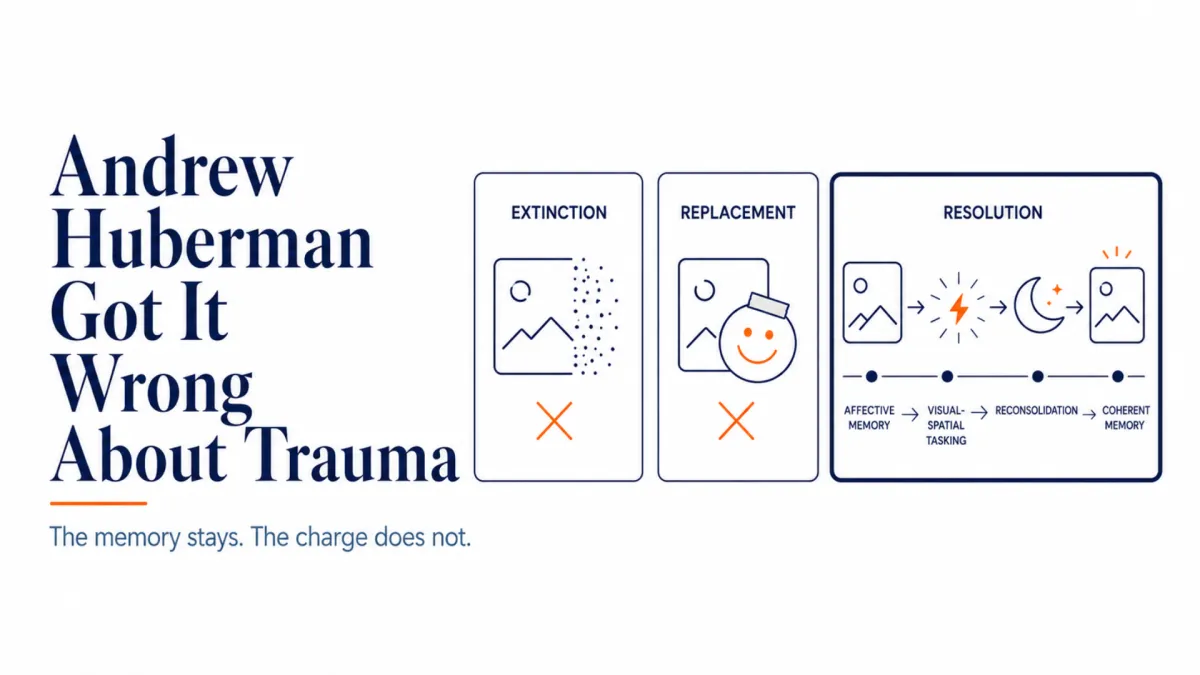
Not Extinction, Not Replacement — Resolution
Now, here's where I believe Andrew went off track. He frames the goal of the trauma and fear work as extinguishing the response — wearing the memory down to zero — and then replacing it with some new positive association bolted onto the old belief, the old thinking. From my experience with hundreds of traumatized clients healed successfully, the body of knowledge that's emerging, and the work of the eighteen people in Albuquerque, New Mexico — both of that is wrong. Extinguish means removing the memory itself; we never extinguish memories, it doesn't have to happen. And we certainly don't add artificial positive stories that never occurred — to me, that would be inappropriate.
So the real goal is the resolution of that memory — a memory that still carries a massive negative emotional charge, one that triggers an inappropriate or unwarranted emotional reaction in the present moment. What we've learned is that when you remove that latent negative emotional charge from a historic affective memory while the memory is labile — meaning it's activated and temporarily changeable — it can have a permanent positive impact for the client.
Then, when the client sleeps that night, the memory reconsolidates overnight through sleep and becomes what I call a coherent long-term memory. It has the same facts, the same story — but the client can recall it and tell it clearly, calmly, in detail, without any inappropriate or unwarranted negative emotion.
I use the example of my own son often, where I can tell the story of learning he would not survive, of his passing, clearly and coherently, in detail, without any negative, inappropriate, or unwarranted emotional breakdown. I'm suggesting that is a coherent long-term memory. And yes, am I sad I don't have a thirty-four-year-old son? Completely — and on every family occasion during the year, I'm reminded of that loss. But it doesn't debilitate me, it doesn't make me break down, and in fact I went on to have five more children. I use that example and hold it out as what I'd consider a coherent, long-term, fully processed memory that came out of an extraordinarily traumatic experience.
The Real Dividing Line: Imagery, Not Talk
So what I want to do now is look at what Andrew said, what kind of treatments he's talking about, and then introduce the concept of imagery — especially visual-spatial imagery. Because in my reading and my experience of the modalities at work, the higher the efficacy, the greater the degree of visual-spatial tasking that occurs.
Andrew gathers three behavioral therapies into one bucket: prolonged exposure, cognitive processing therapy, and cognitive behavioral therapy. They all carry a degree of efficacy, but to the best of my understanding, they also carry very high recurrence rates. Most take a very long time — months and months of therapy — and they're distressing to the client. What separates the modalities that work fastest is something else — and here I'll add some others: EMDR and Accelerated Resolution Therapy. I add these examples because EMDR and ART specifically load the visuospatial system during memory recall, while the memory is labile.
Sohere's the actual point: emotionally charged affective memories are carried largely as vivid sensory or spatial imagery. Of course, visual imagery carries thousands of times more data than words or an auditory memory. When an affective memory is activated and we tax the visuospatial system, image fidelity drops — and when image fidelity drops, emotional intensity drops with it. You'll find a study from Engelhard, van den Hout, and Smeets, back in 2011, that proves exactly that.
And that's the actual point I want to make: talk therapy, where the client recalls the event in verbal detail, as in prolonged exposure, is one path. Non-talk therapy, where we activate the memory and move into a visual-spatial tasking exercise, is the other — it doesn't require recall of the memory in verbal detail, and it's non-retraumatizing.
What Huberman Missed About Psychedelics
Andrew also talked about the use of psychedelics for healing trauma, and there's a huge, growing body of knowledge here. He spoke about ketamine and MDMA specifically, and talked about them as different psychedelics — meaning how they impact the person. What he seemed to miss is that neither is ever given standalone — meaning you take a pill or an injection, go home, and wake up healed of your trauma. Both are administered inside a structured, guided, conversational psychotherapy session.
And here I want to be clear: it's not the drug that removes the latent charge from the memory itself. Ketamine's dissociation and MDMA's dopamine-serotonin surge open a different subjective state, but it's the guided narrative work happening inside that state that does the actual change to the affective memory and facilitates its reconsolidation as a coherent long-term memory. So the psychedelic actually prevents the inappropriate or unwarranted negative emotional reaction to the affective memory — and that is the starting point for the reconsolidation process.
I recently listened to a CBC interview with a paramedic in British Columbia, previously a military soldier, who was heavily traumatized. He said he was okay, but he still had to go back for regular ketamine treatments to deal with his inability to sleep. I'll say this vehemently: my clients sleep. The research shows that when the affective memory has actually resolved, sleep is one of the greatest indicators of healed trauma.
The Missing Syntax
Andrew Huberman is a credentialed professor at Stanford — however, I think he missed what's really going on inside the modalities at work. I think he stayed at the theoretical level: comparing ketamine to MDMA, EMDR to prolonged exposure, trying to understand what's happening. I'd like to share what I believe makes a successful modality successful — at a syntax level, the sequence of what has to happen for an affective memory to heal. Here it is.
First, the memory has to be activated — brought into full conscious recall. Does the client have to tell the story? Absolutely not — they can just run the movie through in their mind's eye. Second, that activation opens a window where the memory is labile: researchers Nader, Schafe, and LeDoux proved this back in 2000, putting that window at roughly six hours, where the memory is genuinely changeable. Third, while we're in this window, we use a modality to remove the latent negative emotional charge from the affective memory — and that modality needs to be heavily engaged in visual-spatial tasking of short-term working memory. This is the piece that removes the latent negative charge from the affective memory. Fourth, the person goes through a reconsolidation cycle — a cycle that happens while we sleep, the same mechanism Matthew Walker has spent his career studying, and I actually believe Andrew Huberman and Matthew Walker are doing a sleep study together. It's the overnight therapy that removes the emotional charge from the content and context of a memory, so the memory can leave short-term working memory and move into long-term coherent memory — and we measure that movement with sleep spindles.
This is an important point: the memory has not been altered, it has not been extinguished, and we haven't cut-and-pasted a happy face onto the end of it. The details remain the same — the negative, latent emotional charge has been removed. That's the triggering mechanism. This is significant: it's not extinguished,it's not swapped out. The memory is resolved.
Step five is equally important: we need to test. We need rigorous evaluation of modalities, and to the best of my experience, that just doesn't happen. I've had so many clients, and interviewed so many people, who said they were diagnosed with trauma or PTSD and were never told what test was administered, or what their score was pre- and post-intervention. That tells me clinicians aren't doing rigorous psychometric assessments — there are a lot of reasons for that, which I won't go into here.
What I'm saying is: the client looking better, or saying they feel better, isn't legitimate on its own. Anecdotal evidence is fine, but rigorous assessment is better. At minimum, there has to be pre- and post-treatment SUDs testing — Subjective Units of Distress. And ultimately, thenumber-one symptom of unresolved trauma is the inability to fall asleep and stay asleep. So a great test of whether the trauma is resolved: can the client fall asleep, and do they stay asleep?
Now, if I go back through Andrew's presentation, I'm sure most of these pieces have been identified somewhere — but they're never in a syntax. Never in an order.
What This Means for Practitioners
So what does this mean for you, reading this? Look at what you're already doing — it's not hard to learn some visuospatial tasking tools and add them to the work you do.
There are certainly a lot of modalities — EMDR, ART, even Emotional Freedom Tapping — that have, or can have, rigorous visuospatial tasking. I'll just tell you that the NLP mechanism I use for overcoming trauma is intensely visuospatially tasking while also being tightly targeted on the affective memory. That's why we get results fast, fast, fast — with very little to no recurrence.
If you want one of the cleanest demonstrations of the impact of visuospatial tasking, look at Holmes, 2009. They used a visuospatial game after exposure to a traumatic movie, and demonstrated significantly reduced intrusive flashbacks in the clients who played it — 80% fewer flashbacks than the control group, who did mindfulness. You should ask: what was the visuospatial tasking? They played Tetris.
I won't even go into pure exposure or cognitive therapies, which never actually touch the affective memory in a meaningful way. I'll tell you there's a study out of King's College where an NLP-based intervention was compared to trauma-focused cognitive behavioral therapy, and the NLP intervention demonstrated 300% better results in one-sixth of the time. If you know that, why would you default to trauma-focused CBT?
So let me be clear, as a trauma-healing advocate, coach, and trainer: the outcome we're aiming for is resolving the affective memory so it consolidates into long-term coherent memory, and the client no longer has inappropriate or unwarranted emotional reactions when reminded of the event. That's a massive contrast to bolting a positive narrative onto an old memory, or trying to extinguish one. Coherence is the absolute marker of resolution — coherence meaning you can tell the story of your life clearly, coherently, in detail, with appropriate emotional states. Techniques that do visual-spatial tasking show greater than 90% efficacy with little to no recurrence. Andrew should have focused on these modalities.
Why does talking about trauma sometimes make it worse?
Talking about it has been proven to re-traumatize; journaling about traumatic events has been proven to re-traumatize the client too — this is basic Hebb's law. The better sequence: activate the memory without verbalizing the event, calibrate the client's reaction, move them back into a parasympathetic state (some of Andrew's own breathing techniques work well here), then use a visual-spatial tasking technique while the memory is labile, and let reconsolidation do its work.
Do Ketamine or MDMA therapy cure trauma by themselves?
No. Neither cures the trauma by itself — they introduce a state of being that allows the memory to be activated without the inappropriate or unwarranted negative emotional states. When a person is under the influence of the hallucinogenic, they'relikely producing massive visual-spatial imagery, and both techniques need to be administered by medical professionals in a medical setting.
How do you know if trauma treatment actually worked?
Not by whether the client says they feel better. People who've been traumatized have often cycled through multiple therapies for years, often on a cornucopia of drugs — that's not a legitimate marker of success. What's legitimate: pre- and post-treatment SUDs testing, and whether the client can fall asleep and stay asleep. The research shows modalities built around visual-spatial tasking can produce greater than 90% efficacy with little to no recurrence, often in three to five ninety-minute sessions.
Where This Sits in the Series
This continues the thread from The Power of Process: A Gold Seal Approach, which laid out the structure and measurement behind a gold standard trauma intervention. This episode goes one layer deeper into the mechanism itself: what has to happen, in what order, for an affective memory to actually resolve.
Where to Take This Next
If you're a practitioner and this changes how you think about your own toolkit, the INSPYRD certification walks through the full protocol, including the visuospatial tasking work described here. If you want to track your own progress with a structured tool, the AMR app is built around the same framework. And if you'd rather talk it through directly, one-on-one work is available.
About the Author
Allen Kanerva is a trauma intervention trainer and the founder of INSPYRD. A former Royal Canadian Air Force tactical helicopter pilot, UN peacekeeping course director, and co-author of Canadian humanitarian security policy work, he developed Affective Memory Resolution (AMR) and Visual-Spatial Tasking (VST), a clinical protocol for nervous-system-level trauma resolution grounded in Hebbian learning and memory reconsolidation research. He trains practitioners internationally in NLP, trauma intervention, and mechanism-first change work.
ORCID iD: 0009-0009-1297-3778
References
Engelhard, I. M., van den Hout, M. A., & Smeets, M. A. M. (2011). Taxing working memory reduces vividness and emotional intensity of images. Journal of Behavior Therapy and Experimental Psychiatry, 42, 32–37. https://doi.org/10.1016/j.jbtep.2010.09.004
This is the direct evidence behind the article's central mechanism: loading the visuospatial system during memory recall measurably reduces both how vivid the image is and how intense the emotion attached to it feels. It's the experimental basis for saying imagery, not talk, is the variable that predicts efficacy.
Gray, R. M., Davison, A. S., & Bourke, F. (2021, August 25). Reconsolidation of Traumatic Memories, The RTM Protocol: Albuquerque trainee results. PsyArXiv. https://doi.org/10.17605/OSF.IO/PFQG4
The Albuquerque data cited in the opening: eighteen clinicians trained in the protocol treated 85 completed cases, with 80 (95%) scoring below the diagnostic threshold for PTSD afterward. This is the practical, trainee-level evidence behind the efficacy claim, not a lab result under ideal conditions.
Holmes, E. A., James, E. L., Coode-Bate, T., & Deeprose, C. (2009). Can playing the computer game "Tetris" reduce the build-up of flashbacks for trauma? A proposal from cognitive science. PLOS ONE, 4(1), e4153. https://doi.org/10.1371/journal.pone.0004153
The cleanest single demonstration that visuospatial tasking interferes with intrusive imagery: playing Tetris shortly after exposure to a traumatic film significantly reduced flashbacks compared to a mindfulness control group.
Nader, K., Schafe, G. E., & LeDoux, J. E. (2000). Fear memories require protein synthesis in the amygdala for reconsolidation after retrieval. Nature, 406, 722–726. https://doi.org/10.1038/35021052
This is the foundational reconsolidation research behind the "labile window" described in the article: once a memory is reactivated, it enters an approximately six-hour period during which it is genuinely changeable before it re-stabilizes.
Sturt, J., Rogers, R., Armour, C., Cameron, D., De Rijk, L., Fiorentino, F., Forbes, T., Glen, C., Grealish, A., Kreft, J., Meye de Souza, I., Spikol, E., Tzouvara, V., & Greenberg, N. (2023). Reconsolidation of traumatic memories protocol compared to trauma-focussed cognitive behaviour therapy for post-traumatic stress disorder in UK military veterans: A randomised controlled feasibility trial. Pilot and Feasibility Studies, 9(1), 175. https://doi.org/10.1186/s40814-023-01396-x
The King's College London trial referenced in the practitioner section: an NLP-rooted intervention outperformed trauma-focused CBT by roughly three to one on diagnostic remission, delivered in a fraction of the sessions.
